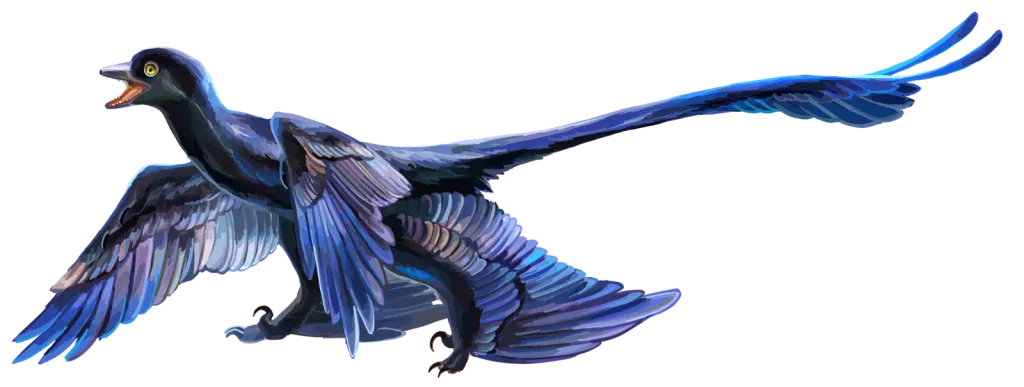
Microraptor zhaoianus
Pronounced MY-kroh-RAP-tor zhow-ee-AH-nus
Maniraptora · Dromaeosauridae
A crow-sized, four-winged dromaeosaurid from the Early Cretaceous of Liaoning, China, with long flight feathers on its arms and legs and glossy, iridescent black plumage. Fossils show it ate birds, fish, lizards and mammals.
- Feathered
- Bipedal
- Sickle claw
- Exceptional preservation
- Unusual anatomy
- Period
- Cretaceous· Aptian
- Diet
- Carnivore
- Length
- 0.8 m
- Mass
- 1–1 kg
- Location
- Liaoning, China, Asia
Quick answers
- How big was Microraptor zhaoianus?
- Microraptor zhaoianus was about 0.8 m long. It stood about 0.2–0.2 m tall at the hips. It weighed about 0.5–1.4 kg. (Wikipedia: Microraptor 2026; Paul 2016)
- When did Microraptor zhaoianus live?
- Microraptor zhaoianus lived during the Early Cretaceous, about 121.4–113.2 million years ago. (Paleobiology Database: Microraptor occurrences 2026)
- Where have Microraptor zhaoianus fossils been found?
- Fossils of Microraptor zhaoianus have been found in Jiufotang Formation (Liaoning) and China. (Xu et al. 2000; Xu et al. 2003)
- What did Microraptor zhaoianus eat?
- Microraptor zhaoianus was a carnivore or piscivore. (Xu et al. 2000; Xu et al. 2003)
- Who named Microraptor zhaoianus, and when?
- Microraptor zhaoianus was described by Xu Xing, Zhou Zhonghe & Wang Xiaolin in 2000. (Xu et al. 2000; Paleobiology Database: Microraptor occurrences 2026)
On this page

MY-kroh-RAP-tor zhow-ee-AH-nus
- Period
- Cretaceous121.4–113.2 Ma
- Diet
- Carnivore
- Length
- 0.8 m
- Mass
- 0–0 t
- Location
- China, Asia
- Classification
- Maniraptora · Dromaeosauridae
- Described
- 2000, Xu Xing, Zhou Zhonghe & Wang Xiaolin
Overview
Microraptor zhaoianus lived in north-eastern China in the Early Cretaceous, in the forested lake country of the Jehol Biota. Xu Xing and colleagues named it in 2000 from the Jiufotang Formation of Liaoning as the smallest known non-bird dinosaur, smaller than Archaeopteryx.
Later specimens showed long flight feathers not only on its arms but also on its legs, so it had four wings; Xu et al. (2003) suggested that it could glide, a possible stage on the way to flapping flight. Its melanosomes match those of birds with glossy, iridescent black feathers (Li et al. 2012).
Stomach contents reveal a varied diet: an enantiornithine bird in one specimen (O'Connor et al. 2011), and fish, a lizard and a small mammal in others. Part of the first Microraptor bones had been glued into the fake "Archaeoraptor" sold in 1999.
Name meaning
"Small plunderer", from Greek mikros ("small") and Latin raptor; zhaoianus honours the palaeontologist Zhao Xijin (Xu et al. 2000).
Biology & evidence
What scientists think about how this animal lived, and how strong the evidence for each idea is.
Feeding
Microraptor ate birds.
Evidence level: Direct evidenceA bird skeleton lies inside a Microraptor. Because Jehol enantiornithines lived in trees, the authors suggest Microraptor hunted there too.
Evidence for / against · 1
Evidence for
Specimen · Bird in a Microraptor stomach
A largely undigested partial skeleton of an adult enantiornithine bird in the abdomen of IVPP V17972.
Specimen: IVPP V17972
Feathers
Microraptor had glossy, iridescent black feathers.
Evidence level: Moderate evidenceThe shape and arrangement of its melanosomes match those of iridescent black birds. Colour inferred this way is a model, not a direct observation.
Evidence for / against · 1
Evidence for
Other · Microraptor melanosomes
Feather melanosomes compared with those of living birds match glossy, iridescent black plumage.
Microraptor had four wings and could probably glide.
Evidence level: Moderate evidenceFlight feathers on all four limbs are preserved. Gliding is inferred; whether it could also flap is debated.
Evidence for / against · 1
Evidence for
Feather impression · Microraptor leg flight feathers
Long pennaceous feathers on both the arms and the legs of several specimens, forming four wings.
Size
- Length
- 0.8 m
- Height
- 0.2 mpublished range 0.2–0.2 m
- Mass
- 1–1 kg
(2.5 ft)
Based on Holotype of M. gui (0.77 m); larger specimens at least 0.8 m
(0.7 ft)
Based on IVPP V13352
Timeline
Periods: Aptian (121.4–113 Ma), Early Cretaceous (145–100.5 Ma)
Aptian bounds of the Jiufotang Formation collections in PBDB (PBDB time scale).
Location
Formations
- Jiufotang Formation · Liaoning
- Near Chaoyang, western Liaoning (Jiufotang Formation) · Jiufotang Formation · Liaoning · position approximate
These are the places where fossils have been found, not the full area where the animal lived.
Ecosystem
Lived in: Jehol Biota
135–121 million years ago · lake, swamp / wetland, forest
Early Cretaceous wetlands and lakes of north-eastern China with seasonal rainfall and frequent volcanic eruptions; ash falls into anoxic lakes preserved feathers and soft tissue.
Same ecosystem

Classification
- cladeDinosauria
- cladeSaurischia
- cladeTheropoda
- cladeCoelurosauria
- cladeManiraptora
- familyDromaeosauridae
- subfamilyMicroraptorinae
- genusMicroraptor
- speciesMicroraptor zhaoianus
Taxonomic status: Valid
Fossil record

| Catalog number | Status | Institution | Found |
|---|---|---|---|
| IVPP V12330 | Holotype | Institute of Vertebrate Paleontology and Paleoanthropology (IVPP) | — |
| IVPP V17972 | Referred specimen | Institute of Vertebrate Paleontology and Paleoanthropology (IVPP) | — |
What has been found
Referred specimen: IVPP V17972
- Preserved
- Partial
- Reconstructed
- Unknown / not recorded
Region by region (table)
| Region | State |
|---|---|
| Skull | Preserved |
| Mandible | Unknown / not recorded |
| Teeth | Unknown / not recorded |
| Cervical vertebrae | Preserved |
| Dorsal vertebrae | Unknown / not recorded |
| Sacrum | Unknown / not recorded |
| Caudal vertebrae | Preserved |
| Ribs | Unknown / not recorded |
| Gastralia | Unknown / not recorded |
| Scapula / shoulder girdle | Unknown / not recorded |
| Humerus | Unknown / not recorded |
| Forearm (radius / ulna) | Unknown / not recorded |
| Hand (manus) | Unknown / not recorded |
| Pelvis | Unknown / not recorded |
| Femur | Unknown / not recorded |
| Tibia / fibula | Unknown / not recorded |
| Foot (pes) | Preserved |
Discovery
- Year described
- 2000
- Described by
- Xu Xing, Zhou Zhonghe & Wang Xiaolin
- Type specimen
- IVPP V12330

Discovery timeline
2000 · Formally described
Xu, Zhou and Wang name Microraptor zhaoianus
Named as the smallest known non-bird dinosaur, smaller than Archaeopteryx.
People: Xu Xing
2003 · Major study
Four-winged Microraptor described
New specimens show flight feathers on the legs; named M. gui.
People: Xu Xing
2011 · Major study
Microraptor found with a bird in its stomach
O'Connor and colleagues describe the first dinosaur preserved with a bird as its meal.
People: Jingmai O'Connor, Xu Xing
2012 · Major study
Microraptor colour reconstructed
Melanosomes suggest iridescent black plumage.
Sources
- (2026). Paleobiology Database: Microraptor occurrences. The Paleobiology Database (paleobiodb.org), data service 1.2, accessed 2026-09-23. https://paleobiodb.org/data1.2/occs/list.txt?base_name=Microraptor&show=coords,paleoloc,strat,loc,ref&pgm=gplates (opens in a new tab)
- (2026). Wikipedia: Microraptor. Wikipedia (English), accessed 2026-09-23. https://en.wikipedia.org/wiki/Microraptor (opens in a new tab)
- Li, Q., Gao, K.-Q., Meng, Q., Clarke, J. A., Shawkey, M. D., D'Alba, L., Pei, R., Ellison, M., Norell, M. A. & Vinther, J. (2012). Reconstruction of Microraptor and the evolution of iridescent plumage. Science 335: 1215-1219. doi:10.1126/science.1213780 (opens in a new tab)
- O'Connor, J., Zhou, Z. & Xu, X. (2011). Additional specimen of Microraptor provides unique evidence of dinosaurs preying on birds. Proceedings of the National Academy of Sciences 108. doi:10.1073/pnas.1117727108 (opens in a new tab)
- Paul, G. S. (2016). The Princeton Field Guide to Dinosaurs (2nd edition). Princeton University Press.
- Xu, X., Zhou, Z. & Wang, X. (2000). The smallest known non-avian theropod dinosaur. Nature 408: 705-708. doi:10.1038/35047056 (opens in a new tab)
- Xu, X., Zhou, Z., Wang, X., Kuang, X., Zhang, F. & Du, X. (2003). Four-winged dinosaurs from China. Nature 421: 335-340. doi:10.1038/nature01342 (opens in a new tab)