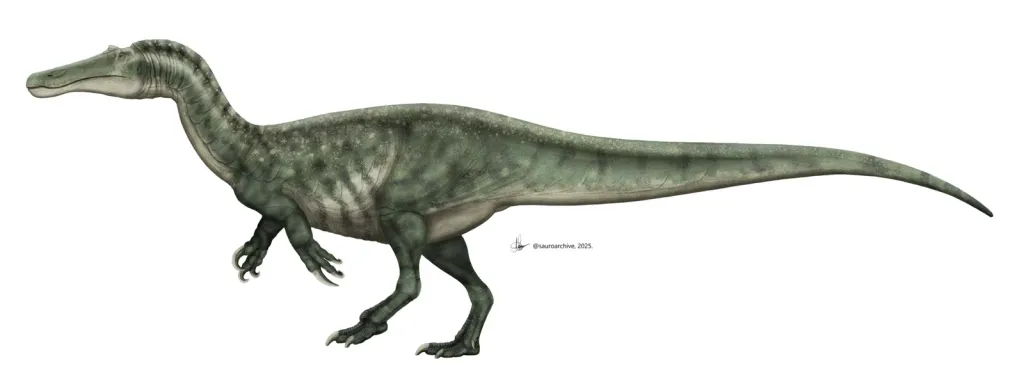
Baryonyx walkeri
读音: BARE-ee-ON-iks WAW-ker-eye
Tetanurae · Spinosauridae
A fish-eating spinosaurid from the Early Cretaceous of southern England, with a long, crocodile-like snout and a 31 cm thumb claw. Its skeleton, found by an amateur collector in 1983, still held fish scales and Iguanodon bones in its belly.
- Bipedal
- Possibly semiaquatic
- Famous specimen
- 时代
- 白垩纪· 巴雷姆阶
- 食性
- 食鱼性
- 体长
- 7.5–10 m
- 体重
- 1,200–2,000 kg
- 地点
- Surrey, United Kingdom
快速问答
- Baryonyx walkeri有多大?
- Baryonyx walkeri体长约7.5–10 m。髋部高约2.2–2.6 m。体重约1.2–2 t。 (Wikipedia: Baryonyx 2026; Paul 2016)
- Baryonyx walkeri生活在什么时候?
- Baryonyx walkeri生活在早白垩世,约1.258亿至1.214亿年前。 (Paleobiology Database: Baryonyx occurrences 2026; Barker et al. 2021)
- 在哪里发现过Baryonyx walkeri的化石?
- Baryonyx walkeri的化石发现于Weald Clay Formation (Surrey)和United Kingdom。 (Charig & Milner 1986; Barker et al. 2021)
- Baryonyx walkeri吃什么?
- Baryonyx walkeri是食鱼性或肉食性。 (Charig & Milner 1986; Barker et al. 2021)
- Baryonyx walkeri由谁命名,何时命名?
- Baryonyx walkeri由Alan J. Charig & Angela C. Milner于1986年描述。 (Charig & Milner 1986; Museum & London 2026)
- Baryonyx walkeri出现在《侏罗纪公园》里吗?
- 是的。Baryonyx walkeri出现在《侏罗纪世界2》 (2018)和《侏罗纪世界3》 (2022)中。电影有不少虚构成分;本页将其与化石证据进行了对比。 (Wikipedia: Dinosaurs in Jurassic Park 2026; Museum & London 2026)
本页内容

BARE-ee-ON-iks WAW-ker-eye
- 时代
- 白垩纪125.8–121.4 Ma
- 食性
- 食鱼性
- 体长
- 7.5–10 m
- 体重
- 1.2–2 t
- 产地
- United Kingdom
- 分类
- Tetanurae · Spinosauridae
- 命名
- 1986, Alan J. Charig & Angela C. Milner
概览
此内容目前仅提供英文版。
Baryonyx walkeri lived in southern England in the Barremian, about 125 million years ago, among lagoons and rivers. In January 1983 the amateur collector William Walker found a huge claw in a clay pit near Ockley, Surrey; Natural History Museum staff excavated the skeleton in May and June 1983, and Alan Charig and Angela Milner named it in 1986.
The skeleton (NHMUK PV R9951) is one of the most complete meat-eating dinosaurs found in Britain, with most of the skull. It showed for the first time what spinosaurids looked like: a long, narrow snout with a rosette of teeth at the tip, nostrils set far back and conical, crocodile-like teeth.
Fish scales and bones of a young Iguanodon were found where the stomach had been, so it ate both fish and land animals. It is the best-known spinosaurid from Europe and a key reference for relatives such as Suchomimus and Spinosaurus.
名称含义
"Heavy claw", from Greek barys ("heavy") and onyx ("claw"); walkeri honours William Walker, who found it (Charig & Milner 1986).
生物学与证据
科学家对这种动物生活方式的看法,以及每种观点的证据有多充分。
进食
Baryonyx also ate land animals such as young Iguanodon.
证据等级:有力证据Bones of a young Iguanodon lay in the same abdominal area. Whether it hunted or scavenged them cannot be told.
支持 / 反对证据 · 1
支持证据
标本 · Baryonyx stomach contents
Fish scales and bones of a young Iguanodon found in the abdominal region of the holotype.
标本: NHMUK PV R9951
Baryonyx ate fish.
证据等级:直接证据Partly digested fish scales were found where its stomach had been, the first direct proof of a fish-eating non-bird dinosaur. Its snout and teeth also resemble those of fish-eating crocodiles.
支持 / 反对证据 · 2
支持证据
标本 · Baryonyx stomach contents
Fish scales and bones of a young Iguanodon found in the abdominal region of the holotype.
标本: NHMUK PV R9951
比较解剖学 · Baryonyx skull and teeth
Nostrils set far back, a rosette of teeth at the snout tip and conical, rounded teeth like those of crocodiles.
标本: NHMUK PV R9951
体型
- 体长
- 7.5–10 m
- 身高
- 2.4 m文献范围 2.2–2.6 m
- 体重
- 1,200–2,000 kg
(32.8 英尺)
依据 NHMUK PV R9951
(7.9 英尺)
依据 NHMUK R9951 (holotype, subadult)
依据 NHMUK PV R9951
时间线
时代: 巴雷姆阶 (125.8–121.4 Ma), 早白垩世 (145–100.5 Ma)
Early Barremian bounds of the type collection in PBDB; the NHM gives "around 125 million years".
产地
地层
- Weald Clay Formation · Surrey
- Smokejacks pit, Wallis Wood, Ockley, Surrey · Weald Clay Formation · Surrey · 位置为近似值
这些是发现化石的地点,而不是该动物生活的全部范围。
生态系统
生活于: Weald Clay
136–125 百万年前 · 河流水系, 湖泊, 沼泽 / 湿地, 沿海平原
Early Cretaceous lagoons, lakes and rivers of south-east England, fresh to brackish, in a semi-arid, fire-prone climate.

分类
- 演化支Dinosauria
- 演化支Saurischia
- 演化支Theropoda
- 演化支Tetanurae
- 总科Megalosauroidea
- 科Spinosauridae
- 亚科Baryonychinae
- 属Baryonyx
- 种Baryonyx walkeri
分类地位: 有效
化石记录

| 编号 | 类型 | 收藏机构 | 发现年份 |
|---|---|---|---|
| NHMUK PV R9951 | 正模标本 | Natural History Museum, London (NHMUK) | 1983 |
已发现的部分
正模标本: NHMUK PV R9951
- 保存
- 部分保存
- 复原
- 未知 / 未记录
按部位查看(表格)
| 部位 | 状态 |
|---|---|
| Skull | 部分保存 · Snout and braincase. |
| Mandible | 部分保存 |
| Teeth | 部分保存 |
| Cervical vertebrae | 未知 / 未记录 |
| Dorsal vertebrae | 未知 / 未记录 |
| Sacrum | 未知 / 未记录 |
| Caudal vertebrae | 未知 / 未记录 |
| Ribs | 未知 / 未记录 |
| Gastralia | 未知 / 未记录 |
| Scapula / shoulder girdle | 未知 / 未记录 |
| Humerus | 未知 / 未记录 |
| Forearm (radius / ulna) | 未知 / 未记录 |
| Hand (manus) | 部分保存 · Large first-finger claw, 31 cm along the curve. |
| Pelvis | 未知 / 未记录 |
| Femur | 未知 / 未记录 |
| Tibia / fibula | 未知 / 未记录 |
| Foot (pes) | 未知 / 未记录 |

发现
- 命名年份
- 1986
- 命名者
- Alan J. Charig & Angela C. Milner
- 模式标本
- NHMUK PV R9951
发现时间线
1983 · 首次发现材料
William Walker finds the Baryonyx claw
An amateur collector finds a 31 cm claw in a clay pit near Ockley, Surrey, in January 1983; the museum excavates the skeleton that spring.
人物:William J. Walker
1986 · 正式命名
Charig and Milner name Baryonyx walkeri
The "heavy claw" is named in Nature.
人物:Alan J. Charig, Angela C. Milner
2021 · 重要研究
Two new baryonychines named from the Isle of Wight
Barker and colleagues describe Ceratosuchops and Riparovenator, close relatives of Baryonyx, and argue spinosaurids originated in Europe.
《侏罗纪公园》与《侏罗纪世界》中的形象
电影
- 侏罗纪世界2 (2018)
- 侏罗纪世界3 (2022)
此内容目前仅提供英文版。
银幕形象
A predator on Isla Nublar during the volcanic eruption in Fallen Kingdom.
电影与化石对比
- Fish scales found with its stomach contents show it ate fish; its long, crocodile-like snout suited catching them.
电影名称仅用于识别。DinoDex 与《侏罗纪公园》/《侏罗纪世界》系列无任何关联,也未获其认可。 所有在电影中出现的恐龙
参考文献
- (2026). Paleobiology Database: Baryonyx occurrences. The Paleobiology Database (paleobiodb.org), data service 1.2, accessed 2026-09-23. https://paleobiodb.org/data1.2/occs/list.txt?base_name=Baryonyx&show=coords,paleoloc,strat,loc,ref&pgm=gplates(在新标签页中打开)
- (2026). Wikipedia: Baryonyx. Wikipedia (English), accessed 2026-09-23. https://en.wikipedia.org/wiki/Baryonyx(在新标签页中打开)
- (2026). Wikipedia: Dinosaurs in Jurassic Park. Wikipedia. https://en.wikipedia.org/wiki/Dinosaurs_in_Jurassic_Park(在新标签页中打开)
- Barker, C. T., Hone, D. W. E., Naish, D., Cau, A., Lockwood, J. A. F., Foster, B., Clarkin, C. E., Schneider, P. & Gostling, N. J. (2021). New spinosaurids from the Wessex Formation (Early Cretaceous, UK) and the European origins of Spinosauridae. Scientific Reports 11. doi:10.1038/s41598-021-97870-8(在新标签页中打开)
- Charig, A. J. & Milner, A. C. (1986). Baryonyx, a remarkable new theropod dinosaur. Nature 324: 359-361. doi:10.1038/324359a0(在新标签页中打开)
- Natural History Museum, London (2026). How did Baryonyx change what we knew about spinosaurs?. nhm.ac.uk. https://www.nhm.ac.uk/discover/how-did-baryonyx-change-what-we-knew-about-spinosaurs.html(在新标签页中打开)
- Paul, G. S. (2016). The Princeton Field Guide to Dinosaurs (2nd edition). Princeton University Press.