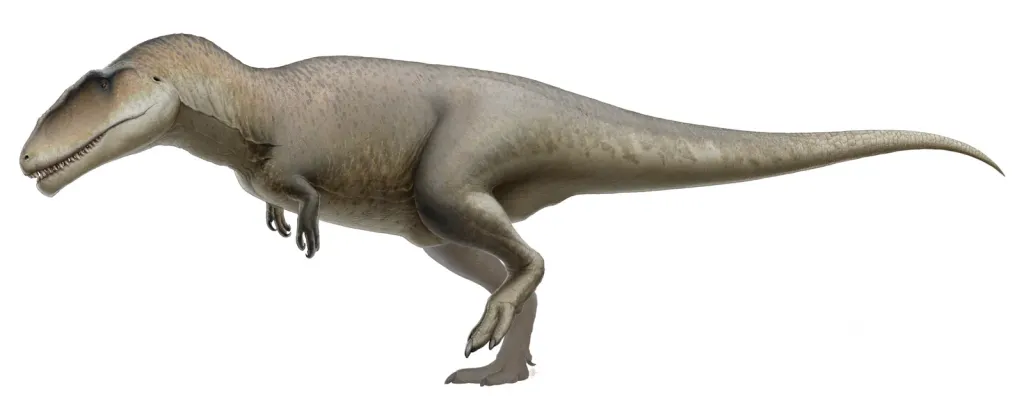
Carcharodontosaurus saharicus
读音: kar-KAR-oh-DON-toh-SORE-us sah-HAR-ih-kus
Tetanurae · Carcharodontosauridae
A giant predator from the mid-Cretaceous of North Africa with a skull about 1.6 m long and serrated, shark-like teeth. Its first skeleton was destroyed in Munich in 1944; a skull found in Morocco in 1995 replaced it.
- Bipedal
- Giant
- Apex predator
- 时代
- 白垩纪· 塞诺曼阶
- 食性
- 肉食性
- 体长
- 12–12.5 m
- 体重
- 5,000–7,000 kg
- 地点
- Morocco, Egypt, Africa
快速问答
- Carcharodontosaurus saharicus有多大?
- Carcharodontosaurus saharicus体长约12–12.5 m。髋部高约2.8–3.3 m。体重约5–7 t。 (Wikipedia: Carcharodontosaurus 2026; Paul 2016)
- Carcharodontosaurus saharicus生活在什么时候?
- Carcharodontosaurus saharicus生活在晚白垩世,约1.005亿至9390万年前。 (Ibrahim et al. 2020; Paleobiology Database: Carcharodontosaurus oc… 2026)
- 在哪里发现过Carcharodontosaurus saharicus的化石?
- Carcharodontosaurus saharicus的化石发现于Kem Kem Group (Morocco)和Bahariya Formation (Egypt)。 (Sereno et al. 1996; Brusatte & Sereno 2007)
- Carcharodontosaurus saharicus吃什么?
- Carcharodontosaurus saharicus是肉食性。 (Sereno et al. 1996; Brusatte & Sereno 2007)
- Carcharodontosaurus saharicus由谁命名,何时命名?
- Carcharodontosaurus saharicus由Charles Depéret & Justin Savornin于1925年描述。 (Ibrahim et al. 2020; Brusatte & Sereno 2007)
本页内容

- 时代
- 白垩纪100.5–93.9 Ma
- 食性
- 肉食性
- 体长
- 12–12.5 m
- 体重
- 5–7 t
- 产地
- Morocco, Egypt, Africa
- 分类
- Tetanurae · Carcharodontosauridae
- 命名
- 1925, Charles Depéret & Justin Savornin
概览
此内容目前仅提供英文版。
Carcharodontosaurus saharicus lived in North Africa in the Cenomanian, about 100 to 94 million years ago, alongside Spinosaurus in a land of rivers and deltas. Charles Depéret and Justin Savornin named it Megalosaurus saharicus in 1925 from teeth found in Algeria; Ernst Stromer created the genus Carcharodontosaurus in 1931 from a partial skull and skeleton collected in 1914 by his assistant Richard Markgraf in Egypt.
Stromer's specimen was destroyed in 1944 during World War II; only a cast of its braincase survives. In 1995 Paul Sereno's team found a more complete skull in the Douira Formation of the Kem Kem region, Morocco, which became the reference specimen of the species.
Its skull was about 1.6 m long, among the longest of any meat-eating dinosaur, with blade-like teeth whose wrinkled enamel recalls a great white shark. Sereno and colleagues (1996) used it to show that carcharodontosaurids formed a widespread family of giant predators across the southern continents.
名称含义
"Shark-toothed lizard", from Greek karcharos ("jagged"), odous ("tooth") and sauros ("lizard"), after the great white shark Carcharodon (Stromer 1931); saharicus for the Sahara.
生物学与证据
科学家对这种动物生活方式的看法,以及每种观点的证据有多充分。
其他
Carcharodontosaurids were a widespread family of giant predators on the southern continents.
证据等级:中等证据Close relatives such as Giganotosaurus in South America show the family spread before Africa became isolated.
支持 / 反对证据 · 1
支持证据
系统发育推断 · Carcharodontosaurid radiation analysis
Comparison of the Kem Kem theropods with others shows a previously unrecognised global radiation of carcharodontosaurids.
The first Carcharodontosaurus skeleton was destroyed in World War II.
证据等级:直接证据Stromer's specimen in Munich was destroyed in 1944, which is why a new reference specimen was chosen from Morocco.
支持 / 反对证据 · 1
支持证据
其他 · Loss of Stromer's Carcharodontosaurus
Stromer's skull and skeleton from Bahariya were destroyed in 1944; only the braincase endocast survives.
标本: MB.R.2056
Carcharodontosaurus had one of the longest skulls of any meat-eating dinosaur.
证据等级:中等证据Its skull is reconstructed at about 1.4 to 1.6 m from an incomplete specimen, in the same range as Giganotosaurus and Tyrannosaurus.
支持 / 反对证据 · 1
支持证据
标本 · Carcharodontosaurus neotype skull
A partial skull reconstructed at about 1.6 m long, referable to Carcharodontosaurus.
标本: UCRC PV12
体型
- 体长
- 12–12.5 m
- 身高
- 3 m文献范围 2.8–3.3 m
- 体重
- 5,000–7,000 kg
(41 英尺)
(9.8 英尺)
时间线
时代: 塞诺曼阶 (100.5–93.9 Ma), 晚白垩世 (100.5–66 Ma)
Cenomanian stage bounds; the Kem Kem Group is Cenomanian (Ibrahim et al. 2020) and PBDB dates the neotype locality to the early Cenomanian.
产地
地层
- Kem Kem Group · Morocco
- Bahariya Formation · Egypt
- Iferda N'Ahouar near Er Remlia, Kem Kem, Morocco · Kem Kem Group · Morocco · 位置为近似值
这些是发现化石的地点,而不是该动物生活的全部范围。
生态系统
生活于: Kem Kem and Bahariya
100.5–93.9 百万年前 · 河流水系, 三角洲, 沿海平原, 沼泽 / 湿地
Cenomanian river systems and deltas along the northern edge of Africa, rich in large fish and crocodyliforms and remarkable for having several giant predatory theropods at once, with comparatively few herbivores preserved.

分类
- 演化支Dinosauria
- 演化支Saurischia
- 演化支Theropoda
- 演化支Tetanurae
- 总科Allosauroidea
- 科Carcharodontosauridae
- 属Carcharodontosaurus
- 种Carcharodontosaurus saharicus
分类地位: 有效
化石记录

| 编号 | 类型 | 收藏机构 | 发现年份 |
|---|---|---|---|
| UCRC PV12 | 新模标本 | University of Chicago Research Collection (UCRC) | 1995 |
| MB.R.2056 | 标本 | Museum für Naturkunde (MB) | 1914 |
已发现的部分
新模标本: UCRC PV12
- 保存
- 部分保存
- 复原
- 未知 / 未记录
新模标本: UCRC PV12
按部位查看(表格)
| 部位 | 状态 |
|---|---|
| Skull | 部分保存 · Braincase, maxilla, nasal, lacrimal and jugal figured by Ibrahim et al. 2020. |
| Mandible | 未知 / 未记录 |
| Teeth | 部分保存 |
| Cervical vertebrae | 未知 / 未记录 |
| Dorsal vertebrae | 未知 / 未记录 |
| Sacrum | 未知 / 未记录 |
| Caudal vertebrae | 未知 / 未记录 |
| Ribs | 未知 / 未记录 |
| Gastralia | 未知 / 未记录 |
| Scapula / shoulder girdle | 未知 / 未记录 |
| Humerus | 未知 / 未记录 |
| Forearm (radius / ulna) | 未知 / 未记录 |
| Hand (manus) | 未知 / 未记录 |
| Pelvis | 未知 / 未记录 |
| Femur | 未知 / 未记录 |
| Tibia / fibula | 未知 / 未记录 |
| Foot (pes) | 未知 / 未记录 |
标本: MB.R.2056
按部位查看(表格)
| 部位 | 状态 |
|---|---|
| Skull | 部分保存 · Endocast only. |
| Mandible | 未知 / 未记录 |
| Teeth | 未知 / 未记录 |
| Cervical vertebrae | 未知 / 未记录 |
| Dorsal vertebrae | 未知 / 未记录 |
| Sacrum | 未知 / 未记录 |
| Caudal vertebrae | 未知 / 未记录 |
| Ribs | 未知 / 未记录 |
| Gastralia | 未知 / 未记录 |
| Scapula / shoulder girdle | 未知 / 未记录 |
| Humerus | 未知 / 未记录 |
| Forearm (radius / ulna) | 未知 / 未记录 |
| Hand (manus) | 未知 / 未记录 |
| Pelvis | 未知 / 未记录 |
| Femur | 未知 / 未记录 |
| Tibia / fibula | 未知 / 未记录 |
| Foot (pes) | 未知 / 未记录 |

发现
- 命名年份
- 1925
- 命名者
- Charles Depéret & Justin Savornin
- 模式标本
- UCRC PV12 (neotype)
发现时间线
1925 · 正式命名
Depéret and Savornin name Megalosaurus saharicus
Two teeth from Algeria are named as a species of Megalosaurus.
1931 · 更名
Stromer names Carcharodontosaurus
Stromer places the species in a new genus based on a skull and skeleton from Bahariya, Egypt.
人物:Ernst Stromer, Richard Markgraf
1944 · 修订
Carcharodontosaurus skeleton destroyed in Munich
Stromer's specimen is lost in World War II.
1995 · 标本出土
Sereno's team finds a Carcharodontosaurus skull in Morocco
A more complete skull is found in the Kem Kem region.
人物:Paul C. Sereno
参考文献
- (2026). Paleobiology Database: Carcharodontosaurus occurrences. The Paleobiology Database (paleobiodb.org), data service 1.2, accessed 2026-09-23. https://paleobiodb.org/data1.2/occs/list.txt?base_name=Carcharodontosaurus&show=coords,paleoloc,strat,loc,ref&pgm=gplates(在新标签页中打开)
- (2026). Wikipedia: Carcharodontosaurus. Wikipedia (English), accessed 2026-09-23. https://en.wikipedia.org/wiki/Carcharodontosaurus(在新标签页中打开)
- Brusatte, S. L. & Sereno, P. C. (2007). A new species of Carcharodontosaurus (Dinosauria: Theropoda) from the Cenomanian of Niger and a revision of the genus. Journal of Vertebrate Paleontology 27(4): 902-916. doi:10.1671/0272-4634(2007)27[902:ANSOCD]2.0.CO;2(在新标签页中打开)
- Cohen, K. M., Harper, D. A. T., Gibbard, P. L. & Car, N. (2023). International Chronostratigraphic Chart (v2023/09). International Commission on Stratigraphy. https://stratigraphy.org/ICSchart/ChronostratChart2023-09.pdf(在新标签页中打开)
- Ibrahim, N., Sereno, P. C., Varricchio, D. J., Martill, D. M., Dutheil, D. B., Unwin, D. M., Baidder, L., Larsson, H. C. E., Zouhri, S. & Kaoukaya, A. (2020). Geology and paleontology of the Upper Cretaceous Kem Kem Group of eastern Morocco. ZooKeys 928: 1-216. doi:10.3897/zookeys.928.47517(在新标签页中打开)
- Paul, G. S. (2016). The Princeton Field Guide to Dinosaurs (2nd edition). Princeton University Press.
- Sereno, P. C., Dutheil, D. B., Iarochene, M., Larsson, H. C. E., Lyon, G. H., Magwene, P. M., Sidor, C. A., Varricchio, D. J. & Wilson, J. A. (1996). Predatory dinosaurs from the Sahara and Late Cretaceous faunal differentiation. Science 272: 986-991. doi:10.1126/science.272.5264.986(在新标签页中打开)