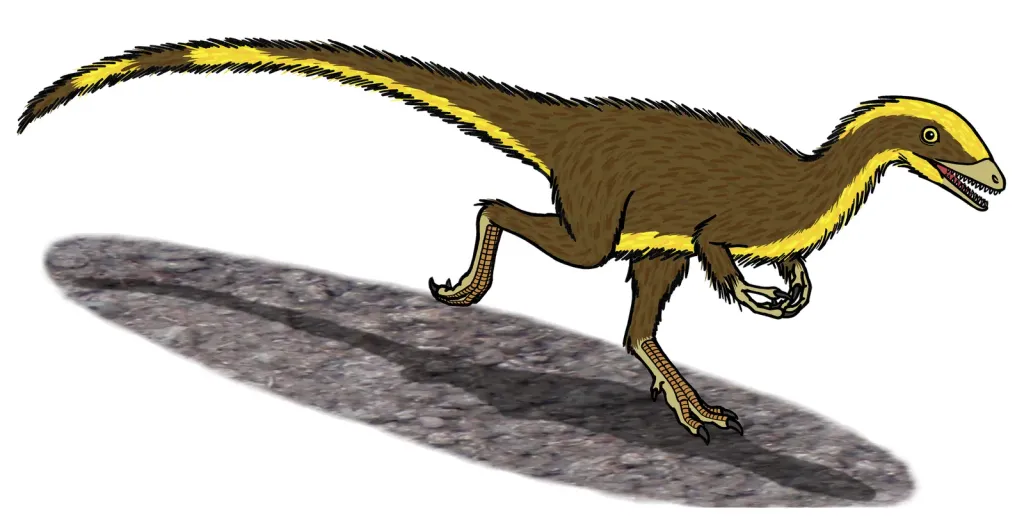
Compsognathus longipes
读音: komp-SOG-nah-thus LON-jih-peez
Coelurosauria · Compsognathidae
A chicken-sized predatory dinosaur from the Late Jurassic lagoons of Bavaria, one of the first nearly complete dinosaur skeletons ever found. Its type specimen still holds the lizard it swallowed.
- Bipedal
- Famous specimen
- Exceptional preservation
- 时代
- 侏罗纪· 钦莫利阶
- 食性
- 肉食性
- 体长
- 0.7–1.4 m
- 体重
- 0–4 kg
- 地点
- Bavaria, Germany, Europe
快速问答
- Compsognathus longipes有多大?
- Compsognathus longipes体长约0.7–1.4 m。髋部高约0.2–0.3 m。体重约0.3–3.5 kg。 (Wikipedia: Compsognathus 2026; Paul 2016)
- Compsognathus longipes生活在什么时候?
- Compsognathus longipes生活在晚侏罗世,约1.522亿至1.451亿年前。 (Paleobiology Database: Compsognathus occurrences 2026)
- 在哪里发现过Compsognathus longipes的化石?
- Compsognathus longipes的化石发现于Painten Formation (Bavaria)和Germany。 (Wagner 1861; Peyer 2006)
- Compsognathus longipes吃什么?
- Compsognathus longipes是肉食性。 (Wagner 1861; Peyer 2006)
- Compsognathus longipes由谁命名,何时命名?
- Compsognathus longipes由Johann Andreas Wagner于1861年描述。 (Wagner 1861; Paleobiology Database: Compsognathus occurrences 2026)
- Compsognathus longipes出现在《侏罗纪公园》里吗?
- 是的。Compsognathus longipes出现在《失落的世界:侏罗纪公园》 (1997)、《侏罗纪公园3》 (2001)、《侏罗纪世界2》 (2018)、《侏罗纪世界3》 (2022)和《侏罗纪世界:重生》 (2025)中。电影有不少虚构成分;本页将其与化石证据进行了对比。 (Wikipedia: Dinosaurs in Jurassic Park 2026; Conrad 2018)
本页内容

komp-SOG-nah-thus LON-jih-peez
- 时代
- 侏罗纪152.2–145.1 Ma
- 食性
- 肉食性
- 体长
- 0.7–1.4 m
- 体重
- 0–0 t
- 产地
- Germany, Europe
- 分类
- Coelurosauria · Compsognathidae
- 命名
- 1861, Johann Andreas Wagner
概览
此内容目前仅提供英文版。
Compsognathus longipes lived about 150 million years ago on the islands of the Solnhofen archipelago in what is now Bavaria, Germany. The skeleton was collected in the 1850s for the physician Joseph Oberndorfer and described by Johann Andreas Wagner; it is kept in Munich (BSPG AS I 563). A larger skeleton from Canjuers, France, described in 1972 as a separate species, is now usually included in the same species.
It was a light, long-legged, two-legged hunter, under a metre long in the German specimen and well over a metre in the French one. For much of its history it was the smallest known dinosaur.
A lizard lies inside the rib cage of the German skeleton; in 2018 Jack Conrad described it as a new species, making it "a holotype inside a holotype". The skeleton's strongly arched neck, once blamed on death throes, is better explained by what happens to a carcass after death (Reisdorf & Wuttke 2012).
名称含义
"Elegant jaw", from Greek kompsos ("elegant, dainty") and gnathos ("jaw"); longipes, Latin for "long foot" (Wagner).
生物学与证据
科学家对这种动物生活方式的看法,以及每种观点的证据有多充分。
进食
Compsognathus ate lizards.
证据等级:直接证据The type specimen has a swallowed lizard in its belly. The French specimen is also reported with lizard remains (secondary).
支持 / 反对证据 · 1
支持证据
标本 · Lizard in the Compsognathus rib cage
A lizard skeleton inside the body cavity of the holotype, named as a new species by Conrad (2018).
标本: BSPG AS I 563
其他
The arched neck of the Compsognathus skeleton formed after death.
证据等级:有力证据The pose was once read as death throes. Experiments show it develops as a carcass decays and dries, so it says nothing about how the animal died.
支持 / 反对证据 · 1
支持证据
其他 · Decay experiments on the opisthotonic posture
Decay experiments with chickens and study of the theropods' anatomy show the arched-back posture forms after death.
标本: BSPG AS I 563

体型
- 体长
- 0.7–1.4 m
- 身高
- 0.3 m文献范围 0.2–0.3 m
- 体重
- 0–4 kg
(4.6 英尺)
依据 BSPG AS I 563 (0.70-0.75 m) and the Canjuers specimen (1.25-1.4 m)
(0.9 英尺)
依据 MNHN CNJ 79 (Canjuers specimen)
依据 BSPG AS I 563 (0.32-0.58 kg) and the Canjuers specimen (2.5-3.5 kg)
时间线
时代: 钦莫利阶 (154.8–149.2 Ma), 提塘阶 (149.2–145 Ma), 晚侏罗世 (161.5–145 Ma)
From the late Kimmeridgian German type (152.21-149.2 Ma) to the early Tithonian French specimen (149.2-145.06 Ma), PBDB time scale.
产地
地层
- Painten Formation · Bavaria
- Riedenburg-Kelheim area, Bavaria · Painten Formation · Bavaria · 位置为近似值
这些是发现化石的地点,而不是该动物生活的全部范围。
生态系统
生活于: Solnhofen archipelago
152–150 百万年前 · 岛屿, 海洋边缘, 其他
Warm, shallow lagoons behind reefs, dotted with low, dry islands, on the northern margin of the Tethys Sea in the Late Jurassic. The stagnant, salty bottom water let fine lime mud bury carcasses in exceptional detail.

分类
- 演化支Dinosauria
- 演化支Saurischia
- 演化支Theropoda
- 演化支Coelurosauria
- 科Compsognathidae
- 属Compsognathus
- 种Compsognathus longipes
分类地位: 有效
化石记录

| 编号 | 类型 | 收藏机构 | 发现年份 |
|---|---|---|---|
| BSPG AS I 563 | 正模标本 | Bayerische Staatssammlung für Paläontologie und Geologie (BSPG) | — |
已发现的部分
正模标本: BSPG AS I 563
- 保存
- 部分保存
- 复原
- 未知 / 未记录
按部位查看(表格)
| 部位 | 状态 |
|---|---|
| Skull | 保存 |
| Mandible | 未知 / 未记录 |
| Teeth | 未知 / 未记录 |
| Cervical vertebrae | 保存 |
| Dorsal vertebrae | 保存 |
| Sacrum | 未知 / 未记录 |
| Caudal vertebrae | 保存 |
| Ribs | 未知 / 未记录 |
| Gastralia | 未知 / 未记录 |
| Scapula / shoulder girdle | 未知 / 未记录 |
| Humerus | 未知 / 未记录 |
| Forearm (radius / ulna) | 未知 / 未记录 |
| Hand (manus) | 部分保存 · The number of fingers has been debated. |
| Pelvis | 未知 / 未记录 |
| Femur | 保存 |
| Tibia / fibula | 保存 |
| Foot (pes) | 保存 |
图库

发现
- 命名年份
- 1861
- 命名者
- Johann Andreas Wagner
- 模式标本
- BSPG AS I 563
发现时间线
1861 · 正式命名
Wagner names Compsognathus longipes
Johann Andreas Wagner describes a tiny, complete dinosaur skeleton from the Bavarian limestones.
人物:Johann Andreas Wagner
2006 · 修订
French Compsognathus reassessed
Peyer restudies the larger Canjuers skeleton, first named C. corallestris.
2018 · 重要研究
The lizard inside Compsognathus is named
Conrad describes the swallowed lizard as a new species.
人物:Jack L. Conrad
《侏罗纪公园》与《侏罗纪世界》中的形象
电影
- 失落的世界:侏罗纪公园 (1997)
- 侏罗纪公园3 (2001)
- 侏罗纪世界2 (2018)
- 侏罗纪世界3 (2022)
- 侏罗纪世界:重生 (2025)
此内容目前仅提供英文版。
银幕形象
The 'compies': chicken-sized dinosaurs that swarm and bite people in The Lost World.
电影与化石对比
- The film calls it 'Compsognathus triassicus', a name that does not exist: it blends Compsognathus longipes with Procompsognathus triassicus.
- One skeleton has a lizard in its stomach: the evidence says it hunted small animals, not people.
电影名称仅用于识别。DinoDex 与《侏罗纪公园》/《侏罗纪世界》系列无任何关联,也未获其认可。 所有在电影中出现的恐龙
参考文献
- (2026). Paleobiology Database: Compsognathus occurrences. The Paleobiology Database (paleobiodb.org), data service 1.2, accessed 2026-09-23. https://paleobiodb.org/data1.2/occs/list.txt?base_name=Compsognathus&show=coords,paleoloc,strat,loc,ref&pgm=gplates(在新标签页中打开)
- (2026). Wikipedia: Compsognathus. Wikipedia (English), accessed 2026-09-23. https://en.wikipedia.org/wiki/Compsognathus(在新标签页中打开)
- (2026). Wikipedia: Dinosaurs in Jurassic Park. Wikipedia. https://en.wikipedia.org/wiki/Dinosaurs_in_Jurassic_Park(在新标签页中打开)
- (2026). Wikipedia: Jurassic World Rebirth. Wikipedia. https://en.wikipedia.org/wiki/Jurassic_World_Rebirth(在新标签页中打开)
- Conrad, J. L. (2018). A new lizard (Squamata) was the last meal of Compsognathus (Theropoda: Dinosauria) and is a holotype in a holotype. Zoological Journal of the Linnean Society 183: 584-634. doi:10.1093/zoolinnean/zlx055(在新标签页中打开)
- Paul, G. S. (2016). The Princeton Field Guide to Dinosaurs (2nd edition). Princeton University Press.
- Peyer, K. (2006). A reconsideration of Compsognathus from the upper Tithonian of Canjuers, southeastern France. Journal of Vertebrate Paleontology 26: 879-896. doi:10.1671/0272-4634(2006)26[879:AROCFT]2.0.CO;2(在新标签页中打开)
- Reisdorf, A. G. & Wuttke, M. (2012). Re-evaluating Moodie's opisthotonic-posture hypothesis in fossil vertebrates. Part I: Reptiles - the taphonomy of the bipedal dinosaurs Compsognathus longipes and Juravenator starki from the Solnhofen Archipelago (Jurassic, Germany). Palaeobiodiversity and Palaeoenvironments 92: 119-168. doi:10.1007/s12549-011-0068-y(在新标签页中打开)
- Wagner, J. A. (1861). Neue Beiträge zur Kenntniss der urweltlichen Fauna des lithographischen Schiefers. Abhandlungen der Bayerischen Akademie der Wissenschaften.