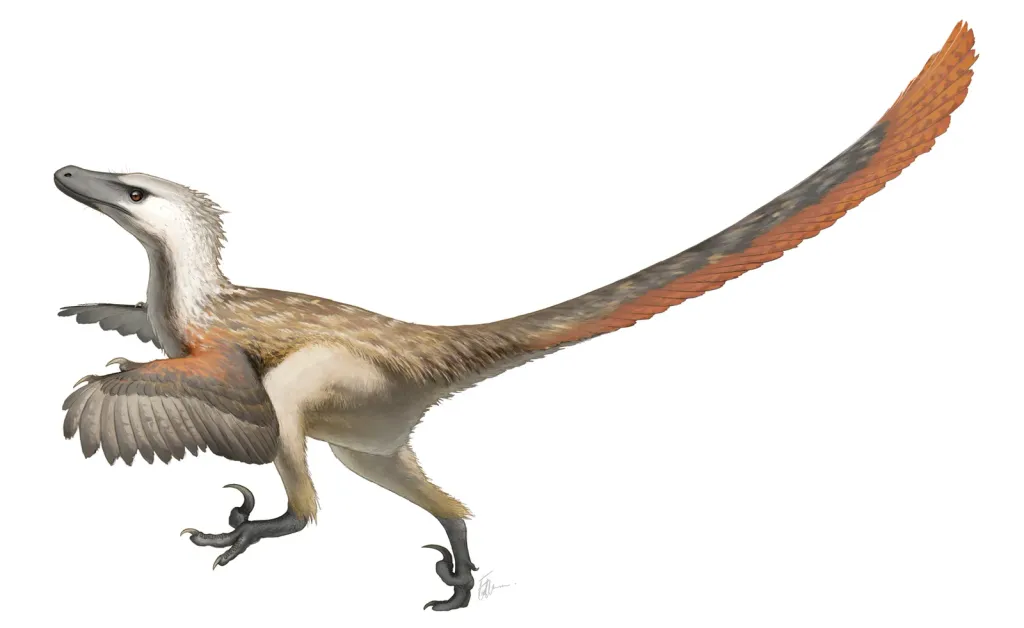
Velociraptor mongoliensis
读音: vel-OSS-ih-RAP-tor mon-GOH-lee-EN-sis
Maniraptora · Dromaeosauridae
A small feathered dromaeosaurid from the Campanian of Mongolia, about 15 kg: far smaller than the film "raptors". Quill knobs on its forearm show it had large wing feathers.
- Feathered
- Bipedal
- Sickle claw
- Famous specimen
- Movie icon
- Exceptional preservation
- Possible pack behavior
- 时代
- 白垩纪· 坎潘阶
- 食性
- 肉食性
- 体长
- 1.5 m
- 体重
- 15 kg
- 地点
- Mongolia, Ömnögovi Province
快速问答
- Velociraptor mongoliensis有多大?
- Velociraptor mongoliensis体长约1.5 m。髋部高约0.5–0.6 m。体重约15 kg。 (Turner et al. 2007; Paul 2016)
- Velociraptor mongoliensis生活在什么时候?
- Velociraptor mongoliensis生活在晚白垩世,约7500万至7100万年前。 (Cohen et al. 2023; Osborn 1924)
- 在哪里发现过Velociraptor mongoliensis的化石?
- Velociraptor mongoliensis的化石发现于Djadokhta Formation (Ömnögovi Province)和Mongolia。 (Osborn 1924; Turner et al. 2007)
- Velociraptor mongoliensis吃什么?
- Velociraptor mongoliensis是肉食性。 (Osborn 1924; Turner et al. 2007)
- Velociraptor mongoliensis由谁命名,何时命名?
- Velociraptor mongoliensis由Henry Fairfield Osborn于1924年描述。 (Osborn 1924)
- Velociraptor mongoliensis出现在《侏罗纪公园》里吗?
- 是的。Velociraptor mongoliensis出现在《侏罗纪公园》 (1993)、《失落的世界:侏罗纪公园》 (1997)、《侏罗纪公园3》 (2001)、《侏罗纪世界》 (2015)、《侏罗纪世界2》 (2018)、《侏罗纪世界3》 (2022)和《侏罗纪世界:重生》 (2025)中。电影有不少虚构成分;本页将其与化石证据进行了对比。 (Wikipedia: Dinosaurs in Jurassic Park 2026; Osborn 1924)
本页内容

- 时代
- 白垩纪75–71 Ma
- 食性
- 肉食性
- 体长
- 1.5 m
- 体重
- 0 t
- 产地
- Mongolia
- 分类
- Maniraptora · Dromaeosauridae
- 命名
- 1924, Henry Fairfield Osborn
概览
此内容目前仅提供英文版。
Velociraptor mongoliensis lived in what is now the Gobi Desert of Mongolia during the Campanian, in the Late Cretaceous. It was named by Henry Fairfield Osborn in 1924 from a skull and foot claw (AMNH 6515) collected in 1923 at the Flaming Cliffs by the American Museum Central Asiatic Expeditions.
It was a small, lightly built predator with an enlarged sickle-shaped claw on each foot. Adults were about the size of a large turkey, roughly 15 kg, much smaller than the animals called "Velociraptor" in the Jurassic Park films, which were modelled on larger dromaeosaurids.
Turner, Makovicky and Norell (2007) found quill knobs, the attachment points of large secondary wing feathers, on a Velociraptor forearm bone. Velociraptor could not fly, but it was feathered like its close relatives.
名称含义
From Latin velox ("swift") and raptor ("robber, plunderer"); mongoliensis refers to Mongolia (Osborn 1924).
生物学与证据
科学家对这种动物生活方式的看法,以及每种观点的证据有多充分。
进食
Velociraptor also scavenged carcasses.
证据等级:中等证据Tooth marks on Protoceratops bones were made when little meat was left, suggesting scavenging or late-stage feeding on a carcass.
支持 / 反对证据 · 1
支持证据
遗迹化石 · Velociraptor tooth marks on Protoceratops bones
Tooth marks and a broken Velociraptor tooth on Protoceratops bones, interpreted as late-stage feeding or scavenging.
羽毛
Velociraptor had feathers, including large quill feathers on its arms.
证据等级:有力证据No feather impressions have been found with Velociraptor, but its forearm shows quill knobs, the bumps where big wing feathers anchor in birds. Its close relatives are known with full feather coats.
支持 / 反对证据 · 1
支持证据
标本 · Quill knobs on a Velociraptor ulna
A row of small bumps on the forearm bone where large wing feathers attached, as in living birds.
标本: IGM 100/981
生物力学
The sickle claw of Velociraptor was used to pin down prey, not to slash it open.
证据等级:假说Modern hawks and eagles hold prey down with their feet while eating. Comparisons suggest dromaeosaurs did something similar; the old idea of slashing open bellies is not supported by claw shape, but no fossil shows the claw in use except the Fighting Dinosaurs.
支持 / 反对证据 · 1
支持证据
比较解剖学 · Raptor prey restraint model
Comparison of dromaeosaur feet with those of living birds of prey: the sickle claw pinned prey down rather than slashing it open.
行为
Velociraptor attacked live prey as big as Protoceratops.
证据等级:直接证据The Fighting Dinosaurs fossil preserves a Velociraptor and a Protoceratops in the act of fighting, killed together, probably by a collapsing dune. It is direct evidence of a predatory attack.
支持 / 反对证据 · 1
支持证据
标本 · Fighting Dinosaurs specimen
A Velociraptor and a Protoceratops buried in the middle of a fight; the raptor's sickle claw is at the neck of its prey, whose jaws grip the raptor's arm.
社会生活
Velociraptor hunted in packs.
证据等级:薄弱证据Pack hunting is popular in films but there is little evidence for Velociraptor: no group burials are known. Trackways of other dromaeosaurs show some walked together.

体型
- 体长
- 1.5 m
- 身高
- 0.5 m文献范围 0.5–0.6 m
- 体重
- 15 kg
(4.9 英尺)
依据 IGM 100/981 (adult, the quill-knob specimen)
(1.6 英尺)
依据 IGM 100/25 and MPC-D 100/54
依据 IGM 100/981 (adult, the quill-knob specimen)
时间线
时代: 坎潘阶 (83.6–72.1 Ma), 晚白垩世 (100.5–66 Ma)
Djadokhta Formation, about 75-71 Ma: magnetostratigraphy suggests, without clearly establishing, deposition during the late Campanian polarity changes (Dashzeveg et al. 2005). Wider bracket: the Campanian stage (ICS 2023/09).
产地
地层
- Djadokhta Formation · Ömnögovi Province
- Flaming Cliffs (Bayanzag), Ömnögovi, Mongolia · Djadokhta Formation · Ömnögovi Province · 位置为近似值
这些是发现化石的地点,而不是该动物生活的全部范围。
生态系统
生活于: Djadokhta
75–71 百万年前 · 沙漠 / 沙丘, 其他
An arid landscape of sand dunes and interdune areas in the Late Cretaceous Gobi, with occasional water. Sandslides and dune collapses buried animals alive, preserving articulated skeletons and nests.


分类
- 演化支Dinosauria
- 演化支Saurischia
- 演化支Theropoda
- 演化支Coelurosauria
- 演化支Maniraptora
- 科Dromaeosauridae
- 亚科Velociraptorinae
- 属Velociraptor
- 种Velociraptor mongoliensis
分类地位: 有效
化石记录

| 编号 | 类型 | 收藏机构 | 发现年份 |
|---|---|---|---|
| AMNH 6515 | 正模标本 | American Museum of Natural History (AMNH) | 1923 |
| MPC-D 100/25 “Fighting Dinosaurs” | 归入标本 | Institute of Paleontology, Mongolian Academy of Sciences (MPC) | 1971 |
| IGM 100/981 | 归入标本 | Institute of Paleontology, Mongolian Academy of Sciences (MPC) | — |
已发现的部分
正模标本: AMNH 6515
- 保存
- 部分保存
- 复原
- 未知 / 未记录
正模标本: AMNH 6515
按部位查看(表格)
| 部位 | 状态 |
|---|---|
| Skull | 保存 · Crushed but complete skull. |
| Mandible | 保存 |
| Teeth | 未知 / 未记录 |
| Cervical vertebrae | 未知 / 未记录 |
| Dorsal vertebrae | 未知 / 未记录 |
| Sacrum | 未知 / 未记录 |
| Caudal vertebrae | 未知 / 未记录 |
| Ribs | 未知 / 未记录 |
| Gastralia | 未知 / 未记录 |
| Scapula / shoulder girdle | 未知 / 未记录 |
| Humerus | 未知 / 未记录 |
| Forearm (radius / ulna) | 未知 / 未记录 |
| Hand (manus) | 部分保存 · Finger bones and claws. |
| Pelvis | 未知 / 未记录 |
| Femur | 未知 / 未记录 |
| Tibia / fibula | 未知 / 未记录 |
| Foot (pes) | 未知 / 未记录 |
归入标本: MPC-D 100/25 “Fighting Dinosaurs”
按部位查看(表格)
| 部位 | 状态 |
|---|---|
| Skull | 保存 |
| Mandible | 保存 |
| Teeth | 未知 / 未记录 |
| Cervical vertebrae | 保存 |
| Dorsal vertebrae | 保存 |
| Sacrum | 未知 / 未记录 |
| Caudal vertebrae | 未知 / 未记录 |
| Ribs | 未知 / 未记录 |
| Gastralia | 未知 / 未记录 |
| Scapula / shoulder girdle | 未知 / 未记录 |
| Humerus | 保存 |
| Forearm (radius / ulna) | 保存 |
| Hand (manus) | 保存 · Right hand gripping the Protoceratops skull. |
| Pelvis | 保存 |
| Femur | 保存 |
| Tibia / fibula | 未知 / 未记录 |
| Foot (pes) | 保存 · Sickle claw in the throat region of the Protoceratops. |
归入标本: IGM 100/981
按部位查看(表格)
| 部位 | 状态 |
|---|---|
| Skull | 未知 / 未记录 |
| Mandible | 未知 / 未记录 |
| Teeth | 未知 / 未记录 |
| Cervical vertebrae | 未知 / 未记录 |
| Dorsal vertebrae | 未知 / 未记录 |
| Sacrum | 未知 / 未记录 |
| Caudal vertebrae | 未知 / 未记录 |
| Ribs | 未知 / 未记录 |
| Gastralia | 未知 / 未记录 |
| Scapula / shoulder girdle | 未知 / 未记录 |
| Humerus | 未知 / 未记录 |
| Forearm (radius / ulna) | 保存 · Ulna with six quill knobs. |
| Hand (manus) | 未知 / 未记录 |
| Pelvis | 未知 / 未记录 |
| Femur | 未知 / 未记录 |
| Tibia / fibula | 未知 / 未记录 |
| Foot (pes) | 未知 / 未记录 |

发现
- 命名年份
- 1924
- 命名者
- Henry Fairfield Osborn
- 模式标本
- AMNH 6515

发现时间线
1923 · 首次发现材料
Peter Kaisen finds the Velociraptor holotype
During the American Museum Central Asiatic Expeditions, Kaisen finds a crushed skull and a claw at the Flaming Cliffs.
人物:Peter Kaisen, Roy Chapman Andrews
1924 · 正式命名
Osborn names Velociraptor mongoliensis
Osborn names three new theropods from the Protoceratops beds, among them Velociraptor.
人物:Henry Fairfield Osborn
1971 · 标本出土
The Fighting Dinosaurs are found
The Polish-Mongolian expedition recovers a Velociraptor and Protoceratops locked together at Tugrikin Shireh.
2007 · 重要研究
Quill knobs found on Velociraptor
Turner, Makovicky and Norell report quill knobs on a Velociraptor forearm.
《侏罗纪公园》与《侏罗纪世界》中的形象
电影
- 侏罗纪公园 (1993)
- 失落的世界:侏罗纪公园 (1997)
- 侏罗纪公园3 (2001)
- 侏罗纪世界 (2015)
- 侏罗纪世界2 (2018)
- 侏罗纪世界3 (2022)
- 侏罗纪世界:重生 (2025)
此内容目前仅提供英文版。
银幕形象
Human-sized, scaly and highly intelligent pack hunters; from Jurassic World on, a trained raptor called Blue.
电影与化石对比
- The film raptors are far bigger than the real animal: Velociraptor mongoliensis was about the size of a large turkey. The films borrow the size of its larger North American relative Deinonychus.
- Quill knobs on a Velociraptor forearm show it had wing feathers; the film raptors are scaly (only Jurassic Park III adds a few quills on the head).
- Coordinated pack hunting is not established from fossils. What the fossils do show is Velociraptor feeding on Protoceratops.
电影名称仅用于识别。DinoDex 与《侏罗纪公园》/《侏罗纪世界》系列无任何关联,也未获其认可。 所有在电影中出现的恐龙
参考文献
- (2026). Wikipedia: Dinosaurs in Jurassic Park. Wikipedia. https://en.wikipedia.org/wiki/Dinosaurs_in_Jurassic_Park(在新标签页中打开)
- (2026). Wikipedia: Jurassic World Rebirth. Wikipedia. https://en.wikipedia.org/wiki/Jurassic_World_Rebirth(在新标签页中打开)
- Cohen, K. M., Harper, D. A. T., Gibbard, P. L. & Car, N. (2023). International Chronostratigraphic Chart (v2023/09). International Commission on Stratigraphy. https://stratigraphy.org/ICSchart/ChronostratChart2023-09.pdf(在新标签页中打开)
- Dashzeveg, D., Dingus, L., Loope, D. B., Swisher, C. C., III, Dulam, T. & Sweeney, M. R. (2005). New stratigraphic subdivision, depositional environment, and age estimate for the Upper Cretaceous Djadokhta Formation, southern Ulan Nur Basin, Mongolia. American Museum Novitates 3498: 1-31. https://digitallibrary.amnh.org/server/api/core/bitstreams/0df4baac-12e4-44ae-8ef7-3328b22e8604/content(在新标签页中打开)
- Hone, D., Choiniere, J., Sullivan, C., Xu, X., Pittman, M. & Tan, Q. (2010). New evidence for a trophic relationship between the dinosaurs Velociraptor and Protoceratops. Palaeogeography, Palaeoclimatology, Palaeoecology 291(3-4): 488-492. doi:10.1016/j.palaeo.2010.03.028(在新标签页中打开)
- Osborn, H. F. (1924). Three new Theropoda, Protoceratops zone, central Mongolia. American Museum Novitates 144: 1-12.
- Ostrom, J. H. (1969). Osteology of Deinonychus antirrhopus, an unusual theropod from the Lower Cretaceous of Montana. Bulletin of the Peabody Museum of Natural History 30: 1-165.
- Paul, G. S. (2016). The Princeton Field Guide to Dinosaurs (2nd edition). Princeton University Press.
- Roach, B. T. & Brinkman, D. L. (2007). A reevaluation of cooperative pack hunting and gregariousness in Deinonychus antirrhopus and other nonavian theropod dinosaurs. Bulletin of the Peabody Museum of Natural History 48(1): 103-138. doi:10.3374/0079-032X(2007)48[103:AROCPH]2.0.CO;2(在新标签页中打开)
- Turner, A. H., Makovicky, P. J. & Norell, M. A. (2007). Feather quill knobs in the dinosaur Velociraptor. Science 317(5845): 1721. doi:10.1126/science.1145076(在新标签页中打开)