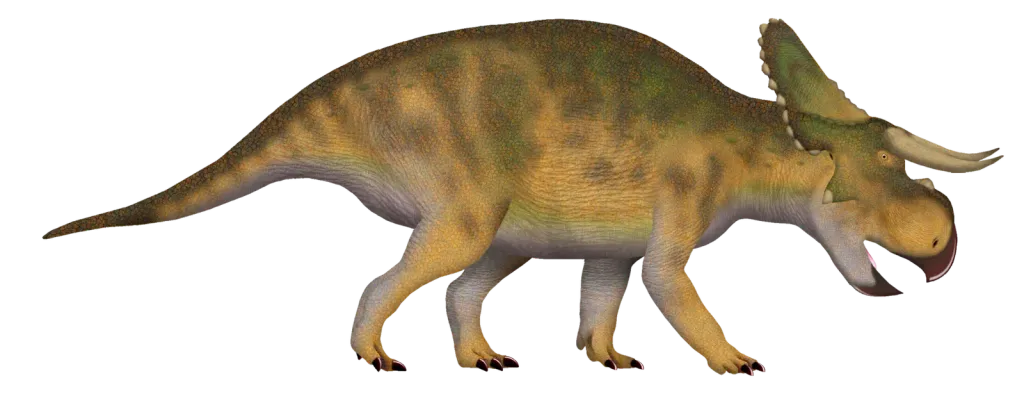
Nasutoceratops titusi
读音: nah-SOO-toh-SERR-ah-tops TY-tus-eye
Ceratopsia · Ceratopsidae
A big-nosed horned dinosaur from the Late Cretaceous of southern Utah, with a short, deep snout and the longest brow horns of any centrosaurine. It lived about 76 million years ago on the island continent of Laramidia.
- Horned
- Quadrupedal
- Skin impressions known
- 时代
- 白垩纪· 坎潘阶
- 食性
- 植食性
- 体长
- 4.5 m
- 体重
- 1,500 kg
- 地点
- Utah, United States
快速问答
- Nasutoceratops titusi有多大?
- Nasutoceratops titusi体长约4.5 m。髋部高约1.4–1.8 m。体重约1.5 t。 (Wikipedia: Nasutoceratops 2026; Paul 2016)
- Nasutoceratops titusi生活在什么时候?
- Nasutoceratops titusi生活在晚白垩世,约7600万至7550万年前。 (Sampson et al. 2013; Paleobiology Database: Nasutoceratops titusi … 2026)
- 在哪里发现过Nasutoceratops titusi的化石?
- Nasutoceratops titusi的化石发现于Kaiparowits Formation (Utah)和United States。 (Sampson et al. 2013; Paleobiology Database: Nasutoceratops titusi … 2026)
- Nasutoceratops titusi吃什么?
- Nasutoceratops titusi是植食性。 (Sampson et al. 2013; Paleobiology Database: Nasutoceratops titusi … 2026)
- Nasutoceratops titusi由谁命名,何时命名?
- Nasutoceratops titusi由Scott D. Sampson et al.于2013年描述。 (Sampson et al. 2013; Paleobiology Database: Nasutoceratops titusi … 2026)
- Nasutoceratops titusi出现在《侏罗纪公园》里吗?
- 是的。Nasutoceratops titusi出现在《侏罗纪世界3》 (2022)中。电影有不少虚构成分;本页将其与化石证据进行了对比。 (Wikipedia: Dinosaurs in Jurassic Park 2026; Sampson et al. 2013)
本页内容

- 时代
- 白垩纪76–75.5 Ma
- 食性
- 植食性
- 体长
- 4.5 m
- 体重
- 1.5 t
- 产地
- United States
- 分类
- Ceratopsia · Ceratopsidae
- 命名
- 2013, Scott D. Sampson et al.
概览
此内容目前仅提供英文版。
Nasutoceratops titusi lived about 76 million years ago in what is now southern Utah, on Laramidia, the western island continent of North America. Eric Lund found its skull in 2006 in the Kaiparowits Formation of Grand Staircase-Escalante National Monument, and Scott Sampson and colleagues named it in 2013.
Its 1.8 m skull had an unusually short, deep snout with a hugely enlarged nasal opening, a low nasal horn and forward-curving brow horns spanning about 40% of the skull length, the longest of any centrosaurine. Its frill was broad and plain.
Nasutoceratops was the first centrosaurine from the south of Laramidia of the same age as the many northern ones. Sampson and colleagues saw it as support for separate northern and southern dinosaur provinces on Laramidia, an idea other researchers have contested.
名称含义
From Latin nasutus ("large-nosed") and Latinized Greek ceratops ("horned face"); titusi honours Alan Titus, palaeontologist at Grand Staircase-Escalante National Monument (Sampson et al. 2013).
生物学与证据
科学家对这种动物生活方式的看法,以及每种观点的证据有多充分。
其他
Laramidia was divided into northern and southern dinosaur provinces.
证据等级:有争议Sampson and colleagues saw a southern centrosaurine lineage living at the same time as northern ones as strong support; others argue the differences reflect age and sampling.
支持 / 反对证据 · 1
支持证据
系统发育推断 · Centrosaurine phylogeny with Nasutoceratops
Nasutoceratops is the sister taxon of Avaceratops in an early-branching centrosaurine subclade.
Nasutoceratops had an unusually large, air-filled nose.
证据等级:直接证据The nasal opening region makes up about three-quarters of the snout in front of the eyes, and the nasal bones hold an internal air space.
支持 / 反对证据 · 1
支持证据
标本 · Nasutoceratops holotype skull
A 1.8 m skull with a hypertrophied narial region (about 75% of preorbital length), pneumatic nasals, a short snout and rostrolaterally directed brow horns spanning about 40% of skull length.
标本: UMNH VP 16800
Nasutoceratops had the longest brow horns of any centrosaurine.
证据等级:直接证据In the holotype they span about 40% of the skull length and reach almost to the tip of the snout.
支持 / 反对证据 · 1
支持证据
标本 · Nasutoceratops holotype skull
A 1.8 m skull with a hypertrophied narial region (about 75% of preorbital length), pneumatic nasals, a short snout and rostrolaterally directed brow horns spanning about 40% of skull length.
标本: UMNH VP 16800
体型
- 体长
- 4.5 m
- 身高
- 1.6 m文献范围 1.4–1.8 m
- 体重
- 1,500 kg
(14.8 英尺)
(5.2 英尺)
时间线
时代: 坎潘阶 (83.6–72.1 Ma), 晚白垩世 (100.5–66 Ma)
Middle unit of the Kaiparowits Formation, about 75.97-75.51 Ma (Sampson et al. 2013, recalibrated after Roberts et al.); PBDB bins the collection as late Campanian.
产地
地层
- Kaiparowits Formation · Utah
- UMNH VP Locality 940, Grand Staircase-Escalante · Kaiparowits Formation · Utah · 位置为近似值
这些是发现化石的地点,而不是该动物生活的全部范围。
生态系统

生活于: Kaiparowits
泛滥平原, 河流水系, 沼泽 / 湿地
Alluvial floodplains of large rivers on coastal southern Laramidia, with wetlands and swamps, west of the Western Interior Seaway.
分类
- 演化支Dinosauria
- 演化支Ornithischia
- 演化支Ceratopsia
- 科Ceratopsidae
- 亚科Centrosaurinae
- 属Nasutoceratops
- 种Nasutoceratops titusi
分类地位: 有效
化石记录

| 编号 | 类型 | 收藏机构 | 发现年份 |
|---|---|---|---|
| UMNH VP 16800 | 正模标本 | Natural History Museum of Utah (UMNH) | 2006 |
| UMNH VP 19466 | 归入标本 | Natural History Museum of Utah (UMNH) | — |
已发现的部分
正模标本: UMNH VP 16800
- 保存
- 部分保存
- 复原
- 未知 / 未记录
正模标本: UMNH VP 16800
按部位查看(表格)
| 部位 | 状态 |
|---|---|
| Skull | 保存 |
| Mandible | 未知 / 未记录 |
| Teeth | 未知 / 未记录 |
| Cervical vertebrae | 部分保存 · Syncervical. |
| Dorsal vertebrae | 部分保存 · Three fragmentary dorsals. |
| Sacrum | 未知 / 未记录 |
| Caudal vertebrae | 未知 / 未记录 |
| Ribs | 未知 / 未记录 |
| Gastralia | 未知 / 未记录 |
| Scapula / shoulder girdle | 未知 / 未记录 |
| Humerus | 保存 |
| Forearm (radius / ulna) | 部分保存 |
| Hand (manus) | 未知 / 未记录 |
| Pelvis | 未知 / 未记录 |
| Femur | 未知 / 未记录 |
| Tibia / fibula | 未知 / 未记录 |
| Foot (pes) | 未知 / 未记录 |
归入标本: UMNH VP 19466
按部位查看(表格)
| 部位 | 状态 |
|---|---|
| Skull | 部分保存 |
| Mandible | 未知 / 未记录 |
| Teeth | 未知 / 未记录 |
| Cervical vertebrae | 未知 / 未记录 |
| Dorsal vertebrae | 未知 / 未记录 |
| Sacrum | 未知 / 未记录 |
| Caudal vertebrae | 未知 / 未记录 |
| Ribs | 未知 / 未记录 |
| Gastralia | 未知 / 未记录 |
| Scapula / shoulder girdle | 未知 / 未记录 |
| Humerus | 未知 / 未记录 |
| Forearm (radius / ulna) | 未知 / 未记录 |
| Hand (manus) | 未知 / 未记录 |
| Pelvis | 未知 / 未记录 |
| Femur | 未知 / 未记录 |
| Tibia / fibula | 未知 / 未记录 |
| Foot (pes) | 未知 / 未记录 |
发现
- 命名年份
- 2013
- 命名者
- Scott D. Sampson et al.
- 模式标本
- UMNH VP 16800

发现时间线
2006 · 首次发现材料
Nasutoceratops skull found at UMNH Locality 940
Found during the Kaiparowits Basin Project surveys of Grand Staircase-Escalante National Monument.
人物:Eric K. Lund
2013 · 正式命名
Sampson and colleagues name Nasutoceratops titusi
The "large-nosed horned face" is named in Proceedings of the Royal Society B.
人物:Scott D. Sampson, Eric K. Lund
《侏罗纪公园》与《侏罗纪世界》中的形象
电影
- 侏罗纪世界3 (2022)
此内容目前仅提供英文版。
银幕形象
A horned herbivore that returns in Dominion after its debut in the short Battle at Big Rock.
电影与化石对比
- The real animal had a short snout and long, forward-curving brow horns, and is known from Utah.
电影名称仅用于识别。DinoDex 与《侏罗纪公园》/《侏罗纪世界》系列无任何关联,也未获其认可。 所有在电影中出现的恐龙
参考文献
- (2026). Paleobiology Database: Nasutoceratops titusi occurrence and type collection 97803. The Paleobiology Database (paleobiodb.org), data service 1.2, accessed 2026-09-23. https://paleobiodb.org/data1.2/colls/list.json?coll_id=97803&show=paleoloc,strat,loc,ref,geo&pgm=gplates&vocab=pbdb(在新标签页中打开)
- (2026). Wikipedia: Nasutoceratops. Wikipedia (English), accessed 2026-09-24. https://en.wikipedia.org/wiki/Nasutoceratops(在新标签页中打开)
- (2026). Wikipedia: Dinosaurs in Jurassic Park. Wikipedia. https://en.wikipedia.org/wiki/Dinosaurs_in_Jurassic_Park(在新标签页中打开)
- Paul, G. S. (2016). The Princeton Field Guide to Dinosaurs (2nd edition). Princeton University Press.
- Sampson, S. D., Lund, E. K., Loewen, M. A., Farke, A. A. & Clayton, K. E. (2013). A remarkable short-snouted horned dinosaur from the Late Cretaceous (late Campanian) of southern Laramidia. Proceedings of the Royal Society B 280: 20131186. doi:10.1098/rspb.2013.1186(在新标签页中打开)