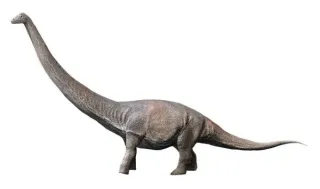
Dreadnoughtus schrani
Pronounced dred-NAW-tus SHRAH-nye
Titanosauria
A giant titanosaur from the Late Cretaceous of southern Patagonia and the most complete giant sauropod known, with about 70% of its skeleton below the head. The type individual was still growing when it died.
- Giant
- Long necked
- Quadrupedal
- Period
- Cretaceous· Campanian
- Diet
- Herbivore
- Length
- 26 m
- Mass
- 22,000–59,300 kg
- Location
- Santa Cruz Province, Argentina
Quick answers
- How big was Dreadnoughtus schrani?
- Dreadnoughtus schrani was about 26 m long. It stood about 3.5–4.2 m tall at the hips. It weighed about 22–59.3 t. (Lacovara et al. 2014; Paul 2016)
- When did Dreadnoughtus schrani live?
- Dreadnoughtus schrani lived during the Late Cretaceous, about 84–66 million years ago. (Lacovara et al. 2014; Paleobiology Database: Dreadnoughtus occurrences 2026)
- Where have Dreadnoughtus schrani fossils been found?
- Fossils of Dreadnoughtus schrani have been found in Cerro Fortaleza Formation (Santa Cruz Province) and Argentina. (Lacovara et al. 2014; Bates et al. 2015)
- What did Dreadnoughtus schrani eat?
- Dreadnoughtus schrani was a herbivore. (Lacovara et al. 2014; Bates et al. 2015)
- Who named Dreadnoughtus schrani, and when?
- Dreadnoughtus schrani was described by Kenneth J. Lacovara et al. in 2014. (Lacovara et al. 2014)
- Was Dreadnoughtus schrani in Jurassic Park?
- Yes. Dreadnoughtus schrani appears in Jurassic World Dominion (2022). A giant long-necked herbivore seen several times in Dominion. It was huge, but its first headline mass has since been revised well downward. (Wikipedia: Dinosaurs in Jurassic Park 2026; Bates et al. 2015)
On this page
dred-NAW-tus SHRAH-nye
- Period
- Cretaceous84–66 Ma
- Diet
- Herbivore
- Length
- 26 m
- Mass
- 22–59.3 t
- Location
- Argentina
- Classification
- Titanosauria
- Described
- 2014, Kenneth J. Lacovara et al.
Overview
Dreadnoughtus schrani lived in southern Patagonia, Argentina, in the Late Cretaceous (Campanian-Maastrichtian). Kenneth Lacovara and colleagues named it in 2014 from two skeletons found on the east bank of the Río La Leona in Santa Cruz Province; they are kept at the Museo Padre Molina in Río Gallegos.
The holotype preserves about 45% of all the bones of a titanosaur skeleton and up to 70% of the postcranial elements, far more than any other giant titanosaur (Argentinosaurus: about 5%). Its bone histology shows the animal was still growing.
The describers estimated 59.3 tonnes from limb-bone circumference. Volumetric models by Bates et al. (2015) found this implausible and gave 22 to 38 tonnes, and Paul (2019) put it around 30 tonnes, so its mass is a textbook example of how much methods differ.
Name meaning
"Dreadnought", Old English for "fearing nothing", for its size and after early-20th-century battleships; schrani honours Adam Schran, who supported the research (Lacovara et al. 2014).
Biology & evidence
What scientists think about how this animal lived, and how strong the evidence for each idea is.
Growth
The Dreadnoughtus type specimen was still growing when it died.
Evidence level: Strong evidenceIts bone lacks the remodelled outer layer seen in fully grown sauropods.
Evidence for / against · 1
Evidence for
Histology · Dreadnoughtus humerus histology
Unremodelled fibrolamellar bone in the outer cortex of the humerus.
Specimen: MPM-PV 1156
Other
Dreadnoughtus is the most complete giant titanosaur known.
Evidence level: Direct evidenceAbout 45% of the skeleton is known, against 15% for Futalognkosaurus and 5% for Argentinosaurus.
Evidence for / against · 1
Evidence for
Biomechanical model · Dreadnoughtus limb-scaling mass estimate
Humeral and femoral circumferences give about 59.3 t.
Specimen: MPM-PV 1156
Dreadnoughtus weighed about 59 tonnes.
Evidence level: DisputedThe 59.3 t figure comes from a limb-bone equation. Volumetric models of the same skeleton give 22 to 38 t, and Paul (2019) about 30 t.
Evidence for / against · 2
Evidence for
Biomechanical model · Dreadnoughtus limb-scaling mass estimate
Humeral and femoral circumferences give about 59.3 t.
Specimen: MPM-PV 1156
Evidence against
Biomechanical model · Dreadnoughtus volumetric models
Three volumetric reconstructions give 22.1, 27.7 and 38.2 t; masses above 40 t would need implausible densities and soft tissue.
Specimen: MPM-PV 1156
Size
- Length
- 26 m
- Height
- 3.8 mpublished range 3.5–4.2 m
- Mass
- 22,000–59,300 kg
(85.3 ft)
Based on MPM-PV 1156
(12.5 ft)
Based on MPM-PV 1156 (holotype, femur 1.91 m)
Based on MPM-PV 1156
Timeline
Periods: Campanian (83.6–72.1 Ma), Maastrichtian (72.1–66 Ma), Late Cretaceous (100.5–66 Ma)
Campanian-Maastrichtian, about 84-66 Ma (Lacovara et al. 2014); PBDB lists the collection as Campanian (83.6-72.2 Ma).
Location
Formations
- Cerro Fortaleza Formation · Santa Cruz Province
- Cerro Fortaleza, east bank of the Río La Leona, Santa Cruz · Cerro Fortaleza Formation · Santa Cruz Province · position approximate
These are the places where fossils have been found, not the full area where the animal lived.
Ecosystem
Lived in: Cerro Fortaleza
84–66 million years ago · floodplain
Late Cretaceous southern Patagonia, about 1,200 km south of the classic Neuquén dinosaur beds; little of the fauna has been described.
Classification
- cladeDinosauria
- cladeSaurischia
- cladeSauropodomorpha
- cladeSauropoda
- cladeMacronaria
- cladeTitanosauria
- genusDreadnoughtus
- speciesDreadnoughtus schrani
Taxonomic status: Valid
Fossil record

| Catalog number | Status | Institution | Found |
|---|---|---|---|
| MPM-PV 1156 | Holotype | Museo Regional Provincial Padre Manuel Jesús Molina (MPM) | — |
| MPM-PV 3546 | Paratype | Museo Regional Provincial Padre Manuel Jesús Molina (MPM) | — |
What has been found
Holotype: MPM-PV 1156
- Preserved
- Partial
- Reconstructed
- Unknown / not recorded
Holotype: MPM-PV 1156
Region by region (table)
| Region | State |
|---|---|
| Skull | Partial · Maxilla fragment. |
| Mandible | Unknown / not recorded |
| Teeth | Partial · One tooth. |
| Cervical vertebrae | Partial |
| Dorsal vertebrae | Partial |
| Sacrum | Preserved |
| Caudal vertebrae | Partial · 32 caudal vertebrae. |
| Ribs | Partial |
| Gastralia | Unknown / not recorded |
| Scapula / shoulder girdle | Preserved |
| Humerus | Preserved |
| Forearm (radius / ulna) | Preserved |
| Hand (manus) | Unknown / not recorded |
| Pelvis | Preserved |
| Femur | Preserved |
| Tibia / fibula | Preserved |
| Foot (pes) | Partial · Right metatarsals I-II and pedal ungual I only. |
Paratype: MPM-PV 3546
Region by region (table)
| Region | State |
|---|---|
| Skull | Unknown / not recorded |
| Mandible | Unknown / not recorded |
| Teeth | Unknown / not recorded |
| Cervical vertebrae | Unknown / not recorded |
| Dorsal vertebrae | Unknown / not recorded |
| Sacrum | Preserved |
| Caudal vertebrae | Unknown / not recorded |
| Ribs | Unknown / not recorded |
| Gastralia | Unknown / not recorded |
| Scapula / shoulder girdle | Unknown / not recorded |
| Humerus | Unknown / not recorded |
| Forearm (radius / ulna) | Unknown / not recorded |
| Hand (manus) | Unknown / not recorded |
| Pelvis | Preserved |
| Femur | Preserved |
| Tibia / fibula | Unknown / not recorded |
| Foot (pes) | Unknown / not recorded |

Discovery
- Year described
- 2014
- Described by
- Kenneth J. Lacovara et al.
- Type specimen
- MPM-PV 1156

Discovery timeline
2014 · Formally described
Lacovara et al. name Dreadnoughtus schrani
The most complete giant titanosaur is named in Scientific Reports.
People: Kenneth J. Lacovara
2015 · Major study
Dreadnoughtus mass re-evaluated
Volumetric models cut the mass estimate to 22-38 t.
People: Karl T. Bates
In Jurassic Park & Jurassic World
Films
- Jurassic World Dominion (2022)
On screen
A giant long-necked herbivore seen several times in Dominion.
Film vs fossils
- It was huge, but its first headline mass has since been revised well downward.
Film titles are used for identification only. DinoDex is not affiliated with or endorsed by the Jurassic Park / Jurassic World franchise. All dinosaurs seen in the films
Sources
- (2026). Paleobiology Database: Dreadnoughtus occurrences. The Paleobiology Database (paleobiodb.org), data service 1.2, accessed 2026-09-23. https://paleobiodb.org/data1.2/occs/list.txt?base_name=Dreadnoughtus&show=coords,paleoloc,strat,loc,ref&pgm=gplates (opens in a new tab)
- (2026). Wikipedia: Dinosaurs in Jurassic Park. Wikipedia. https://en.wikipedia.org/wiki/Dinosaurs_in_Jurassic_Park (opens in a new tab)
- Bates, K. T., Falkingham, P. L., Macaulay, S., Brassey, C. & Maidment, S. C. R. (2015). Downsizing a giant: re-evaluating Dreadnoughtus body mass. Biology Letters 11. doi:10.1098/rsbl.2015.0215 (opens in a new tab)
- Lacovara, K. J., Lamanna, M. C., Ibiricu, L. M., Poole, J. C., Schroeter, E. R., Ullmann, P. V., Voegele, K. K., Boles, Z. M., et al. (2014). A gigantic, exceptionally complete titanosaurian sauropod dinosaur from southern Patagonia, Argentina. Scientific Reports 4: 6196. doi:10.1038/srep06196 (opens in a new tab)
- Paul, G. S. (2016). The Princeton Field Guide to Dinosaurs (2nd edition). Princeton University Press.
- Paul, G. S. (2019). Determining the largest known land animal: a critical comparison of differing methods for restoring the volume and mass of extinct animals. Annals of Carnegie Museum 85(4): 335-358. doi:10.2992/007.085.0403 (opens in a new tab)