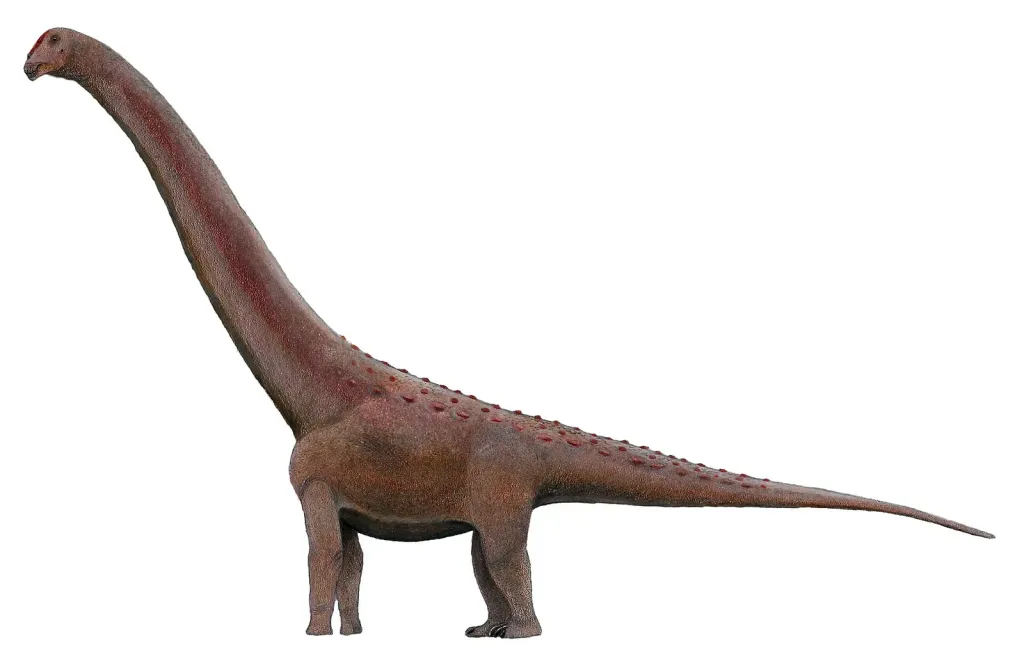
Patagotitan mayorum
Pronounced PAT-ah-go-TY-tan may-OR-um
Titanosauria
A giant titanosaur from the latest Early Cretaceous of Chubut, Argentina, known from at least six individuals in one quarry. Its describers estimated 69 tonnes; later work suggests 50 to 55 tonnes.
- Giant
- Long necked
- Quadrupedal
- Period
- Cretaceous· Albian
- Diet
- Herbivore
- Length
- 31–37 m
- Mass
- 50,000–69,000 kg
- Location
- Chubut Province, Argentina
Quick answers
- How big was Patagotitan mayorum?
- Patagotitan mayorum was about 31–37 m long. It stood about 4.4–5.2 m tall at the hips. It weighed about 50–69 t. (Wikipedia: Patagotitan 2026; Carballido et al. 2017)
- When did Patagotitan mayorum live?
- Patagotitan mayorum lived during the Early Cretaceous, about 101.8–101.4 million years ago. (Carballido et al. 2017; Paleobiology Database: Patagotitan occurrences 2026)
- Where have Patagotitan mayorum fossils been found?
- Fossils of Patagotitan mayorum have been found in Cerro Barcino Formation (Chubut Province) and Argentina. (Carballido et al. 2017; Paul 2019)
- What did Patagotitan mayorum eat?
- Patagotitan mayorum was a herbivore. (Carballido et al. 2017; Paul 2019)
- Who named Patagotitan mayorum, and when?
- Patagotitan mayorum was described by José L. Carballido et al. in 2017. (Carballido et al. 2017)
On this page

PAT-ah-go-TY-tan may-OR-um
- Period
- Cretaceous101.8–101.4 Ma
- Diet
- Herbivore
- Length
- 31–37 m
- Mass
- 50–69 t
- Location
- Argentina
- Classification
- Titanosauria
- Described
- 2017, José L. Carballido et al.
Overview
Patagotitan mayorum lived in Patagonia about 101.6 million years ago, at the end of the Early Cretaceous. A farm worker found the first bone in 2010 on the La Flecha ranch in Chubut Province; teams from the Museo Paleontológico Egidio Feruglio excavated the quarry, and José Carballido and colleagues named it in 2017.
At least six individuals were found in the same quarry, so almost the whole skeleton is known from repeated bones. The holotype (MPEF-PV 3400) includes neck, back and tail vertebrae, the shoulder, both pubes and both femora.
From the size of its limb bones Carballido et al. estimated 69 tonnes (with a standard error of 17 tonnes). Gregory Paul (2019) found it lighter, about 50 to 55 tonnes, and smaller than Argentinosaurus. A cast of the skeleton is displayed at the American Museum of Natural History.
Name meaning
From Patagonia and the Titans of Greek myth, "symbolic of strength and large size"; mayorum honours the Mayo family of the La Flecha ranch (Carballido et al. 2017).
Biology & evidence
What scientists think about how this animal lived, and how strong the evidence for each idea is.
Social life
Several Patagotitan died at the same place on separate occasions.
Evidence level: Moderate evidenceThe six individuals lie in three separate horizons, so the site records repeated deaths rather than a single herd dying together.
Evidence for / against · 1
Evidence for
Specimen · Patagotitan multi-individual quarry
At least six individuals of similar size in one quarry, in three closely spaced horizons.
Specimen: MPEF-PV 3400
Other
Patagotitan weighed more than 50 tonnes.
Evidence level: Strong evidenceTwo independent methods give 50 to 69 tonnes. Whether it was heavier than Argentinosaurus is disputed.
Evidence for / against · 2
Evidence for
Biomechanical model · Patagotitan limb-scaling mass estimate
Femur and humerus circumferences give 69 t (standard error 17 t), about 15% more than Dreadnoughtus with the same equation.
Specimen: MPEF-PV 3400
Biomechanical model · Patagotitan volumetric mass estimate
A volumetric model gives 50-55 t, with dorsal vertebrae smaller than those of Argentinosaurus.
Size
- Length
- 31–37 m
- Height
- 4.8 mpublished range 4.4–5.2 m
- Mass
- 50,000–69,000 kg
(121.4 ft)
(15.7 ft)
Based on MPEF-PV 3400 (femur 2.38 m)
Based on MPEF-PV 3400 and paratypes
Timeline
Periods: Albian (113–100.5 Ma), Early Cretaceous (145–100.5 Ma)
U-Pb age of the type horizon, 101.62 ± 0.18 Ma (latest Albian). PBDB gives the broader Albian bounds 113.2-100.5 Ma.
Location
Formations
- Cerro Barcino Formation · Chubut Province
Places
- La Flecha ranch, 15 km W of Los Altares, Chubut · Cerro Barcino Formation · Chubut Province · position approximate
These are the places where fossils have been found, not the full area where the animal lived.
Ecosystem
Lived in: Cerro Castaño
113–100.5 million years ago · floodplain, river system
Humid floodplains of central Patagonia at the end of the Early Cretaceous.
Classification
- cladeDinosauria
- cladeSaurischia
- cladeSauropodomorpha
- cladeSauropoda
- cladeMacronaria
- cladeTitanosauria
- genusPatagotitan
- speciesPatagotitan mayorum
Taxonomic status: Valid
Fossil record

| Catalog number | Status | Institution | Found |
|---|---|---|---|
| MPEF-PV 3400 | Holotype | Museo Paleontológico Egidio Feruglio (MPEF) | — |
What has been found
Holotype: MPEF-PV 3400
- Preserved
- Partial
- Reconstructed
- Unknown / not recorded
Region by region (table)
| Region | State |
|---|---|
| Skull | Unknown / not recorded |
| Mandible | Unknown / not recorded |
| Teeth | Unknown / not recorded |
| Cervical vertebrae | Partial · One anterior and two middle cervicals. |
| Dorsal vertebrae | Partial · Seven dorsals. |
| Sacrum | Unknown / not recorded |
| Caudal vertebrae | Partial · Six anterior caudals and three chevrons. |
| Ribs | Partial |
| Gastralia | Unknown / not recorded |
| Scapula / shoulder girdle | Partial · Right scapulocoracoid and both sternal plates. |
| Humerus | Unknown / not recorded |
| Forearm (radius / ulna) | Unknown / not recorded |
| Hand (manus) | Unknown / not recorded |
| Pelvis | Partial · Both pubes. |
| Femur | Preserved · Both femora. |
| Tibia / fibula | Unknown / not recorded |
| Foot (pes) | Unknown / not recorded |
Discovery
- Year described
- 2017
- Described by
- José L. Carballido et al.
- Type specimen
- MPEF-PV 3400

Discovery timeline
2010 · First material found
A farm worker finds a giant femur at La Flecha
The first bone is found on La Flecha ranch, Chubut.
2017 · Formally described
Carballido et al. name Patagotitan mayorum
The giant titanosaur is named with a dated type horizon and a mass estimate.
People: José L. Carballido, Diego Pol
Sources
- (2026). Paleobiology Database: Patagotitan occurrences. The Paleobiology Database (paleobiodb.org), data service 1.2, accessed 2026-09-23. https://paleobiodb.org/data1.2/occs/list.txt?base_name=Patagotitan&show=coords,paleoloc,strat,loc,ref&pgm=gplates (opens in a new tab)
- (2026). Wikipedia: Patagotitan. Wikipedia (English), accessed 2026-09-23. https://en.wikipedia.org/wiki/Patagotitan (opens in a new tab)
- Carballido, J. L., Pol, D., Otero, A., Cerda, I. A., Salgado, L., Garrido, A. C., Ramezani, J., Cúneo, N. R. & Krause, J. M. (2017). A new giant titanosaur sheds light on body mass evolution among sauropod dinosaurs. Proceedings of the Royal Society B 284: 20171219. doi:10.1098/rspb.2017.1219 (opens in a new tab)
- Paul, G. S. (2016). The Princeton Field Guide to Dinosaurs (2nd edition). Princeton University Press.
- Paul, G. S. (2019). Determining the largest known land animal: a critical comparison of differing methods for restoring the volume and mass of extinct animals. Annals of Carnegie Museum 85(4): 335-358. doi:10.2992/007.085.0403 (opens in a new tab)