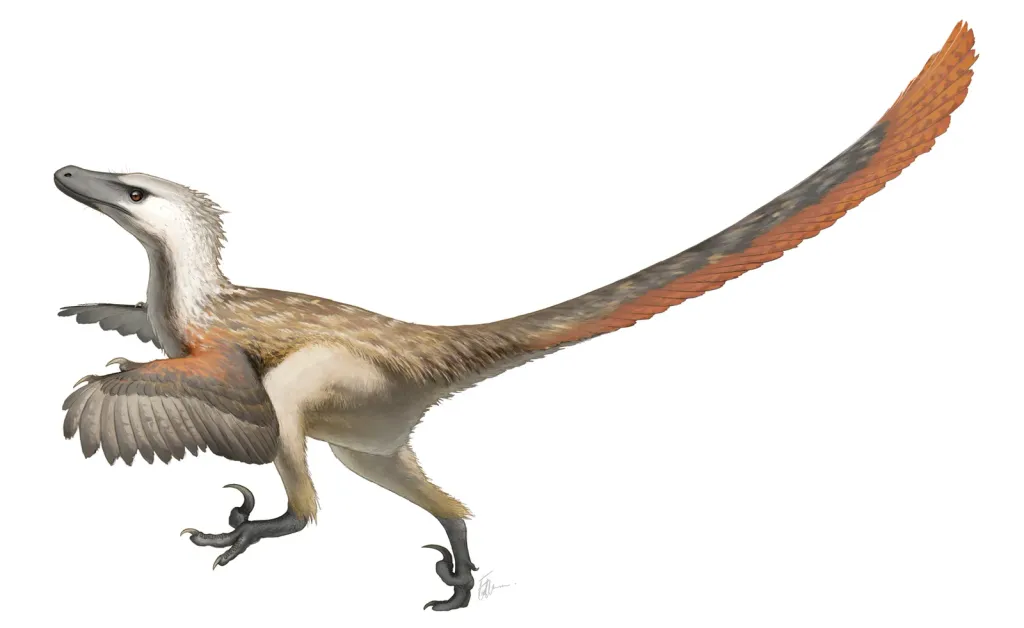
Velociraptor mongoliensis
Pronounced vel-OSS-ih-RAP-tor mon-GOH-lee-EN-sis
Maniraptora · Dromaeosauridae
A small feathered dromaeosaurid from the Campanian of Mongolia, about 15 kg: far smaller than the film "raptors". Quill knobs on its forearm show it had large wing feathers.
- Feathered
- Bipedal
- Sickle claw
- Famous specimen
- Movie icon
- Exceptional preservation
- Possible pack behavior
- Period
- Cretaceous· Campanian
- Diet
- Carnivore
- Length
- 1.5 m
- Mass
- 15 kg
- Location
- Mongolia, Ömnögovi Province
Quick answers
- How big was Velociraptor mongoliensis?
- Velociraptor mongoliensis was about 1.5 m long. It stood about 0.5–0.6 m tall at the hips. It weighed about 15 kg. (Turner et al. 2007; Paul 2016)
- When did Velociraptor mongoliensis live?
- Velociraptor mongoliensis lived during the Late Cretaceous, about 75–71 million years ago. (Cohen et al. 2023; Osborn 1924)
- Where have Velociraptor mongoliensis fossils been found?
- Fossils of Velociraptor mongoliensis have been found in Djadokhta Formation (Ömnögovi Province) and Mongolia. (Osborn 1924; Turner et al. 2007)
- What did Velociraptor mongoliensis eat?
- Velociraptor mongoliensis was a carnivore. (Osborn 1924; Turner et al. 2007)
- Who named Velociraptor mongoliensis, and when?
- Velociraptor mongoliensis was described by Henry Fairfield Osborn in 1924. (Osborn 1924)
- Was Velociraptor mongoliensis in Jurassic Park?
- Yes. Velociraptor mongoliensis appears in Jurassic Park (1993), The Lost World: Jurassic Park (1997), Jurassic Park III (2001), Jurassic World (2015), Jurassic World: Fallen Kingdom (2018), Jurassic World Dominion (2022), and Jurassic World Rebirth (2025). Human-sized, scaly and highly intelligent pack hunters; from Jurassic World on, a trained raptor called Blue. The film raptors are far bigger than the real animal: Velociraptor mongoliensis was about the size of a large turkey. The films borrow the size of its larger North American relative Deinonychus. (Wikipedia: Dinosaurs in Jurassic Park 2026; Osborn 1924)
On this page

- Period
- Cretaceous75–71 Ma
- Diet
- Carnivore
- Length
- 1.5 m
- Mass
- 0 t
- Location
- Mongolia
- Classification
- Maniraptora · Dromaeosauridae
- Described
- 1924, Henry Fairfield Osborn
Overview
Velociraptor mongoliensis lived in what is now the Gobi Desert of Mongolia during the Campanian, in the Late Cretaceous. It was named by Henry Fairfield Osborn in 1924 from a skull and foot claw (AMNH 6515) collected in 1923 at the Flaming Cliffs by the American Museum Central Asiatic Expeditions.
It was a small, lightly built predator with an enlarged sickle-shaped claw on each foot. Adults were about the size of a large turkey, roughly 15 kg, much smaller than the animals called "Velociraptor" in the Jurassic Park films, which were modelled on larger dromaeosaurids.
Turner, Makovicky and Norell (2007) found quill knobs, the attachment points of large secondary wing feathers, on a Velociraptor forearm bone. Velociraptor could not fly, but it was feathered like its close relatives.
Name meaning
From Latin velox ("swift") and raptor ("robber, plunderer"); mongoliensis refers to Mongolia (Osborn 1924).
Biology & evidence
What scientists think about how this animal lived, and how strong the evidence for each idea is.
Feeding
Velociraptor also scavenged carcasses.
Evidence level: Moderate evidenceTooth marks on Protoceratops bones were made when little meat was left, suggesting scavenging or late-stage feeding on a carcass.
Evidence for / against · 1
Evidence for
Trace fossil · Velociraptor tooth marks on Protoceratops bones
Tooth marks and a broken Velociraptor tooth on Protoceratops bones, interpreted as late-stage feeding or scavenging.
Feathers
Velociraptor had feathers, including large quill feathers on its arms.
Evidence level: Strong evidenceNo feather impressions have been found with Velociraptor, but its forearm shows quill knobs, the bumps where big wing feathers anchor in birds. Its close relatives are known with full feather coats.
Evidence for / against · 1
Evidence for
Specimen · Quill knobs on a Velociraptor ulna
A row of small bumps on the forearm bone where large wing feathers attached, as in living birds.
Specimen: IGM 100/981
Biomechanics
The sickle claw of Velociraptor was used to pin down prey, not to slash it open.
Evidence level: HypothesisModern hawks and eagles hold prey down with their feet while eating. Comparisons suggest dromaeosaurs did something similar; the old idea of slashing open bellies is not supported by claw shape, but no fossil shows the claw in use except the Fighting Dinosaurs.
Evidence for / against · 1
Evidence for
Comparative anatomy · Raptor prey restraint model
Comparison of dromaeosaur feet with those of living birds of prey: the sickle claw pinned prey down rather than slashing it open.
Behavior
Velociraptor attacked live prey as big as Protoceratops.
Evidence level: Direct evidenceThe Fighting Dinosaurs fossil preserves a Velociraptor and a Protoceratops in the act of fighting, killed together, probably by a collapsing dune. It is direct evidence of a predatory attack.
Evidence for / against · 1
Evidence for
Specimen · Fighting Dinosaurs specimen
A Velociraptor and a Protoceratops buried in the middle of a fight; the raptor's sickle claw is at the neck of its prey, whose jaws grip the raptor's arm.
Specimen: MPC-D 100/25 “Fighting Dinosaurs”
Social life
Velociraptor hunted in packs.
Evidence level: Weak evidencePack hunting is popular in films but there is little evidence for Velociraptor: no group burials are known. Trackways of other dromaeosaurs show some walked together.

Size
- Length
- 1.5 m
- Height
- 0.5 mpublished range 0.5–0.6 m
- Mass
- 15 kg
(4.9 ft)
Based on IGM 100/981 (adult, the quill-knob specimen)
(1.6 ft)
Based on IGM 100/25 and MPC-D 100/54
Based on IGM 100/981 (adult, the quill-knob specimen)
Timeline
Periods: Campanian (83.6–72.1 Ma), Late Cretaceous (100.5–66 Ma)
Djadokhta Formation, about 75-71 Ma: magnetostratigraphy suggests, without clearly establishing, deposition during the late Campanian polarity changes (Dashzeveg et al. 2005). Wider bracket: the Campanian stage (ICS 2023/09).
Location
Formations
- Djadokhta Formation · Ömnögovi Province
- Flaming Cliffs (Bayanzag), Ömnögovi, Mongolia · Djadokhta Formation · Ömnögovi Province · position approximate
These are the places where fossils have been found, not the full area where the animal lived.
Ecosystem
Lived in: Djadokhta
75–71 million years ago · desert / dunes, other
An arid landscape of sand dunes and interdune areas in the Late Cretaceous Gobi, with occasional water. Sandslides and dune collapses buried animals alive, preserving articulated skeletons and nests.
Same ecosystem

Same ecosystem

Classification
- cladeDinosauria
- cladeSaurischia
- cladeTheropoda
- cladeCoelurosauria
- cladeManiraptora
- familyDromaeosauridae
- subfamilyVelociraptorinae
- genusVelociraptor
- speciesVelociraptor mongoliensis
Taxonomic status: Valid
Fossil record

| Catalog number | Status | Institution | Found |
|---|---|---|---|
| AMNH 6515 | Holotype | American Museum of Natural History (AMNH) | 1923 |
| MPC-D 100/25 “Fighting Dinosaurs” | Referred specimen | Institute of Paleontology, Mongolian Academy of Sciences (MPC) | 1971 |
| IGM 100/981 | Referred specimen | Institute of Paleontology, Mongolian Academy of Sciences (MPC) | — |
What has been found
Holotype: AMNH 6515
- Preserved
- Partial
- Reconstructed
- Unknown / not recorded
Holotype: AMNH 6515
Region by region (table)
| Region | State |
|---|---|
| Skull | Preserved · Crushed but complete skull. |
| Mandible | Preserved |
| Teeth | Unknown / not recorded |
| Cervical vertebrae | Unknown / not recorded |
| Dorsal vertebrae | Unknown / not recorded |
| Sacrum | Unknown / not recorded |
| Caudal vertebrae | Unknown / not recorded |
| Ribs | Unknown / not recorded |
| Gastralia | Unknown / not recorded |
| Scapula / shoulder girdle | Unknown / not recorded |
| Humerus | Unknown / not recorded |
| Forearm (radius / ulna) | Unknown / not recorded |
| Hand (manus) | Partial · Finger bones and claws. |
| Pelvis | Unknown / not recorded |
| Femur | Unknown / not recorded |
| Tibia / fibula | Unknown / not recorded |
| Foot (pes) | Unknown / not recorded |
Referred specimen: MPC-D 100/25 “Fighting Dinosaurs”
Region by region (table)
| Region | State |
|---|---|
| Skull | Preserved |
| Mandible | Preserved |
| Teeth | Unknown / not recorded |
| Cervical vertebrae | Preserved |
| Dorsal vertebrae | Preserved |
| Sacrum | Unknown / not recorded |
| Caudal vertebrae | Unknown / not recorded |
| Ribs | Unknown / not recorded |
| Gastralia | Unknown / not recorded |
| Scapula / shoulder girdle | Unknown / not recorded |
| Humerus | Preserved |
| Forearm (radius / ulna) | Preserved |
| Hand (manus) | Preserved · Right hand gripping the Protoceratops skull. |
| Pelvis | Preserved |
| Femur | Preserved |
| Tibia / fibula | Unknown / not recorded |
| Foot (pes) | Preserved · Sickle claw in the throat region of the Protoceratops. |
Referred specimen: IGM 100/981
Region by region (table)
| Region | State |
|---|---|
| Skull | Unknown / not recorded |
| Mandible | Unknown / not recorded |
| Teeth | Unknown / not recorded |
| Cervical vertebrae | Unknown / not recorded |
| Dorsal vertebrae | Unknown / not recorded |
| Sacrum | Unknown / not recorded |
| Caudal vertebrae | Unknown / not recorded |
| Ribs | Unknown / not recorded |
| Gastralia | Unknown / not recorded |
| Scapula / shoulder girdle | Unknown / not recorded |
| Humerus | Unknown / not recorded |
| Forearm (radius / ulna) | Preserved · Ulna with six quill knobs. |
| Hand (manus) | Unknown / not recorded |
| Pelvis | Unknown / not recorded |
| Femur | Unknown / not recorded |
| Tibia / fibula | Unknown / not recorded |
| Foot (pes) | Unknown / not recorded |

Discovery
- Year described
- 1924
- Described by
- Henry Fairfield Osborn
- Type specimen
- AMNH 6515

Discovery timeline
1923 · First material found
Peter Kaisen finds the Velociraptor holotype
During the American Museum Central Asiatic Expeditions, Kaisen finds a crushed skull and a claw at the Flaming Cliffs.
People: Peter Kaisen, Roy Chapman Andrews
1924 · Formally described
Osborn names Velociraptor mongoliensis
Osborn names three new theropods from the Protoceratops beds, among them Velociraptor.
People: Henry Fairfield Osborn
1971 · Specimen recovered
The Fighting Dinosaurs are found
The Polish-Mongolian expedition recovers a Velociraptor and Protoceratops locked together at Tugrikin Shireh.
2007 · Major study
Quill knobs found on Velociraptor
Turner, Makovicky and Norell report quill knobs on a Velociraptor forearm.
In Jurassic Park & Jurassic World
Films
- Jurassic Park (1993)
- The Lost World: Jurassic Park (1997)
- Jurassic Park III (2001)
- Jurassic World (2015)
- Jurassic World: Fallen Kingdom (2018)
- Jurassic World Dominion (2022)
- Jurassic World Rebirth (2025)
On screen
Human-sized, scaly and highly intelligent pack hunters; from Jurassic World on, a trained raptor called Blue.
Film vs fossils
- The film raptors are far bigger than the real animal: Velociraptor mongoliensis was about the size of a large turkey. The films borrow the size of its larger North American relative Deinonychus.
- Quill knobs on a Velociraptor forearm show it had wing feathers; the film raptors are scaly (only Jurassic Park III adds a few quills on the head).
- Coordinated pack hunting is not established from fossils. What the fossils do show is Velociraptor feeding on Protoceratops.
Film titles are used for identification only. DinoDex is not affiliated with or endorsed by the Jurassic Park / Jurassic World franchise. All dinosaurs seen in the films
Sources
- (2026). Wikipedia: Dinosaurs in Jurassic Park. Wikipedia. https://en.wikipedia.org/wiki/Dinosaurs_in_Jurassic_Park (opens in a new tab)
- (2026). Wikipedia: Jurassic World Rebirth. Wikipedia. https://en.wikipedia.org/wiki/Jurassic_World_Rebirth (opens in a new tab)
- Cohen, K. M., Harper, D. A. T., Gibbard, P. L. & Car, N. (2023). International Chronostratigraphic Chart (v2023/09). International Commission on Stratigraphy. https://stratigraphy.org/ICSchart/ChronostratChart2023-09.pdf (opens in a new tab)
- Dashzeveg, D., Dingus, L., Loope, D. B., Swisher, C. C., III, Dulam, T. & Sweeney, M. R. (2005). New stratigraphic subdivision, depositional environment, and age estimate for the Upper Cretaceous Djadokhta Formation, southern Ulan Nur Basin, Mongolia. American Museum Novitates 3498: 1-31. https://digitallibrary.amnh.org/server/api/core/bitstreams/0df4baac-12e4-44ae-8ef7-3328b22e8604/content (opens in a new tab)
- Hone, D., Choiniere, J., Sullivan, C., Xu, X., Pittman, M. & Tan, Q. (2010). New evidence for a trophic relationship between the dinosaurs Velociraptor and Protoceratops. Palaeogeography, Palaeoclimatology, Palaeoecology 291(3-4): 488-492. doi:10.1016/j.palaeo.2010.03.028 (opens in a new tab)
- Osborn, H. F. (1924). Three new Theropoda, Protoceratops zone, central Mongolia. American Museum Novitates 144: 1-12.
- Ostrom, J. H. (1969). Osteology of Deinonychus antirrhopus, an unusual theropod from the Lower Cretaceous of Montana. Bulletin of the Peabody Museum of Natural History 30: 1-165.
- Paul, G. S. (2016). The Princeton Field Guide to Dinosaurs (2nd edition). Princeton University Press.
- Roach, B. T. & Brinkman, D. L. (2007). A reevaluation of cooperative pack hunting and gregariousness in Deinonychus antirrhopus and other nonavian theropod dinosaurs. Bulletin of the Peabody Museum of Natural History 48(1): 103-138. doi:10.3374/0079-032X(2007)48[103:AROCPH]2.0.CO;2 (opens in a new tab)
- Turner, A. H., Makovicky, P. J. & Norell, M. A. (2007). Feather quill knobs in the dinosaur Velociraptor. Science 317(5845): 1721. doi:10.1126/science.1145076 (opens in a new tab)