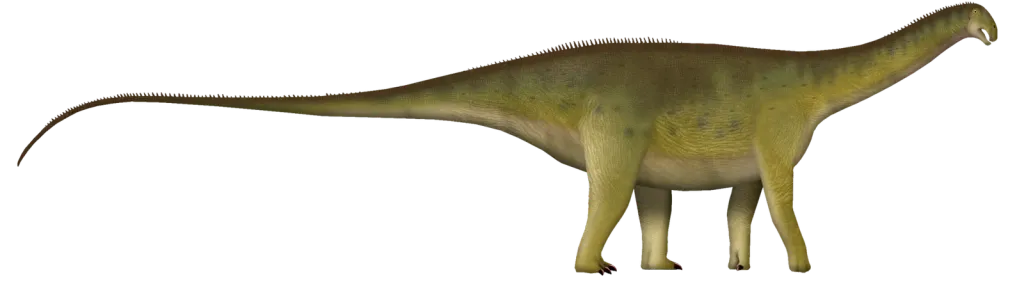
Nigersaurus taqueti
Pronounced nee-ZHER-sore-us tah-KET-eye
Sauropoda · Rebbachisauridae
A small rebbachisaurid sauropod from the Early Cretaceous of Niger with a broad, straight-edged muzzle packed with hundreds of teeth that were replaced very quickly: a Cretaceous lawnmower.
- Quadrupedal
- Long necked
- Unusual anatomy
- Period
- Cretaceous· Aptian
- Diet
- Herbivore
- Length
- 9 m
- Mass
- 1,900–4,000 kg
- Location
- Agadez Region, Niger
Quick answers
- How big was Nigersaurus taqueti?
- Nigersaurus taqueti was about 9 m long. It stood about 1.6–2 m tall at the hips. It weighed about 1.9–4 t. (Sereno et al. 1999; Sereno et al. 2007)
- When did Nigersaurus taqueti live?
- Nigersaurus taqueti lived during the Early Cretaceous, about 121.4–100.5 million years ago. (Cohen et al. 2023; Sereno et al. 1999)
- Where have Nigersaurus taqueti fossils been found?
- Fossils of Nigersaurus taqueti have been found in Elrhaz Formation (Agadez Region) and Niger. (Sereno et al. 1999; Sereno et al. 2007)
- What did Nigersaurus taqueti eat?
- Nigersaurus taqueti was a herbivore. (Sereno et al. 1999; Sereno et al. 2007)
- Who named Nigersaurus taqueti, and when?
- Nigersaurus taqueti was described by Paul C. Sereno et al. in 1999. (Sereno et al. 1999; Sereno et al. 2007)
On this page

nee-ZHER-sore-us tah-KET-eye
- Period
- Cretaceous121.4–100.5 Ma
- Diet
- Herbivore
- Length
- 9 m
- Mass
- 1.9–4 t
- Location
- Niger
- Classification
- Sauropoda · Rebbachisauridae
- Described
- 1999, Paul C. Sereno et al.
Overview
Nigersaurus taqueti lived in what is now the Sahara of Niger in the Early Cretaceous, when the region was a land of rivers and floodplains. French expeditions led by Philippe Taquet found its first bones in the 1960s and 1970s at Gadoufaoua; Paul Sereno's team collected better material in the 1990s and named it in 1999.
For a sauropod it was small, about 9 m long. Its skull was extremely light, with paper-thin bones, and its jaws ended in a wide, straight muzzle lined with more than 500 teeth in columns, each replaced every few weeks. Sereno et al. (2007) argued it grazed close to the ground.
Many of these interpretations are debated: the head posture reconstructed from its inner ear, and the exact tooth replacement rate, which D'Emic et al. (2013) estimated from growth lines in the teeth.
Name meaning
"Niger lizard"; taqueti honours French paleontologist Philippe Taquet, who led the first expeditions to its site (Sereno et al. 1999).
Biology & evidence
What scientists think about how this animal lived, and how strong the evidence for each idea is.
Feeding
Nigersaurus grazed close to the ground.
Evidence level: Moderate evidenceIts wide, straight muzzle and fast-wearing teeth suit cropping low plants such as ferns or horsetails. A downward head posture was reconstructed from the inner ear, but that method is debated.
Evidence for / against · 2
Evidence for
Specimen · Nigersaurus tooth batteries
Jaws with a straight front edge lined with columns of replacement teeth, more than 500 teeth in all.
Specimen: MNN GAD512
Comparative anatomy · Nigersaurus inner ear and head posture
CT scans of the inner ear, used to reconstruct the habitual head posture as pointing down.
Specimen: MNN GAD512
Teeth
Nigersaurus replaced its teeth faster than any other known dinosaur.
Evidence level: Strong evidenceEach tooth position held a column of up to ten replacement teeth, and growth lines show a new tooth came into use every few weeks.
Evidence for / against · 2
Evidence for
Specimen · Nigersaurus tooth batteries
Jaws with a straight front edge lined with columns of replacement teeth, more than 500 teeth in all.
Specimen: MNN GAD512
Histology · Nigersaurus tooth growth lines
Daily growth lines in the teeth used to calculate how often each tooth was replaced.
Other
Nigersaurus had an extremely light skeleton full of air spaces.
Evidence level: Direct evidenceIts skull bones are thin enough to see light through and its vertebrae are hollowed by air sacs, observed directly in the fossils.
Evidence for / against · 1
Evidence for
Specimen · Nigersaurus air-filled skeleton
Very thin skull bones and vertebrae hollowed by air sacs, making the skeleton exceptionally light.
Specimen: MNN GAD512

Size
- Length
- 9 m
- Height
- 1.8 mpublished range 1.6–2 m
- Mass
- 1,900–4,000 kg
(29.5 ft)
(5.9 ft)
Based on MNN GAD512 and referred material
Timeline
Periods: Aptian (121.4–113 Ma), Albian (113–100.5 Ma), Early Cretaceous (145–100.5 Ma)
Ages are the ICS 2023/09 bounds of the Aptian and Albian, the stage(s) the fossils are assigned to; they bracket the record and are not dated first/last appearances. The Elrhaz Formation is usually cited as about 115-105 Ma.
Location
Formations
- Elrhaz Formation · Agadez Region
Places
- Gadoufaoua, Agadez Region, Niger · Elrhaz Formation · Agadez Region · position approximate
These are the places where fossils have been found, not the full area where the animal lived.
Ecosystem

Lived in: Elrhaz (Gadoufaoua)
115–105 million years ago · river system, floodplain, swamp / wetland
Early Cretaceous rivers and swampy floodplains in what is now the Ténéré desert of Niger, with abundant crocodyliforms and fish.

Classification
- cladeDinosauria
- cladeSaurischia
- cladeSauropodomorpha
- cladeSauropoda
- superfamilyDiplodocoidea
- familyRebbachisauridae
- genusNigersaurus
- speciesNigersaurus taqueti
Taxonomic status: Valid
Fossil record

| Catalog number | Status | Institution | Found |
|---|---|---|---|
| MNN GAD512 | Holotype | Musée National Boubou Hama (MNN) | — |
What has been found
Holotype: MNN GAD512
- Preserved
- Partial
- Reconstructed
- Unknown / not recorded
Region by region (table)
| Region | State |
|---|---|
| Skull | Partial |
| Mandible | Preserved |
| Teeth | Preserved |
| Cervical vertebrae | Partial |
| Dorsal vertebrae | Unknown / not recorded |
| Sacrum | Unknown / not recorded |
| Caudal vertebrae | Unknown / not recorded |
| Ribs | Unknown / not recorded |
| Gastralia | Unknown / not recorded |
| Scapula / shoulder girdle | Unknown / not recorded |
| Humerus | Unknown / not recorded |
| Forearm (radius / ulna) | Unknown / not recorded |
| Hand (manus) | Unknown / not recorded |
| Pelvis | Unknown / not recorded |
| Femur | Unknown / not recorded |
| Tibia / fibula | Unknown / not recorded |
| Foot (pes) | Unknown / not recorded |

Discovery
- Year described
- 1999
- Described by
- Paul C. Sereno et al.
- Type specimen
- MNN GAD512
Discovery timeline
1965 · First material found
Taquet's expeditions find the first Nigersaurus bones
French expeditions led by Philippe Taquet collect sauropod remains at Gadoufaoua (1965-1972).
People: Philippe Taquet
1999 · Formally described
Sereno et al. name Nigersaurus taqueti
Named in a paper on Cretaceous sauropods of the Sahara.
People: Paul C. Sereno
2007 · Major study
Skull of Nigersaurus reconstructed
CT scans reveal the extreme skull and tooth batteries.
People: Paul C. Sereno
Sources
- Cohen, K. M., Harper, D. A. T., Gibbard, P. L. & Car, N. (2023). International Chronostratigraphic Chart (v2023/09). International Commission on Stratigraphy. https://stratigraphy.org/ICSchart/ChronostratChart2023-09.pdf (opens in a new tab)
- D'Emic, M. D., Whitlock, J. A., Smith, K. M., Fisher, D. C. & Wilson, J. A. (2013). Evolution of high tooth replacement rates in sauropod dinosaurs. PLoS ONE 8(7): e69235. doi:10.1371/journal.pone.0069235 (opens in a new tab)
- Paul, G. S. (2016). The Princeton Field Guide to Dinosaurs (2nd edition). Princeton University Press.
- Sereno, P. C., Beck, A. L., Dutheil, D. B., et al. (1999). Cretaceous sauropods from the Sahara and the uneven rate of skeletal evolution among dinosaurs. Science 286: 1342-1347. doi:10.1126/science.286.5443.1342 (opens in a new tab)
- Sereno, P. C., Wilson, J. A., Witmer, L. M., Whitlock, J. A., Maga, A., Ide, O. & Rowe, T. A. (2007). Structural extremes in a Cretaceous dinosaur. PLoS ONE 2(11): e1230. doi:10.1371/journal.pone.0001230 (opens in a new tab)