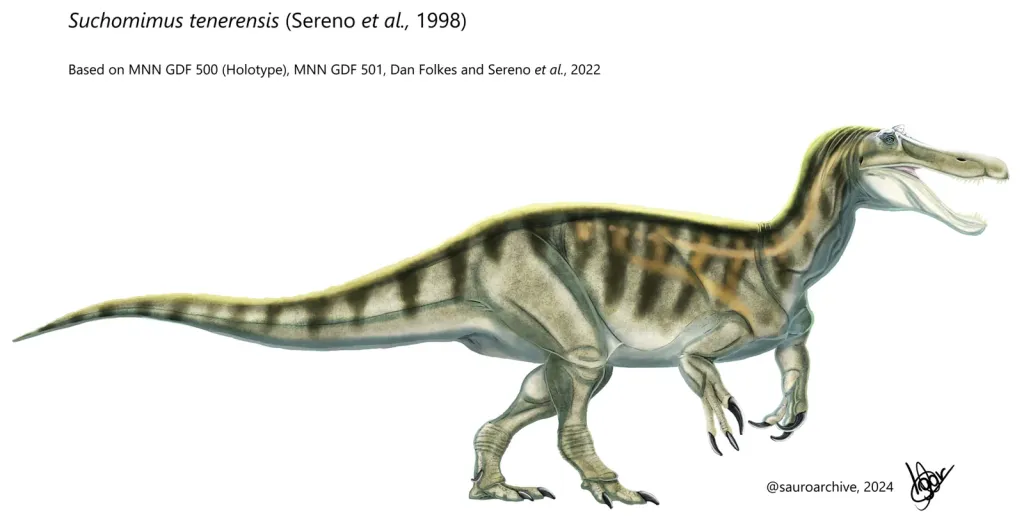
Suchomimus tenerensis
Pronounced SOO-koh-MY-mus ten-er-EN-sis
Tetanurae · Spinosauridae
A long-snouted, fish-eating spinosaurid from the Early Cretaceous of Niger, with a big thumb claw and a low ridge along its back. A close African relative of Baryonyx, it shared its rivers with Nigersaurus and Sarcosuchus.
- Bipedal
- Possibly semiaquatic
- Sail backed
- Period
- Cretaceous· Aptian
- Diet
- Piscivore
- Length
- 9.5–11 m
- Mass
- 2,500–5,300 kg
- Location
- Agadez Region, Niger, Africa
Quick answers
- How big was Suchomimus tenerensis?
- Suchomimus tenerensis was about 9.5–11 m long. It stood about 2.5–3 m tall at the hips. It weighed about 2.5–5.3 t. (Wikipedia: Suchomimus 2026; Sereno et al. 1998)
- When did Suchomimus tenerensis live?
- Suchomimus tenerensis lived during the Early Cretaceous, about 121.4–100.5 million years ago. (Paleobiology Database: Suchomimus occurrences 2026; Sereno et al. 1998)
- Where have Suchomimus tenerensis fossils been found?
- Fossils of Suchomimus tenerensis have been found in Elrhaz Formation (Agadez Region) and Niger. (Sereno et al. 1998; Paleobiology Database: Suchomimus occurrences 2026)
- What did Suchomimus tenerensis eat?
- Suchomimus tenerensis was a piscivore or carnivore. (Sereno et al. 1998; Paleobiology Database: Suchomimus occurrences 2026)
- Who named Suchomimus tenerensis, and when?
- Suchomimus tenerensis was described by Paul C. Sereno et al. in 1998. (Sereno et al. 1998; Paleobiology Database: Suchomimus occurrences 2026)
On this page

SOO-koh-MY-mus ten-er-EN-sis
- Period
- Cretaceous121.4–100.5 Ma
- Diet
- Piscivore
- Length
- 9.5–11 m
- Mass
- 2.5–5.3 t
- Location
- Niger, Africa
- Classification
- Tetanurae · Spinosauridae
- Described
- 1998, Paul C. Sereno et al.
Overview
Suchomimus tenerensis lived in what is now the Ténéré Desert of Niger in the Early Cretaceous (Aptian-Albian), among rivers teeming with fish and giant crocodyliforms. Paul Sereno's team found it at Gadoufaoua in 1997, and Sereno and colleagues named it in 1998.
It had a very long, narrow, crocodile-like snout, a large thumb claw and blade-shaped spines over its hips forming a low sail. Its skeleton showed that the enlarged thumb claw and strong arms of spinosaurids evolved before their fish-catching skulls (Sereno et al. 1998).
Its close relationship to Baryonyx from England suggests that spinosaurids crossed the Tethys seaway in the Early Cretaceous; some authors even place it in the genus Baryonyx.
Name meaning
"Crocodile mimic", from Greek souchos ("crocodile") and mimos ("mimic"), for its long snout; tenerensis for the Ténéré Desert (Sereno et al. 1998).
Biology & evidence
What scientists think about how this animal lived, and how strong the evidence for each idea is.
Feeding
Suchomimus was adapted to catching fish.
Evidence level: Strong evidenceIts long, narrow snout and conical teeth match those of fish-eating crocodiles, like other spinosaurids; no stomach contents are known for it.
Evidence for / against · 1
Evidence for
Specimen · Suchomimus snout and postcranium
An extremely long, narrow snout, blade-shaped spines forming a low sail over the hips, a big thumb claw and robust forelimbs.
Specimen: MNN GDF 500
Other
Spinosaurids crossed from Europe to Africa in the Early Cretaceous.
Evidence level: HypothesisThe close relationship of Suchomimus and Baryonyx suggests dispersal across the Tethys seaway.
Evidence for / against · 1
Evidence for
Phylogenetic inference · Spinosaurid phylogeny with Suchomimus
The enlarged thumb claw and robust forelimb evolved in the Jurassic, before the elongate snout; Suchomimus is closest to Baryonyx.
Size
- Length
- 9.5–11 m
- Height
- 2.7 mpublished range 2.5–3 m
- Mass
- 2,500–5,300 kg
(36.1 ft)
Based on MNN GDF 500
(8.9 ft)
Based on MNN GDF500 (holotype, femur c. 1.08 m)
Based on MNN GDF 500
Timeline
Periods: Aptian (121.4–113 Ma), Albian (113–100.5 Ma), Early Cretaceous (145–100.5 Ma)
Aptian-Albian bounds of the type collection in PBDB; Sereno et al. give the rocks as Aptian.
Location
Formations
- Elrhaz Formation · Agadez Region
Places
- Gadoufaoua, Ténéré Desert (PBDB collection 60029) · Elrhaz Formation · Agadez Region · position approximate
These are the places where fossils have been found, not the full area where the animal lived.
Ecosystem

Lived in: Elrhaz (Gadoufaoua)
115–105 million years ago · river system, floodplain, swamp / wetland
Early Cretaceous rivers and swampy floodplains in what is now the Ténéré desert of Niger, with abundant crocodyliforms and fish.
Same ecosystem

Classification
- cladeDinosauria
- cladeSaurischia
- cladeTheropoda
- cladeTetanurae
- superfamilyMegalosauroidea
- familySpinosauridae
- subfamilyBaryonychinae
- genusSuchomimus
- speciesSuchomimus tenerensis
Taxonomic status: Valid
Fossil record

| Catalog number | Status | Institution | Found |
|---|---|---|---|
| MNN GDF 500 | Holotype | Musée National Boubou Hama (MNN) | 1997 |
What has been found
Holotype: MNN GDF 500
- Preserved
- Partial
- Reconstructed
- Unknown / not recorded
Region by region (table)
| Region | State |
|---|---|
| Skull | Unknown / not recorded |
| Mandible | Unknown / not recorded |
| Teeth | Unknown / not recorded |
| Cervical vertebrae | Unknown / not recorded |
| Dorsal vertebrae | Partial |
| Sacrum | Unknown / not recorded |
| Caudal vertebrae | Unknown / not recorded |
| Ribs | Partial |
| Gastralia | Unknown / not recorded |
| Scapula / shoulder girdle | Unknown / not recorded |
| Humerus | Unknown / not recorded |
| Forearm (radius / ulna) | Unknown / not recorded |
| Hand (manus) | Partial · Thumb claw. |
| Pelvis | Partial |
| Femur | Unknown / not recorded |
| Tibia / fibula | Unknown / not recorded |
| Foot (pes) | Unknown / not recorded |

Discovery
- Year described
- 1998
- Described by
- Paul C. Sereno et al.
- Type specimen
- MNN GDF 500
Discovery timeline
1997 · First material found
Sereno's team finds Suchomimus at Gadoufaoua
A huge thumb claw spotted by David Varricchio leads to the skeleton.
People: Paul C. Sereno, David J. Varricchio
1998 · Formally described
Sereno et al. name Suchomimus tenerensis
The "crocodile mimic" is named in Science.
People: Paul C. Sereno
Sources
- (2026). Paleobiology Database: Suchomimus occurrences. The Paleobiology Database (paleobiodb.org), data service 1.2, accessed 2026-09-23. https://paleobiodb.org/data1.2/occs/list.txt?base_name=Suchomimus&show=coords,paleoloc,strat,loc,ref&pgm=gplates (opens in a new tab)
- (2026). Wikipedia: Suchomimus. Wikipedia (English), accessed 2026-09-23. https://en.wikipedia.org/wiki/Suchomimus (opens in a new tab)
- Paul, G. S. (2016). The Princeton Field Guide to Dinosaurs (2nd edition). Princeton University Press.
- Sereno, P. C., Beck, A. L., Dutheil, D. B., Gado, B., Larsson, H. C. E., Lyon, G. H., Marcot, J. D., Rauhut, O. W. M., Sadleir, R. W., Sidor, C. A., Varricchio, D. D., Wilson, G. P. & Wilson, J. A. (1998). A long-snouted predatory dinosaur from Africa and the evolution of spinosaurids. Science 282: 1298-1302. doi:10.1126/science.282.5392.1298 (opens in a new tab)