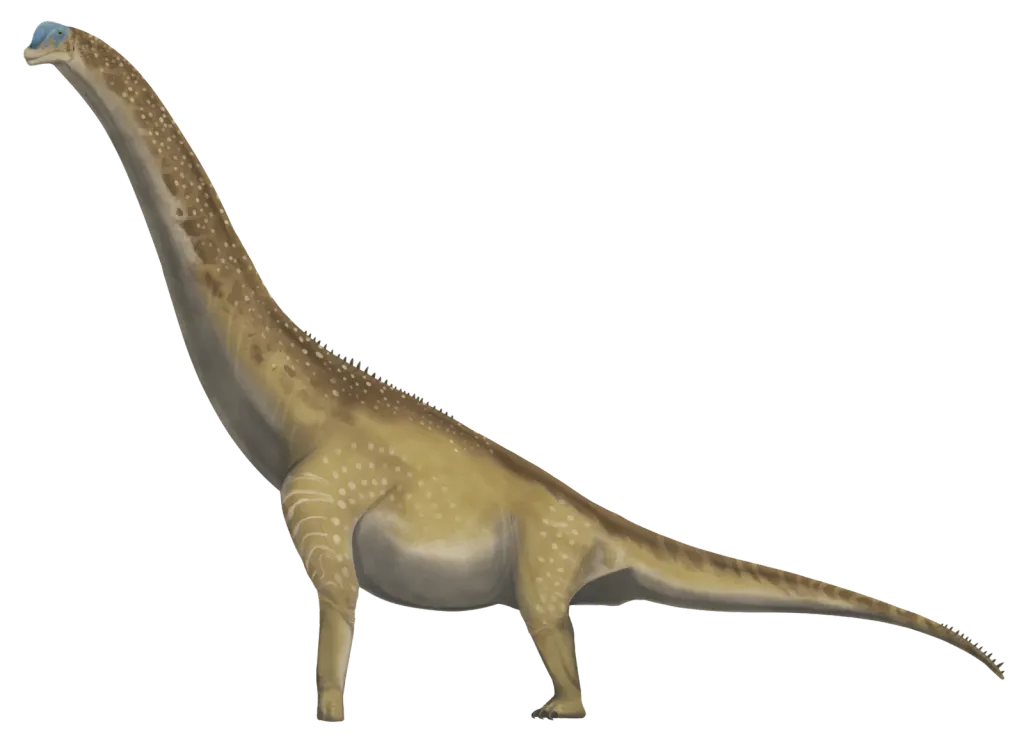
Brachiosaurus altithorax
Pronounced BRAK-ee-oh-SORE-us al-tih-THOR-ax
Macronaria · Brachiosauridae
A giant long-necked sauropod from the Late Jurassic Morrison Formation of Colorado, with forelimbs longer than its hind limbs. The famous mounted skeleton in Berlin belongs to a different genus, Giraffatitan.
- Quadrupedal
- Giant
- Long necked
- Movie icon
- Period
- Jurassic· Kimmeridgian
- Diet
- Herbivore
- Length
- Unknown
- Mass
- 28,700 kg
- Location
- Colorado, United States
Quick answers
- How big was Brachiosaurus altithorax?
- It stood about 3.8–4.4 m tall at the hips. It weighed about 28.7 t. (Taylor 2009; Paul 2016)
- When did Brachiosaurus altithorax live?
- Brachiosaurus altithorax lived during the Late Jurassic, about 154.8–145 million years ago. (Cohen et al. 2023; Taylor 2009)
- Where have Brachiosaurus altithorax fossils been found?
- Fossils of Brachiosaurus altithorax have been found in Morrison Formation (Colorado) and United States. (Riggs 1903; Taylor 2009)
- What did Brachiosaurus altithorax eat?
- Brachiosaurus altithorax was a herbivore. (Riggs 1903; Taylor 2009)
- Who named Brachiosaurus altithorax, and when?
- Brachiosaurus altithorax was described by Elmer S. Riggs in 1903. (Riggs 1903; Taylor 2009)
- Was Brachiosaurus altithorax in Jurassic Park?
- Yes. Brachiosaurus altithorax appears in Jurassic Park (1993), Jurassic Park III (2001), and Jurassic World: Fallen Kingdom (2018). The first dinosaur the visitors see: a gentle giant that rears up on its hind legs to browse and chews its food like a cow. Sauropods did not chew: they cropped plants and swallowed them, leaving digestion to the gut. (Wikipedia: Dinosaurs in Jurassic Park 2026; Taylor 2009)
On this page

- Period
- Jurassic154.8–145 Ma
- Diet
- Herbivore
- Length
- Unknown
- Mass
- 28.7 t
- Location
- United States
- Classification
- Macronaria · Brachiosauridae
- Described
- 1903, Elmer S. Riggs
Overview
Brachiosaurus altithorax lived in western North America in the Late Jurassic. Elmer Riggs of the Field Columbian Museum found the holotype (FMNH P25107) in 1900 near Grand Junction, Colorado, and named it in 1903, calling it "the largest known dinosaur".
It was a macronarian sauropod with front legs longer than its back legs and a long neck held upwards, giving it a sloping back like a giraffe. Its remains in the Morrison Formation are rare: the holotype is still the best specimen, and it lacks the skull and most of the neck.
Much of what is popularly shown as "Brachiosaurus", including the tall skeleton in the Museum für Naturkunde in Berlin, is based on fossils from Tendaguru, Tanzania, once called Brachiosaurus brancai. Taylor (2009) showed that the two differ in many parts of the skeleton and supported moving the African species to its own genus, Giraffatitan. They should not be mixed up when reading sizes.
Name meaning
From Greek brachion ("arm") and sauros ("lizard"), for the long forelimbs; altithorax, from Latin altus ("deep, high") and Greek thorax ("chest"), for its deep chest (Riggs 1903).
Biology & evidence
What scientists think about how this animal lived, and how strong the evidence for each idea is.
Posture
Brachiosaurus had front legs about as long as its hind legs, giving it a back that sloped down to the tail.
Evidence level: Direct evidenceThe upper arm bone of the type specimen is as long as its thigh bone, which is measured directly on the fossil and gave the animal its name ("arm lizard").
Evidence for / against · 1
Evidence for
Specimen · Brachiosaurus humerus as long as its femur
The holotype humerus is about as long as the femur, unlike most sauropods, giving a sloping back.
Specimen: FMNH P25107
Feeding
Brachiosaurus fed high in the trees, like a giraffe.
Evidence level: Moderate evidenceIts long front legs raise the shoulders, which suggests high browsing. How upright the neck was held is still debated, because the neck of B. altithorax itself has not been found.
Evidence for / against · 1
Evidence for
Specimen · Brachiosaurus humerus as long as its femur
The holotype humerus is about as long as the femur, unlike most sauropods, giving a sloping back.
Specimen: FMNH P25107
Other
The African "Brachiosaurus brancai" is a separate genus, Giraffatitan.
Evidence level: Strong evidenceTaylor (2009) found many differences between the American and African skeletons. Most researchers now use Giraffatitan for the Tendaguru animal, including the tall mounted skeleton in Berlin.
Evidence for / against · 1
Evidence for
Comparative anatomy · Brachiosaurus vs Giraffatitan skeleton comparison
Point-by-point comparison of the Brachiosaurus holotype with the Tendaguru material, finding many differences in the back vertebrae, hips and limbs.
Specimen: FMNH P25107
Size
- Length
- Unknown
- Height
- 4 mpublished range 3.8–4.4 m
- Mass
- 28,700 kg
(13.1 ft)
Based on FMNH P25107 (holotype, femur 2.03 m)
Based on FMNH P25107 (holotype), partly reconstructed from Giraffatitan
Length unknown, so no size comparison yet.
Timeline
Periods: Kimmeridgian (154.8–149.2 Ma), Tithonian (149.2–145 Ma), Late Jurassic (161.5–145 Ma)
Ages are the ICS 2023/09 bounds of the Kimmeridgian and Tithonian, the stage(s) the fossils are assigned to; they bracket the record and are not dated first/last appearances. Brachiosaurus material is rare and mostly from the upper Morrison Formation.
Location
Formations
- Morrison Formation · Colorado
Places
- Riggs Quarry 13, near Fruita / Grand Junction, Colorado · Morrison Formation · Colorado · position approximate
- Garden Park, near Cañon City, Colorado · Morrison Formation · Colorado · position approximate
These are the places where fossils have been found, not the full area where the animal lived.
Ecosystem
Lived in: Morrison
156–147 million years ago · floodplain, river system, open woodland, lake
A vast, seasonally dry floodplain crossed by rivers in the western interior of North America in the Late Jurassic, with a wet and a dry season, conifer and fern vegetation along the water and giant sauropods in abundance.
Same ecosystem

Same ecosystem

Same ecosystem

Same ecosystem

Same ecosystem

Same ecosystem

Classification
- cladeDinosauria
- cladeSaurischia
- cladeSauropodomorpha
- cladeSauropoda
- cladeMacronaria
- familyBrachiosauridae
- genusBrachiosaurus
- speciesBrachiosaurus altithorax
Taxonomic status: Valid
Fossil record

| Catalog number | Status | Institution | Found |
|---|---|---|---|
| FMNH P25107 | Holotype | Field Museum of Natural History (FMNH) | 1900 |
| USNM 5730 | Referred specimen | National Museum of Natural History, Smithsonian Institution (USNM) | 1883 |
What has been found
Holotype: FMNH P25107
- Preserved
- Partial
- Reconstructed
- Unknown / not recorded
Holotype: FMNH P25107
Region by region (table)
| Region | State |
|---|---|
| Skull | Unknown / not recorded · Not preserved. |
| Mandible | Unknown / not recorded |
| Teeth | Unknown / not recorded |
| Cervical vertebrae | Unknown / not recorded · Not preserved. |
| Dorsal vertebrae | Preserved |
| Sacrum | Preserved |
| Caudal vertebrae | Partial · Two tail vertebrae. |
| Ribs | Preserved |
| Gastralia | Unknown / not recorded |
| Scapula / shoulder girdle | Partial · Coracoid. |
| Humerus | Preserved |
| Forearm (radius / ulna) | Unknown / not recorded |
| Hand (manus) | Unknown / not recorded |
| Pelvis | Preserved |
| Femur | Preserved |
| Tibia / fibula | Unknown / not recorded |
| Foot (pes) | Unknown / not recorded |
Referred specimen: USNM 5730
Region by region (table)
| Region | State |
|---|---|
| Skull | Partial |
| Mandible | Partial |
| Teeth | Unknown / not recorded |
| Cervical vertebrae | Unknown / not recorded |
| Dorsal vertebrae | Unknown / not recorded |
| Sacrum | Unknown / not recorded |
| Caudal vertebrae | Unknown / not recorded |
| Ribs | Unknown / not recorded |
| Gastralia | Unknown / not recorded |
| Scapula / shoulder girdle | Unknown / not recorded |
| Humerus | Unknown / not recorded |
| Forearm (radius / ulna) | Unknown / not recorded |
| Hand (manus) | Unknown / not recorded |
| Pelvis | Unknown / not recorded |
| Femur | Unknown / not recorded |
| Tibia / fibula | Unknown / not recorded |
| Foot (pes) | Unknown / not recorded |

Discovery
- Year described
- 1903
- Described by
- Elmer S. Riggs
- Type specimen
- FMNH P25107
Discovery timeline
1900 · First material found
Riggs excavates the Brachiosaurus holotype
The Field Columbian Museum expedition led by Riggs digs up the skeleton near Grand Junction, Colorado.
People: Elmer S. Riggs
1903 · Formally described
Riggs names Brachiosaurus altithorax
Riggs names it "the largest known dinosaur".
People: Elmer S. Riggs
2009 · Revision
Taylor separates Brachiosaurus and Giraffatitan
A detailed comparison supports treating the African species as its own genus.
People: Michael P. Taylor
In Jurassic Park & Jurassic World
Films
- Jurassic Park (1993)
- Jurassic Park III (2001)
- Jurassic World: Fallen Kingdom (2018)
On screen
The first dinosaur the visitors see: a gentle giant that rears up on its hind legs to browse and chews its food like a cow.
Film vs fossils
- Sauropods did not chew: they cropped plants and swallowed them, leaving digestion to the gut.
- Rearing on the hind legs is doubtful for Brachiosaurus, whose long forelimbs carried its weight forward.
- The film animal follows the well-known Tanzanian skeletons then called Brachiosaurus brancai, now a separate genus, Giraffatitan; B. altithorax itself is known from far less material.
Film titles are used for identification only. DinoDex is not affiliated with or endorsed by the Jurassic Park / Jurassic World franchise. All dinosaurs seen in the films
Sources
- (2026). Wikipedia: Dinosaurs in Jurassic Park. Wikipedia. https://en.wikipedia.org/wiki/Dinosaurs_in_Jurassic_Park (opens in a new tab)
- Cohen, K. M., Harper, D. A. T., Gibbard, P. L. & Car, N. (2023). International Chronostratigraphic Chart (v2023/09). International Commission on Stratigraphy. https://stratigraphy.org/ICSchart/ChronostratChart2023-09.pdf (opens in a new tab)
- Paul, G. S. (2016). The Princeton Field Guide to Dinosaurs (2nd edition). Princeton University Press.
- Riggs, E. S. (1903). Brachiosaurus altithorax, the largest known dinosaur. American Journal of Science (series 4) 15: 299-306.
- Shay, D. & Duncan, J. (1993). The Making of Jurassic Park. Ballantine Books.
- Taylor, M. P. (2009). A re-evaluation of Brachiosaurus altithorax Riggs 1903 (Dinosauria, Sauropoda) and its generic separation from Giraffatitan brancai (Janensch 1914). Journal of Vertebrate Paleontology 29(3): 787-806. doi:10.1671/039.029.0309 (opens in a new tab)