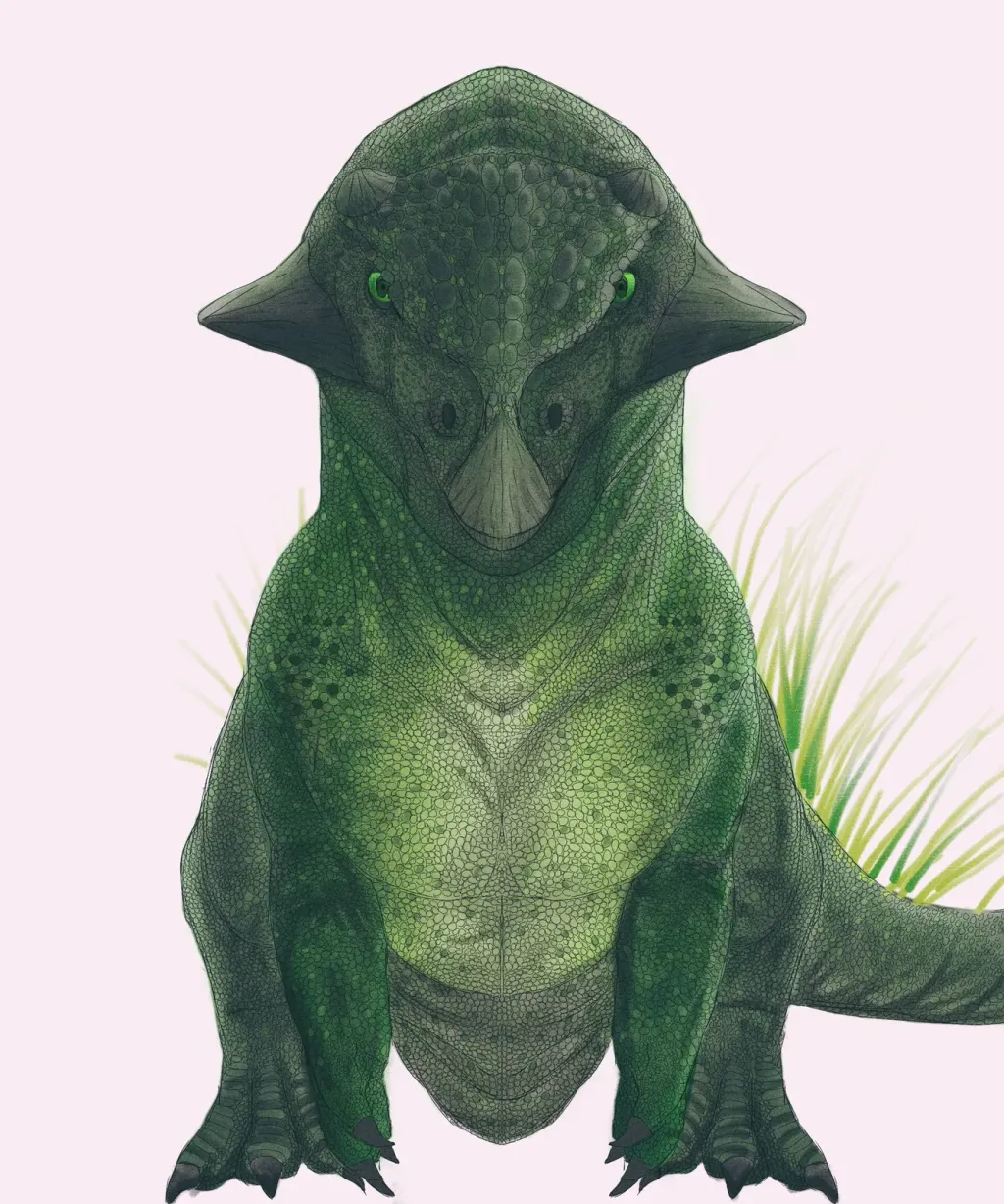
Psittacosaurus mongoliensis
Pronounced SIT-ah-koh-SORE-us mon-goh-lee-EN-sis
Ceratopsia
The "parrot lizard", a small two-legged early horned dinosaur from the Early Cretaceous of Mongolia with a deep, beaked skull. Its genus is known from hundreds of skeletons, and one specimen kept skin, colour and bristles on its tail.
- Bipedal
- Skin impressions known
- Exceptional preservation
- Period
- Cretaceous· Early Cretaceous
- Diet
- Herbivore
- Length
- 2 m
- Mass
- Unknown
- Location
- Övörkhangai Province, Mongolia, Asia
Quick answers
- How big was Psittacosaurus mongoliensis?
- Psittacosaurus mongoliensis was about 2 m long. It stood about 0.5–0.6 m tall at the hips. (Wikipedia: Psittacosaurus 2026; Paul 2016)
- When did Psittacosaurus mongoliensis live?
- Psittacosaurus mongoliensis lived during the Early Cretaceous, about 143.1–100.5 million years ago. (Paleobiology Database: Psittacosaurus mongoli… 2026)
- Where have Psittacosaurus mongoliensis fossils been found?
- Fossils of Psittacosaurus mongoliensis have been found in Öösh Formation (Övörkhangai Province) and Mongolia. (Osborn 1923; Mayr et al. 2002)
- What did Psittacosaurus mongoliensis eat?
- Psittacosaurus mongoliensis was a herbivore. (Osborn 1923; Mayr et al. 2002)
- Who named Psittacosaurus mongoliensis, and when?
- Psittacosaurus mongoliensis was described by Henry Fairfield Osborn in 1923. (Osborn 1923; Paleobiology Database: Psittacosaurus mongoli… 2026)
On this page

- Period
- Cretaceous143.1–100.5 Ma
- Diet
- Herbivore
- Length
- 2 m
- Mass
- Unknown
- Location
- Mongolia, Asia
- Classification
- Ceratopsia
- Described
- 1923, Henry Fairfield Osborn
Overview
Psittacosaurus mongoliensis lived in the Early Cretaceous in what is now Mongolia. During the American Museum's Central Asiatic Expedition of 1922, the expedition's driver, Wong, found a nearly complete skeleton at Red Mesa, Artsa Bogdo, in the Oshih Basin, and Henry Fairfield Osborn named it in 1923 for its parrot-like beak.
It was one of the earliest ceratopsians, a distant relative of Triceratops without horns or a large frill, with a short, deep skull, a strong beak and small bony cheek bosses. Adults walked on two legs, and the largest P. mongoliensis reached about 2 m.
Psittacosaurus is the most species-rich non-avian dinosaur genus and one of the best known, with growth series from hatchlings to adults. A Chinese Psittacosaurus specimen preserves long bristles on the tail (Mayr et al. 2002) and a countershaded skin pattern suggesting it lived in forests (Vinther et al. 2016).
Name meaning
"Parrot lizard", from Greek psittakos and sauros, for its beak; mongoliensis for Mongolia (Osborn 1923).
Biology & evidence
What scientists think about how this animal lived, and how strong the evidence for each idea is.
Locomotion
Adult Psittacosaurus walked on two legs.
Evidence level: Strong evidenceIts short arms could not reach the ground in a walking pose; young individuals may have used all four legs.
Skin & covering
Psittacosaurus was countershaded and lived in forests.
Evidence level: Moderate evidenceIts dark back grading into a light belly matches the camouflage best suited to diffuse light under a canopy. The specimen is an undetermined Chinese species.
Evidence for / against · 1
Evidence for
Skin impression · Psittacosaurus colour pattern (SMF R 4970)
Fossil melanin in the skin of Psittacosaurus sp. SMF R 4970 from the Jehol Biota shows a dark back, a light belly and a gradual transition, tested on a life-size model under different light.
Psittacosaurus had long bristles on its tail.
Evidence level: Direct evidenceThey are preserved on a Chinese Psittacosaurus specimen; whether they are related to the filaments of theropods is not established. Not known for P. mongoliensis itself.
Evidence for / against · 1
Evidence for
Skin impression · Psittacosaurus tail bristles
A Psittacosaurus from the Early Cretaceous of China with well-preserved skin and long, bristle-like structures on the upper part of the tail.

Size
- Length
- 2 m
- Height
- 0.5 mpublished range 0.5–0.6 m
- Mass
- Unknown
(6.6 ft)
(1.6 ft)
Based on adults
Timeline
Periods: Early Cretaceous (145–100.5 Ma)
PBDB bins the type collection only as "Early Cretaceous" (143.1-100.5 Ma); the Oshih locality is usually given as Aptian-Albian (secondary), and the genus as about 125-105 Ma.
Location
Formations
- Öösh Formation · Övörkhangai Province
- Red Mesa, Artsa Bogdo, Oshih Basin (AMNH loc. 11494) · Öösh Formation · Övörkhangai Province · position approximate
These are the places where fossils have been found, not the full area where the animal lived.
Ecosystem
Lived in: Öösh (Oshih Basin)
143.1–100.5 million years ago · other
Early Cretaceous terrestrial beds of the Oshih Basin in central Mongolia; PBDB records the setting only as "terrestrial indet.", and the sources we opened do not describe it further.
Classification
- cladeDinosauria
- cladeOrnithischia
- cladeCeratopsia
- genusPsittacosaurus
- speciesPsittacosaurus mongoliensis
Taxonomic status: Valid
Fossil record

| Catalog number | Status | Institution | Found |
|---|---|---|---|
| AMNH 6254 “Red Mesa skeleton” | Holotype | American Museum of Natural History (AMNH) | 1922 |
What has been found
Holotype: AMNH 6254 “Red Mesa skeleton”
- Preserved
- Partial
- Reconstructed
- Unknown / not recorded
Region by region (table)
| Region | State |
|---|---|
| Skull | Preserved |
| Mandible | Preserved |
| Teeth | Unknown / not recorded |
| Cervical vertebrae | Unknown / not recorded |
| Dorsal vertebrae | Unknown / not recorded |
| Sacrum | Unknown / not recorded |
| Caudal vertebrae | Unknown / not recorded |
| Ribs | Unknown / not recorded |
| Gastralia | Unknown / not recorded |
| Scapula / shoulder girdle | Unknown / not recorded |
| Humerus | Unknown / not recorded |
| Forearm (radius / ulna) | Unknown / not recorded |
| Hand (manus) | Unknown / not recorded |
| Pelvis | Unknown / not recorded |
| Femur | Unknown / not recorded |
| Tibia / fibula | Unknown / not recorded |
| Foot (pes) | Unknown / not recorded |

Discovery
- Year described
- 1923
- Described by
- Henry Fairfield Osborn
- Type specimen
- AMNH 6254
Discovery timeline
1922 · First material found
Red Mesa Psittacosaurus skeleton found
The expedition driver finds a nearly complete skeleton in the Oshih Basin.
People: Wong (expedition driver), Roy Chapman Andrews
1923 · Formally described
Osborn names Psittacosaurus mongoliensis
Named in American Museum Novitates together with Protiguanodon, later found to be the same animal.
People: Henry Fairfield Osborn
2016 · Major study
Psittacosaurus colour pattern reconstructed
Vinther and colleagues reconstruct countershading from fossil melanin.
People: Jakob Vinther, Gerald Mayr
Sources
- (2026). Paleobiology Database: Psittacosaurus mongoliensis type collection 48936. The Paleobiology Database (paleobiodb.org), data service 1.2, accessed 2026-09-23. https://paleobiodb.org/data1.2/colls/list.json?coll_id=48936&show=paleoloc,strat,loc,ref,geo&pgm=gplates&vocab=pbdb (opens in a new tab)
- (2026). Wikipedia: Psittacosaurus. Wikipedia (English), accessed 2026-09-24. https://en.wikipedia.org/wiki/Psittacosaurus (opens in a new tab)
- Mayr, G., Peters, D. S., Plodowski, G. & Vogel, O. (2002). Bristle-like integumentary structures at the tail of the horned dinosaur Psittacosaurus. Naturwissenschaften 89: 361-365. doi:10.1007/s00114-002-0339-6 (opens in a new tab)
- Osborn, H. F. (1923). Two Lower Cretaceous dinosaurs of Mongolia. American Museum Novitates 95: 1-10.
- Paul, G. S. (2016). The Princeton Field Guide to Dinosaurs (2nd edition). Princeton University Press.
- Vinther, J., Nicholls, R., Lautenschlager, S., Pittman, M., Kaye, T. G., Rayfield, E., Mayr, G. & Cuthill, I. C. (2016). 3D camouflage in an ornithischian dinosaur. Current Biology 26: 2456-2462. doi:10.1016/j.cub.2016.06.065 (opens in a new tab)