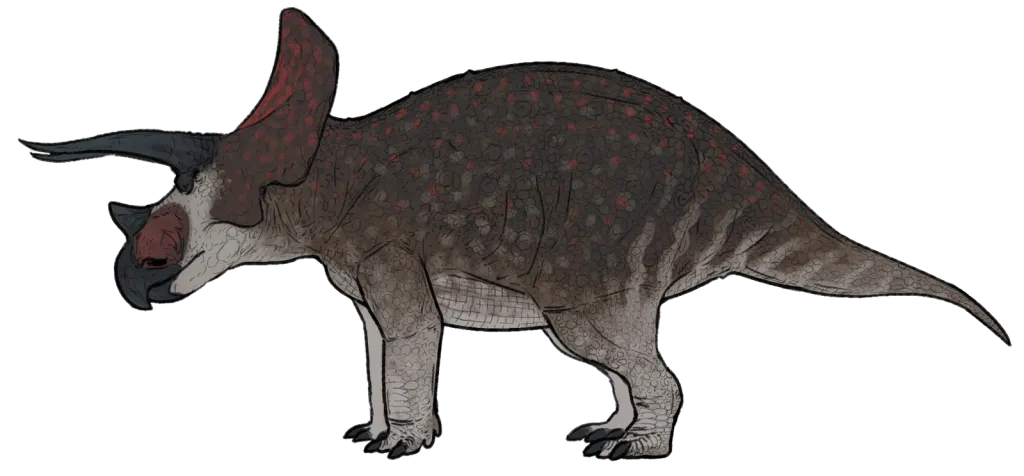
Triceratops horridus
Pronounced try-SER-ah-tops HOR-ih-dus
Ceratopsia · Ceratopsidae
A large three-horned chasmosaurine ceratopsid from the very end of the Cretaceous of western North America, living alongside Tyrannosaurus rex in the Hell Creek and Lance formations.
- Horned
- Quadrupedal
- Giant
- Skin impressions known
- Movie icon
- Period
- Cretaceous· Maastrichtian
- Diet
- Herbivore
- Length
- 8–9 m
- Mass
- 6,000–10,000 kg
- Location
- Montana, Wyoming, South Dakota, North Dakota
Quick answers
- How big was Triceratops horridus?
- Triceratops horridus was about 8–9 m long. It stood about 2.4–3 m tall at the hips. It weighed about 6–10 t. (Paul 2010; Paul 2016)
- When did Triceratops horridus live?
- Triceratops horridus lived during the Late Cretaceous, about 68–66 million years ago. (Cohen et al. 2023; Fowler 2017)
- Where have Triceratops horridus fossils been found?
- Fossils of Triceratops horridus have been found in Hell Creek Formation (Montana), Lance Formation (Wyoming), South Dakota, and North Dakota. (Marsh 1889; Paul 2010)
- What did Triceratops horridus eat?
- Triceratops horridus was a herbivore. (Marsh 1889; Paul 2010)
- Who named Triceratops horridus, and when?
- Triceratops horridus was described by Othniel Charles Marsh in 1889. (Marsh 1889)
- Was Triceratops horridus in Jurassic Park?
- Yes. Triceratops horridus appears in Jurassic Park (1993), The Lost World: Jurassic Park (1997), Jurassic Park III (2001), Jurassic World (2015), Jurassic World: Fallen Kingdom (2018), and Jurassic World Dominion (2022). A sick Triceratops is the park's gentle patient in the first film; later films show it in herds and in fights. The anatomy is broadly faithful. Healed horn wounds on skulls suggest Triceratops really did lock horns with each other. (Wikipedia: Dinosaurs in Jurassic Park 2026; Farke et al. 2009)
On this page

try-SER-ah-tops HOR-ih-dus
- Period
- Cretaceous68–66 Ma
- Diet
- Herbivore
- Length
- 8–9 m
- Mass
- 6–10 t
- Classification
- Ceratopsia · Ceratopsidae
- Described
- 1889, Othniel Charles Marsh
Overview
Triceratops horridus lived in western North America during the Maastrichtian, the last age of the Cretaceous. O. C. Marsh first described it in 1889 as Ceratops horridus from a skull (YPM 1820) collected by John Bell Hatcher in the Lance Formation of Wyoming, and moved it to the new genus Triceratops later that year.
It was a heavy, four-legged plant eater with a short nose horn, two long brow horns and a solid bony frill. Its fossils are among the most common dinosaur remains in the Hell Creek and Lance formations, where it shared its world with Tyrannosaurus rex.
Complete skeletons are rare, so body size is less certain than the many skulls suggest. The figures below are given as ranges with their source.
Name meaning
From Greek tri- ("three"), keras ("horn") and ops ("face"): "three-horned face"; Latin horridus means "rough" or "bristling" (Marsh 1889).
Biology & evidence
What scientists think about how this animal lived, and how strong the evidence for each idea is.
Skin & covering
Triceratops was covered in large, non-overlapping scales.
Evidence level: Moderate evidenceA nearly complete Triceratops in Houston preserves skin with large polygonal scales. The skin has been shown and discussed but not yet fully published, so the details may change.
Evidence for / against · 1
Evidence for
Skin impression · Triceratops skin impression (Lane specimen)
Large patches of skin with big polygonal scales, some with a central bump, from a nearly complete Triceratops in Houston.
Growth
Torosaurus is the fully adult form of Triceratops.
Evidence level: DisputedScannella and Horner argued that the frill of Triceratops opened up with age until it looked like Torosaurus. Others found immature Torosaurus and no clear transitional skulls. Most researchers still keep them as separate genera.
Evidence for / against · 2
Evidence for
Specimen · Triceratops skull growth series
A series of skulls from juvenile to large adult showing the frill thinning, lengthening and opening holes with age.
Evidence against
Comparative anatomy · Torosaurus specimens with mature bone but no Triceratops transition
Torosaurus specimens that are not fully mature and lack the transitional features predicted if they were old Triceratops.
Behavior
Triceratops used its horns to fight other Triceratops.
Evidence level: Moderate evidenceMany Triceratops skulls carry healed wounds on the frill and cheeks that fit the horns of another Triceratops, much more often than in related horned dinosaurs. This points to horn-locking fights, like those of modern antelope.
Evidence for / against · 1
Evidence for
Specimen · Healed horn and frill lesions in Triceratops
Healed wounds on squamosals (frill bones) of Triceratops are far more frequent than in Centrosaurus and match the shape of Triceratops horn tips.

Size
- Length
- 8–9 m
- Height
- 2.7 mpublished range 2.4–3 m
- Mass
- 6,000–10,000 kg
(29.5 ft)
(8.9 ft)
Based on composite mounts (e.g. USNM 4842 "Hatcher")
Timeline
Periods: Maastrichtian (72.1–66 Ma), Late Cretaceous (100.5–66 Ma)
endAgeMa 66.0 = end of the Maastrichtian (ICS 2023/09). startAgeMa left empty: no primary source verified for the first appearance.
Location
Formations
- Hell Creek Formation · Montana
- Lance Formation · Wyoming
- Lance Formation outcrops, Niobrara County, Wyoming · Lance Formation · Wyoming · position approximate
These are the places where fossils have been found, not the full area where the animal lived.
Ecosystem
Lived in: Hell Creek
68–66 million years ago · floodplain, river system, forest, coastal plain
Warm, humid coastal lowlands and river floodplains west of the retreating Western Interior Seaway at the very end of the Cretaceous, with forests of conifers and flowering plants. The ecosystem ends at the Cretaceous-Paleogene extinction.


Classification
- cladeDinosauria
- cladeOrnithischia
- cladeCeratopsia
- familyCeratopsidae
- subfamilyChasmosaurinae
- genusTriceratops
- speciesTriceratops horridus
Taxonomic status: Valid
Fossil record

| Catalog number | Status | Institution | Found |
|---|---|---|---|
| YPM 1820 | Holotype | Yale Peabody Museum (YPM) | 1888 |
| USNM 4842 “Hatcher” | Referred specimen | National Museum of Natural History, Smithsonian Institution (USNM) | — |
What has been found
Holotype: YPM 1820
- Preserved
- Partial
- Reconstructed
- Unknown / not recorded
Holotype: YPM 1820
Region by region (table)
| Region | State |
|---|---|
| Skull | Partial · Horn cores and partial skull. |
| Mandible | Unknown / not recorded |
| Teeth | Unknown / not recorded |
| Cervical vertebrae | Unknown / not recorded |
| Dorsal vertebrae | Unknown / not recorded |
| Sacrum | Unknown / not recorded |
| Caudal vertebrae | Unknown / not recorded |
| Ribs | Unknown / not recorded |
| Gastralia | Unknown / not recorded |
| Scapula / shoulder girdle | Unknown / not recorded |
| Humerus | Unknown / not recorded |
| Forearm (radius / ulna) | Unknown / not recorded |
| Hand (manus) | Unknown / not recorded |
| Pelvis | Unknown / not recorded |
| Femur | Unknown / not recorded |
| Tibia / fibula | Unknown / not recorded |
| Foot (pes) | Unknown / not recorded |
Referred specimen: USNM 4842 “Hatcher”
Region by region (table)
| Region | State |
|---|---|
| Skull | Reconstructed |
| Mandible | Unknown / not recorded |
| Teeth | Unknown / not recorded |
| Cervical vertebrae | Unknown / not recorded |
| Dorsal vertebrae | Partial |
| Sacrum | Unknown / not recorded |
| Caudal vertebrae | Unknown / not recorded |
| Ribs | Unknown / not recorded |
| Gastralia | Unknown / not recorded |
| Scapula / shoulder girdle | Unknown / not recorded |
| Humerus | Unknown / not recorded |
| Forearm (radius / ulna) | Unknown / not recorded |
| Hand (manus) | Unknown / not recorded |
| Pelvis | Partial |
| Femur | Preserved |
| Tibia / fibula | Unknown / not recorded |
| Foot (pes) | Unknown / not recorded |

Discovery
- Year described
- 1889
- Described by
- Othniel Charles Marsh
- Type specimen
- YPM 1820 (holotype of Ceratops horridus)

Discovery timeline
1887 · First material found
Horn cores found near Denver named Bison alticornis
Marsh first mistakes a pair of horn cores from Colorado for those of a giant bison; they were later recognised as Triceratops.
People: Othniel Charles Marsh
1889 · Formally described
Marsh names Ceratops horridus, then Triceratops
Marsh names Ceratops horridus from Hatcher's skull and, later in 1889, the new genus Triceratops.
People: Othniel Charles Marsh, John Bell Hatcher
2010 · Revision
Torosaurus proposed as adult Triceratops
Scannella and Horner propose that Torosaurus is the mature form of Triceratops; the idea is contested.
In Jurassic Park & Jurassic World
Films
- Jurassic Park (1993)
- The Lost World: Jurassic Park (1997)
- Jurassic Park III (2001)
- Jurassic World (2015)
- Jurassic World: Fallen Kingdom (2018)
- Jurassic World Dominion (2022)
On screen
A sick Triceratops is the park's gentle patient in the first film; later films show it in herds and in fights.
Film vs fossils
- The anatomy is broadly faithful. Healed horn wounds on skulls suggest Triceratops really did lock horns with each other.
Film titles are used for identification only. DinoDex is not affiliated with or endorsed by the Jurassic Park / Jurassic World franchise. All dinosaurs seen in the films
Sources
- (2026). Wikipedia: Dinosaurs in Jurassic Park. Wikipedia. https://en.wikipedia.org/wiki/Dinosaurs_in_Jurassic_Park (opens in a new tab)
- Cohen, K. M., Harper, D. A. T., Gibbard, P. L. & Car, N. (2023). International Chronostratigraphic Chart (v2023/09). International Commission on Stratigraphy. https://stratigraphy.org/ICSchart/ChronostratChart2023-09.pdf (opens in a new tab)
- Farke, A. A., Wolff, E. D. S. & Tanke, D. H. (2009). Evidence of combat in Triceratops. PLoS ONE 4(1): e4252. doi:10.1371/journal.pone.0004252 (opens in a new tab)
- Fowler, D. W. (2017). Revised geochronology, correlation, and dinosaur stratigraphic ranges of the Santonian-Maastrichtian (Late Cretaceous) formations of the Western Interior of North America. PLoS ONE 12(11): e0188426. doi:10.1371/journal.pone.0188426 (opens in a new tab)
- Marsh, O. C. (1889). Notice of gigantic horned Dinosauria from the Cretaceous. American Journal of Science (series 3) 38: 173-175.
- Paul, G. S. (2010). The Princeton Field Guide to Dinosaurs. Princeton University Press.
- Paul, G. S. (2016). The Princeton Field Guide to Dinosaurs (2nd edition). Princeton University Press.
- Shay, D. & Duncan, J. (1993). The Making of Jurassic Park. Ballantine Books.