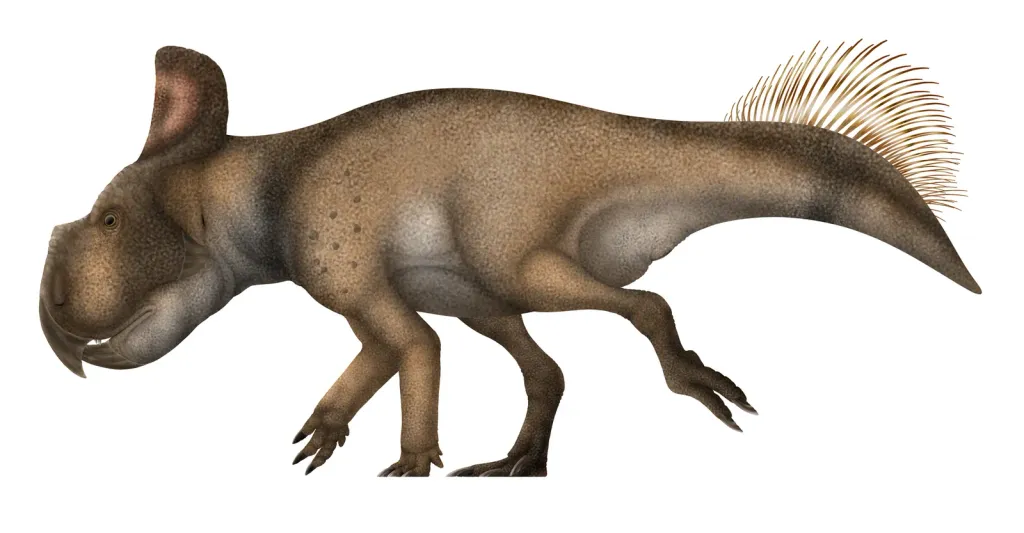
Protoceratops andrewsi
Pronounced PRO-toh-SERR-ah-tops AN-droo-zye
Ceratopsia · Protoceratopsidae
A sheep-sized horned dinosaur with a large frill and a parrot-like beak from the Late Cretaceous Gobi Desert of Mongolia. Hundreds of skeletons are known, including one locked in combat with a Velociraptor.
- Quadrupedal
- Eggs known
- Famous specimen
- Period
- Cretaceous· Campanian
- Diet
- Herbivore
- Length
- 2–2.5 m
- Mass
- 62–104 kg
- Location
- Ömnögovi Province, Mongolia, Asia
Quick answers
- How big was Protoceratops andrewsi?
- Protoceratops andrewsi was about 2–2.5 m long. It stood about 0.6–0.8 m tall at the hips. It weighed about 62–104 kg. (Wikipedia: Protoceratops 2026; Paul 2016)
- When did Protoceratops andrewsi live?
- Protoceratops andrewsi lived during the Late Cretaceous, about 75–71 million years ago. (Paleobiology Database: Protoceratops andrewsi… 2026; Dashzeveg et al. 2005)
- Where have Protoceratops andrewsi fossils been found?
- Fossils of Protoceratops andrewsi have been found in Djadokhta Formation (Ömnögovi Province) and Mongolia. (Granger & Gregory 1923; Hone et al. 2016)
- What did Protoceratops andrewsi eat?
- Protoceratops andrewsi was a herbivore. (Granger & Gregory 1923; Hone et al. 2016)
- Who named Protoceratops andrewsi, and when?
- Protoceratops andrewsi was described by Walter Granger & William K. Gregory in 1923. (Granger & Gregory 1923; Paleobiology Database: Protoceratops andrewsi… 2026)
On this page

PRO-toh-SERR-ah-tops AN-droo-zye
- Period
- Cretaceous75–71 Ma
- Diet
- Herbivore
- Length
- 2–2.5 m
- Mass
- 0.1–0.1 t
- Location
- Mongolia, Asia
- Classification
- Ceratopsia · Protoceratopsidae
- Described
- 1923, Walter Granger & William K. Gregory
Overview
Protoceratops andrewsi lived among the sand dunes of the Djadokhta Formation in what is now the Gobi Desert of Mongolia, in the Late Cretaceous. The photographer James B. Shackelford of the American Museum's Central Asiatic Expedition found the first skull at the Flaming Cliffs (Shabarakh Usu) in 1922, and Walter Granger and William K. Gregory named it in 1923 after the expedition leader Roy Chapman Andrews.
It was an early relative of the large horned dinosaurs, about 2 m long, with a big head, a bony frill and a small bump in place of a nose horn. The frill and nasal bump grew faster than the rest of the body as the animal matured, which suggests they were used as social or sexual signals (Hone et al. 2016).
Protoceratops is one of the best known dinosaurs, with many skeletons from hatchlings to adults. Its eggs were originally soft-shelled (Norell et al. 2020), and the famous "Fighting Dinosaurs" specimen preserves one locked in combat with Velociraptor.
Name meaning
"First horned face", from Greek protos, keras and ops; andrewsi after Roy Chapman Andrews, leader of the Central Asiatic Expeditions (Granger & Gregory 1923).
Biology & evidence
What scientists think about how this animal lived, and how strong the evidence for each idea is.
Eggs
Protoceratops laid soft-shelled eggs.
Evidence level: Strong evidenceThe eggshells were originally organic, not mineralised, and resemble the soft eggshells of some turtles.
Evidence for / against · 1
Evidence for
Specimen · Protoceratops eggshell chemistry and histology
Raman spectra and histology of exceptionally preserved Protoceratops eggs cluster them with soft, non-mineralised eggshells.
Behavior
The frill of Protoceratops was a social or sexual signal.
Evidence level: HypothesisStructures that grow disproportionately as an animal matures are typical of signals; other uses, such as anchoring jaw muscles, are not ruled out.
Evidence for / against · 1
Evidence for
Comparative anatomy · Protoceratops frill and nasal allometry
Frill and nasal boss grow faster than the rest of the skull through growth (positive allometry).
Other
Protoceratops was prey of Velociraptor.
Evidence level: Direct evidenceThe Fighting Dinosaurs show the two in combat, and Velociraptor tooth marks on Protoceratops bones show feeding.
Evidence for / against · 1
Evidence for
Specimen · Fighting Dinosaurs specimen
A Velociraptor and a Protoceratops buried in the middle of a fight; the raptor's sickle claw is at the neck of its prey, whose jaws grip the raptor's arm.
Specimen: MPC-D 100/25 “Fighting Dinosaurs”
Size
- Length
- 2–2.5 m
- Height
- 0.7 mpublished range 0.6–0.8 m
- Mass
- 62–104 kg
(8.2 ft)
(2.3 ft)
Based on adults
Timeline
Periods: Campanian (83.6–72.1 Ma), Late Cretaceous (100.5–66 Ma)
Djadokhta Formation, about 75-71 Ma: magnetostratigraphy suggests, without clearly establishing, deposition during the late Campanian polarity changes (Dashzeveg et al. 2005). PBDB bins the type collection in the whole late Campanian (83.6-72.2 Ma).
Location
Formations
- Djadokhta Formation · Ömnögovi Province
- Shabarakh Usu (Flaming Cliffs, Bayn Dzak), AMNH loc. 12049 · Djadokhta Formation · Ömnögovi Province · position approximate
These are the places where fossils have been found, not the full area where the animal lived.
Ecosystem

Lived in: Djadokhta
75–71 million years ago · desert / dunes, other
An arid landscape of sand dunes and interdune areas in the Late Cretaceous Gobi, with occasional water. Sandslides and dune collapses buried animals alive, preserving articulated skeletons and nests.
Same ecosystem

Same ecosystem

Classification
- cladeDinosauria
- cladeOrnithischia
- cladeCeratopsia
- familyProtoceratopsidae
- genusProtoceratops
- speciesProtoceratops andrewsi
Taxonomic status: Valid
Fossil record

| Catalog number | Status | Institution | Found |
|---|---|---|---|
| AMNH 6251 | Holotype | American Museum of Natural History (AMNH) | 1922 |
What has been found
Holotype: AMNH 6251
- Preserved
- Partial
- Reconstructed
- Unknown / not recorded
Region by region (table)
| Region | State |
|---|---|
| Skull | Partial |
| Mandible | Unknown / not recorded |
| Teeth | Unknown / not recorded |
| Cervical vertebrae | Unknown / not recorded |
| Dorsal vertebrae | Unknown / not recorded |
| Sacrum | Unknown / not recorded |
| Caudal vertebrae | Unknown / not recorded |
| Ribs | Unknown / not recorded |
| Gastralia | Unknown / not recorded |
| Scapula / shoulder girdle | Unknown / not recorded |
| Humerus | Unknown / not recorded |
| Forearm (radius / ulna) | Unknown / not recorded |
| Hand (manus) | Unknown / not recorded |
| Pelvis | Unknown / not recorded |
| Femur | Unknown / not recorded |
| Tibia / fibula | Unknown / not recorded |
| Foot (pes) | Unknown / not recorded |
Discovery
- Year described
- 1923
- Described by
- Walter Granger & William K. Gregory
- Type specimen
- AMNH 6251
Discovery timeline
1922 · First material found
Shackelford finds the first Protoceratops skull
The expedition photographer spots a small skull at the Flaming Cliffs.
People: James B. Shackelford, Roy Chapman Andrews
1923 · Formally described
Granger and Gregory name Protoceratops andrewsi
Named as a "pre-ceratopsian" in American Museum Novitates.
People: Walter Granger, William K. Gregory
2020 · Major study
Protoceratops eggs shown to be soft-shelled
Norell and colleagues show the first dinosaur eggs were soft.
People: Mark A. Norell
Sources
- (2026). Paleobiology Database: Protoceratops andrewsi occurrences and type collection 46152. The Paleobiology Database (paleobiodb.org), data service 1.2, accessed 2026-09-23. https://paleobiodb.org/data1.2/occs/list.txt?taxon_name=Protoceratops%20andrewsi&show=coords,paleoloc,strat,loc,ref&pgm=gplates (opens in a new tab)
- (2026). Wikipedia: Protoceratops. Wikipedia (English), accessed 2026-09-24. https://en.wikipedia.org/wiki/Protoceratops (opens in a new tab)
- Dashzeveg, D., Dingus, L., Loope, D. B., Swisher, C. C., III, Dulam, T. & Sweeney, M. R. (2005). New stratigraphic subdivision, depositional environment, and age estimate for the Upper Cretaceous Djadokhta Formation, southern Ulan Nur Basin, Mongolia. American Museum Novitates 3498: 1-31. https://digitallibrary.amnh.org/server/api/core/bitstreams/0df4baac-12e4-44ae-8ef7-3328b22e8604/content (opens in a new tab)
- Granger, W. & Gregory, W. K. (1923). Protoceratops andrewsi, a pre-ceratopsian dinosaur from Mongolia, with an appendix on the structural relationships of the Protoceratops beds. American Museum Novitates 72: 1-9.
- Hone, D. W. E., Wood, D. & Knell, R. J. (2016). Positive allometry for exaggerated structures in the ceratopsian dinosaur Protoceratops andrewsi supports socio-sexual signaling. Palaeontologia Electronica 19.1.5A. doi:10.26879/591 (opens in a new tab)
- Norell, M. A., Wiemann, J., Fabbri, M., Yu, C., Marsicano, C. A., Moore-Nall, A., Varricchio, D. J., Pol, D. & Zelenitsky, D. K. (2020). The first dinosaur egg was soft. Nature 583: 406-410. doi:10.1038/s41586-020-2412-8 (opens in a new tab)
- Paul, G. S. (2016). The Princeton Field Guide to Dinosaurs (2nd edition). Princeton University Press.