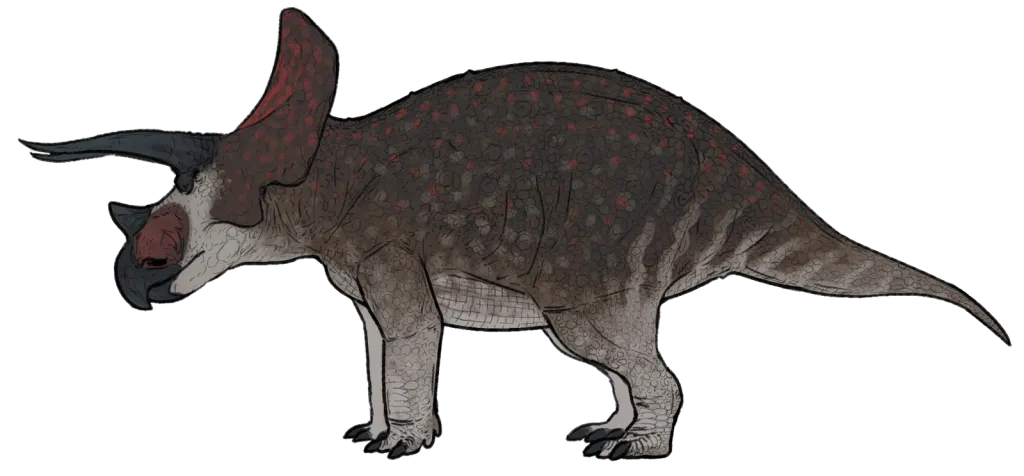
Triceratops horridus
発音: try-SER-ah-tops HOR-ih-dus
Ceratopsia · Ceratopsidae
A large three-horned chasmosaurine ceratopsid from the very end of the Cretaceous of western North America, living alongside Tyrannosaurus rex in the Hell Creek and Lance formations.
- Horned
- Quadrupedal
- Giant
- Skin impressions known
- Movie icon
- 時代
- 白亜紀· マーストリヒチアン期
- 食性
- 植物食
- 全長
- 8–9 m
- 体重
- 6,000–10,000 kg
- 産地
- Montana, Wyoming, South Dakota, North Dakota
クイックアンサー
- Triceratops horridusの大きさは?
- Triceratops horridusの全長は約8–9 mでした。腰の高さは約2.4–3 mでした。体重は約6–10 tでした。 (Paul 2010; Paul 2016)
- Triceratops horridusはいつ生きていた?
- Triceratops horridusは白亜紀後期、約6800万〜6600万年前に生きていました。 (Cohen et al. 2023; Fowler 2017)
- Triceratops horridusの化石はどこで見つかった?
- Triceratops horridusの化石はHell Creek Formation (Montana)、Lance Formation (Wyoming)、South Dakota、North Dakotaで見つかっています。 (Marsh 1889; Paul 2010)
- Triceratops horridusは何を食べていた?
- Triceratops horridusは植物食でした。 (Marsh 1889; Paul 2010)
- Triceratops horridusは誰がいつ命名した?
- Triceratops horridusは1889年にOthniel Charles Marshによって記載されました。 (Marsh 1889)
- Triceratops horridusは『ジュラシック・パーク』に登場しますか?
- はい。Triceratops horridusは『ジュラシック・パーク』 (1993)、『ロスト・ワールド/ジュラシック・パーク』 (1997)、『ジュラシック・パークIII』 (2001)、『ジュラシック・ワールド』 (2015)、『ジュラシック・ワールド/炎の王国』 (2018)、『ジュラシック・ワールド/新たなる支配者』 (2022)に登場します。映画には脚色があります。このページでは化石からわかることと比べています。 (Wikipedia: Dinosaurs in Jurassic Park 2026; Farke et al. 2009)
このページの内容

try-SER-ah-tops HOR-ih-dus
- 時代
- 白亜紀68–66 Ma
- 食性
- 植物食
- 全長
- 8–9 m
- 体重
- 6–10 t
- 分類
- Ceratopsia · Ceratopsidae
- 記載
- 1889, Othniel Charles Marsh
概要
このコンテンツは英語でご覧いただけます。
Triceratops horridus lived in western North America during the Maastrichtian, the last age of the Cretaceous. O. C. Marsh first described it in 1889 as Ceratops horridus from a skull (YPM 1820) collected by John Bell Hatcher in the Lance Formation of Wyoming, and moved it to the new genus Triceratops later that year.
It was a heavy, four-legged plant eater with a short nose horn, two long brow horns and a solid bony frill. Its fossils are among the most common dinosaur remains in the Hell Creek and Lance formations, where it shared its world with Tyrannosaurus rex.
Complete skeletons are rare, so body size is less certain than the many skulls suggest. The figures below are given as ranges with their source.
名前の意味
From Greek tri- ("three"), keras ("horn") and ops ("face"): "three-horned face"; Latin horridus means "rough" or "bristling" (Marsh 1889).
生態と証拠
この動物がどのように暮らしていたかについての科学者の考えと、それぞれの説を支える証拠の強さです。
皮膚と体表
Triceratops was covered in large, non-overlapping scales.
証拠レベル:中程度の証拠A nearly complete Triceratops in Houston preserves skin with large polygonal scales. The skin has been shown and discussed but not yet fully published, so the details may change.
賛成・反対の証拠 · 1
支持する証拠
皮膚印象 · Triceratops skin impression (Lane specimen)
Large patches of skin with big polygonal scales, some with a central bump, from a nearly complete Triceratops in Houston.
成長
Torosaurus is the fully adult form of Triceratops.
証拠レベル:議論ありScannella and Horner argued that the frill of Triceratops opened up with age until it looked like Torosaurus. Others found immature Torosaurus and no clear transitional skulls. Most researchers still keep them as separate genera.
賛成・反対の証拠 · 2
支持する証拠
標本 · Triceratops skull growth series
A series of skulls from juvenile to large adult showing the frill thinning, lengthening and opening holes with age.
反する証拠
比較解剖学 · Torosaurus specimens with mature bone but no Triceratops transition
Torosaurus specimens that are not fully mature and lack the transitional features predicted if they were old Triceratops.
行動
Triceratops used its horns to fight other Triceratops.
証拠レベル:中程度の証拠Many Triceratops skulls carry healed wounds on the frill and cheeks that fit the horns of another Triceratops, much more often than in related horned dinosaurs. This points to horn-locking fights, like those of modern antelope.
賛成・反対の証拠 · 1
支持する証拠
標本 · Healed horn and frill lesions in Triceratops
Healed wounds on squamosals (frill bones) of Triceratops are far more frequent than in Centrosaurus and match the shape of Triceratops horn tips.

サイズ
- 全長
- 8–9 m
- 体高
- 2.7 m文献上の範囲 2.4–3 m
- 体重
- 6,000–10,000 kg
(29.5 フィート)
(8.9 フィート)
composite mounts (e.g. USNM 4842 "Hatcher") に基づく
タイムライン
時代: マーストリヒチアン期 (72.1–66 Ma), 白亜紀後期 (100.5–66 Ma)
endAgeMa 66.0 = end of the Maastrichtian (ICS 2023/09). startAgeMa left empty: no primary source verified for the first appearance.
産地
累層
- Hell Creek Formation · Montana
- Lance Formation · Wyoming
- Lance Formation outcrops, Niobrara County, Wyoming · Lance Formation · Wyoming · 位置はおおよそ
これは化石が見つかった場所で、この動物が暮らしていた範囲全体ではありません。
生態系
生息環境: Hell Creek
68–66 百万年前 · 氾濫原, 河川系, 森林, 海岸平野
Warm, humid coastal lowlands and river floodplains west of the retreating Western Interior Seaway at the very end of the Cretaceous, with forests of conifers and flowering plants. The ecosystem ends at the Cretaceous-Paleogene extinction.


分類
- クレードDinosauria
- クレードOrnithischia
- クレードCeratopsia
- 科Ceratopsidae
- 亜科Chasmosaurinae
- 属Triceratops
- 種Triceratops horridus
分類上の地位: 有効
化石記録

| 標本番号 | 種別 | 所蔵機関 | 発見 |
|---|---|---|---|
| YPM 1820 | ホロタイプ | Yale Peabody Museum (YPM) | 1888 |
| USNM 4842 “Hatcher” | 参照標本 | National Museum of Natural History, Smithsonian Institution (USNM) | — |
見つかった部位
ホロタイプ: YPM 1820
- 保存
- 部分的
- 復元
- 不明・未記録
ホロタイプ: YPM 1820
部位ごと(表)
| 部位 | 状態 |
|---|---|
| Skull | 部分的 · Horn cores and partial skull. |
| Mandible | 不明・未記録 |
| Teeth | 不明・未記録 |
| Cervical vertebrae | 不明・未記録 |
| Dorsal vertebrae | 不明・未記録 |
| Sacrum | 不明・未記録 |
| Caudal vertebrae | 不明・未記録 |
| Ribs | 不明・未記録 |
| Gastralia | 不明・未記録 |
| Scapula / shoulder girdle | 不明・未記録 |
| Humerus | 不明・未記録 |
| Forearm (radius / ulna) | 不明・未記録 |
| Hand (manus) | 不明・未記録 |
| Pelvis | 不明・未記録 |
| Femur | 不明・未記録 |
| Tibia / fibula | 不明・未記録 |
| Foot (pes) | 不明・未記録 |
参照標本: USNM 4842 “Hatcher”
部位ごと(表)
| 部位 | 状態 |
|---|---|
| Skull | 復元 |
| Mandible | 不明・未記録 |
| Teeth | 不明・未記録 |
| Cervical vertebrae | 不明・未記録 |
| Dorsal vertebrae | 部分的 |
| Sacrum | 不明・未記録 |
| Caudal vertebrae | 不明・未記録 |
| Ribs | 不明・未記録 |
| Gastralia | 不明・未記録 |
| Scapula / shoulder girdle | 不明・未記録 |
| Humerus | 不明・未記録 |
| Forearm (radius / ulna) | 不明・未記録 |
| Hand (manus) | 不明・未記録 |
| Pelvis | 部分的 |
| Femur | 保存 |
| Tibia / fibula | 不明・未記録 |
| Foot (pes) | 不明・未記録 |

発見
- 記載年
- 1889
- 記載者
- Othniel Charles Marsh
- タイプ標本
- YPM 1820 (holotype of Ceratops horridus)

発見の年表
1887 · 最初の化石の発見
Horn cores found near Denver named Bison alticornis
Marsh first mistakes a pair of horn cores from Colorado for those of a giant bison; they were later recognised as Triceratops.
人物:Othniel Charles Marsh
1889 · 正式に記載
Marsh names Ceratops horridus, then Triceratops
Marsh names Ceratops horridus from Hatcher's skull and, later in 1889, the new genus Triceratops.
人物:Othniel Charles Marsh, John Bell Hatcher
2010 · 再検討
Torosaurus proposed as adult Triceratops
Scannella and Horner propose that Torosaurus is the mature form of Triceratops; the idea is contested.
『ジュラシック・パーク』『ジュラシック・ワールド』での登場
映画
- ジュラシック・パーク (1993)
- ロスト・ワールド/ジュラシック・パーク (1997)
- ジュラシック・パークIII (2001)
- ジュラシック・ワールド (2015)
- ジュラシック・ワールド/炎の王国 (2018)
- ジュラシック・ワールド/新たなる支配者 (2022)
このコンテンツは英語でご覧いただけます。
映画での描かれ方
A sick Triceratops is the park's gentle patient in the first film; later films show it in herds and in fights.
映画と化石の違い
- The anatomy is broadly faithful. Healed horn wounds on skulls suggest Triceratops really did lock horns with each other.
映画のタイトルは作品の特定のためにのみ記載しています。DinoDex は『ジュラシック・パーク』/『ジュラシック・ワールド』シリーズとは無関係であり、その承認を受けていません。 映画に登場する恐竜をすべて見る
出典
- (2026). Wikipedia: Dinosaurs in Jurassic Park. Wikipedia. https://en.wikipedia.org/wiki/Dinosaurs_in_Jurassic_Park(新しいタブで開きます)
- Cohen, K. M., Harper, D. A. T., Gibbard, P. L. & Car, N. (2023). International Chronostratigraphic Chart (v2023/09). International Commission on Stratigraphy. https://stratigraphy.org/ICSchart/ChronostratChart2023-09.pdf(新しいタブで開きます)
- Farke, A. A., Wolff, E. D. S. & Tanke, D. H. (2009). Evidence of combat in Triceratops. PLoS ONE 4(1): e4252. doi:10.1371/journal.pone.0004252(新しいタブで開きます)
- Fowler, D. W. (2017). Revised geochronology, correlation, and dinosaur stratigraphic ranges of the Santonian-Maastrichtian (Late Cretaceous) formations of the Western Interior of North America. PLoS ONE 12(11): e0188426. doi:10.1371/journal.pone.0188426(新しいタブで開きます)
- Marsh, O. C. (1889). Notice of gigantic horned Dinosauria from the Cretaceous. American Journal of Science (series 3) 38: 173-175.
- Paul, G. S. (2010). The Princeton Field Guide to Dinosaurs. Princeton University Press.
- Paul, G. S. (2016). The Princeton Field Guide to Dinosaurs (2nd edition). Princeton University Press.
- Shay, D. & Duncan, J. (1993). The Making of Jurassic Park. Ballantine Books.