Carnotaurus sastrei
读音: KAR-noh-TORE-us SAS-tree-eye
Ceratosauria · Abelisauridae
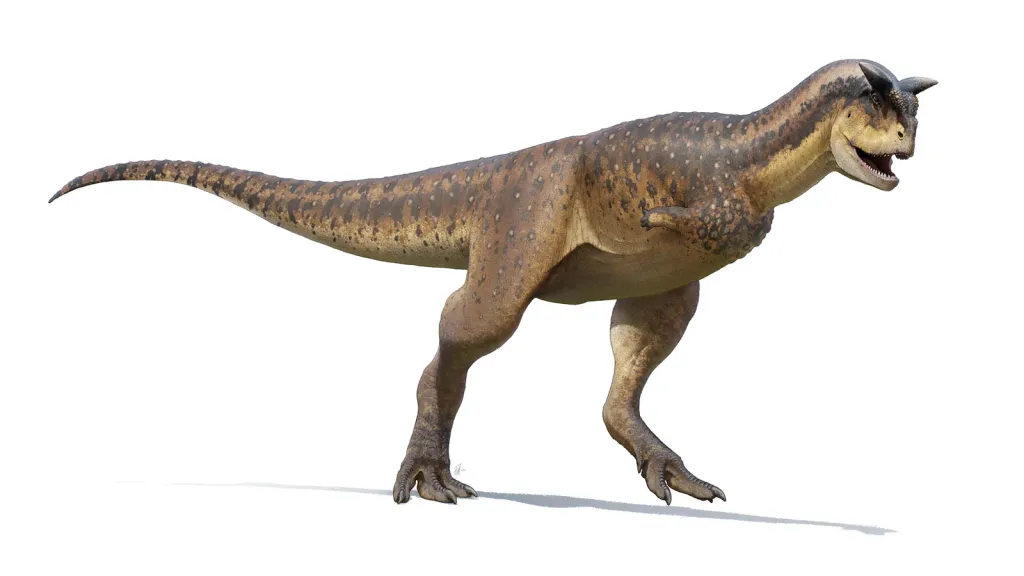
A horned abelisaurid theropod from the Late Cretaceous of Patagonia, with two bull-like horns above the eyes, tiny arms and the best-known skin of any large theropod.
- Horned
- Bipedal
- Skin impressions known
- Unusual anatomy
- Movie icon
- 时代
- 白垩纪· 坎潘阶
- 食性
- 肉食性
- 体长
- 7.5–8 m
- 体重
- 1,300–2,100 kg
- 地点
- Chubut Province, Argentina
快速问答
- Carnotaurus sastrei有多大?
- Carnotaurus sastrei体长约7.5–8 m。髋部高约2.3–2.7 m。体重约1.3–2.1 t。 (Bonaparte et al. 1990; Paul 2016)
- Carnotaurus sastrei生活在什么时候?
- Carnotaurus sastrei生活在晚白垩世,约8360万至6600万年前。 (Cohen et al. 2023; Bonaparte et al. 1990)
- 在哪里发现过Carnotaurus sastrei的化石?
- Carnotaurus sastrei的化石发现于La Colonia Formation (Chubut Province)和Argentina。 (Bonaparte 1985; Bonaparte et al. 1990)
- Carnotaurus sastrei吃什么?
- Carnotaurus sastrei是肉食性。 (Bonaparte 1985; Bonaparte et al. 1990)
- Carnotaurus sastrei由谁命名,何时命名?
- Carnotaurus sastrei由José F. Bonaparte于1985年描述。 (Bonaparte 1985; Bonaparte et al. 1990)
- Carnotaurus sastrei出现在《侏罗纪公园》里吗?
- 是的。Carnotaurus sastrei出现在《侏罗纪世界2》 (2018)和《侏罗纪世界3》 (2022)中。电影有不少虚构成分;本页将其与化石证据进行了对比。 (Wikipedia: Dinosaurs in Jurassic Park 2026; Hendrickx & Bell 2021)
本页内容

KAR-noh-TORE-us SAS-tree-eye
- 时代
- 白垩纪83.6–66 Ma
- 食性
- 肉食性
- 体长
- 7.5–8 m
- 体重
- 1.3–2.1 t
- 产地
- Argentina
- 分类
- Ceratosauria · Abelisauridae
- 命名
- 1985, José F. Bonaparte
概览
此内容目前仅提供英文版。
Carnotaurus sastrei lived in Patagonia, Argentina, near the end of the Cretaceous. José Bonaparte found its single known skeleton in 1984 in the La Colonia Formation of Chubut Province and named it in 1985.
It had a short, deep skull with a pair of thick horns above the eyes, and arms even more reduced than those of T. rex, with stubby forearms. The skeleton was found with large areas of skin impressions: rows of big conical bumps among small scales, and no sign of feathers (Hendrickx & Bell 2021).
Its tail had very large muscle attachments, and Persons and Currie (2011) argued it was one of the fastest large theropods in a straight line, though not agile in turns. How it used its horns, and how it hunted, remain open questions.
名称含义
From Latin carnis ("flesh") and taurus ("bull"): "meat-eating bull", for its horns; sastrei honours Ángel Sastre, owner of the ranch where it was found (Bonaparte 1985).
生物学与证据
科学家对这种动物生活方式的看法,以及每种观点的证据有多充分。
运动方式
Carnotaurus was a fast runner in a straight line but not agile.
证据等级:中等证据Its tail had room for very large leg-retracting muscles, which suggests high speed. The same stiff tail would have made sharp turns difficult.
支持 / 反对证据 · 1
支持证据
生物力学模型 · Carnotaurus tail muscle reconstruction
Reconstruction of the caudofemoralis muscle, very large thanks to wide tail ribs, the main muscle for pulling the leg back.
标本: MACN-CH 894
皮肤与体表覆盖
Carnotaurus had scaly skin with rows of large bumps and no feathers.
证据等级:直接证据Its only skeleton was found with large patches of skin impressions, showing small scales mixed with bigger cone-shaped ones on several parts of the body.
支持 / 反对证据 · 1
支持证据
皮肤印痕 · Carnotaurus skin impressions
Skin from the neck, shoulder, chest and tail: small pebbly scales with scattered large conical scales, and no feathers.
标本: MACN-CH 894
行为
Carnotaurus used its horns in head-butting contests.
证据等级:假说Models show the skull could bear the loads of head-to-head shoving, but how the horns were used is not observed. Display is also possible.
支持 / 反对证据 · 1
支持证据
生物力学模型 · Carnotaurus skull finite-element model
Stress model of the skull and jaws: a fast but relatively weak bite; the horns and skull roof can bear head-butting loads.
标本: MACN-CH 894
其他
The arms of Carnotaurus were vestigial and had little use.
证据等级:中等证据Its forearms are extremely short and its hands lack proper claws, so the arms were probably of little use for catching prey.
支持 / 反对证据 · 1
支持证据
标本 · Carnotaurus reduced forelimbs
Tiny arms with forearm bones about a quarter the length of the upper arm and ball-like hand bones.
标本: MACN-CH 894

体型
- 体长
- 7.5–8 m
- 身高
- 2.5 m文献范围 2.3–2.7 m
- 体重
- 1,300–2,100 kg
(26.2 英尺)
依据 MACN-CH 894 (holotype, only specimen)
(8.2 英尺)
依据 MACN-CH 894 (holotype, femur c. 1.03 m)
依据 MACN-CH 894
时间线
时代: 坎潘阶 (83.6–72.1 Ma), 马斯特里赫特阶 (72.1–66 Ma), 晚白垩世 (100.5–66 Ma)
Ages are the ICS 2023/09 bounds of the Campanian and Maastrichtian, the stage(s) the fossils are assigned to; they bracket the record and are not dated first/last appearances. The La Colonia Formation is usually cited as late Campanian to early Maastrichtian (~72-69 Ma).
产地
地层
- La Colonia Formation · Chubut Province
- Bajada Moreno, Telsen Department, Chubut · La Colonia Formation · Chubut Province · 位置为近似值
这些是发现化石的地点,而不是该动物生活的全部范围。
生态系统
生活于: La Colonia
72–69 百万年前 · 沿海平原, 三角洲, 海洋边缘
Late Cretaceous coastal plains, estuaries and tidal flats of Patagonia at the edge of an Atlantic incursion.
分类
- 演化支Dinosauria
- 演化支Saurischia
- 演化支Theropoda
- 演化支Neotheropoda
- 演化支Ceratosauria
- 科Abelisauridae
- 属Carnotaurus
- 种Carnotaurus sastrei
分类地位: 有效
化石记录

| 编号 | 类型 | 收藏机构 | 发现年份 |
|---|---|---|---|
| MACN-CH 894 | 正模标本 | Museo Argentino de Ciencias Naturales Bernardino Rivadavia (MACN) | 1984 |
已发现的部分
正模标本: MACN-CH 894
- 保存
- 部分保存
- 复原
- 未知 / 未记录
按部位查看(表格)
| 部位 | 状态 |
|---|---|
| Skull | 保存 |
| Mandible | 保存 |
| Teeth | 未知 / 未记录 |
| Cervical vertebrae | 保存 |
| Dorsal vertebrae | 保存 |
| Sacrum | 保存 |
| Caudal vertebrae | 部分保存 |
| Ribs | 保存 |
| Gastralia | 未知 / 未记录 |
| Scapula / shoulder girdle | 保存 |
| Humerus | 保存 |
| Forearm (radius / ulna) | 保存 |
| Hand (manus) | 部分保存 |
| Pelvis | 保存 |
| Femur | 部分保存 |
| Tibia / fibula | 部分保存 |
| Foot (pes) | 未知 / 未记录 · Lower legs largely missing (eroded). |

发现
- 命名年份
- 1985
- 命名者
- José F. Bonaparte
- 模式标本
- MACN-CH 894
发现时间线
1984 · 首次发现材料
Bonaparte finds Carnotaurus in Chubut
An expedition led by José Bonaparte finds the skeleton on the Sastre ranch.
人物:José F. Bonaparte
1985 · 正式命名
Bonaparte names Carnotaurus sastrei
A short paper names the horned carnivore.
人物:José F. Bonaparte
1990 · 重要研究
Full description of Carnotaurus
Bonaparte, Novas and Coria publish the detailed anatomy.
人物:José F. Bonaparte
2021 · 重要研究
Carnotaurus skin described in detail
Hendrickx and Bell describe the skin impressions.
人物:Christophe Hendrickx
《侏罗纪公园》与《侏罗纪世界》中的形象
电影
- 侏罗纪世界2 (2018)
- 侏罗纪世界3 (2022)
此内容目前仅提供英文版。
银幕形象
A horned predator seen during the volcanic eruption in Fallen Kingdom.
电影与化石对比
- Skin impressions show it was covered in small scales, as the films show.
- Big tail muscles suggest it was a fast runner for its size.
电影名称仅用于识别。DinoDex 与《侏罗纪公园》/《侏罗纪世界》系列无任何关联,也未获其认可。 所有在电影中出现的恐龙
参考文献
- (2026). Wikipedia: Dinosaurs in Jurassic Park. Wikipedia. https://en.wikipedia.org/wiki/Dinosaurs_in_Jurassic_Park(在新标签页中打开)
- Bonaparte, J. F. (1985). A horned Cretaceous carnosaur from Patagonia. National Geographic Research 1(1): 149-151.
- Bonaparte, J. F., Novas, F. E. & Coria, R. A. (1990). Carnotaurus sastrei Bonaparte, the horned, lightly built carnosaur from the Middle Cretaceous of Patagonia. Natural History Museum of Los Angeles County Contributions in Science 416: 1-42.
- Cohen, K. M., Harper, D. A. T., Gibbard, P. L. & Car, N. (2023). International Chronostratigraphic Chart (v2023/09). International Commission on Stratigraphy. https://stratigraphy.org/ICSchart/ChronostratChart2023-09.pdf(在新标签页中打开)
- Hendrickx, C. & Bell, P. R. (2021). The scaly skin of the abelisaurid Carnotaurus sastrei (Theropoda: Ceratosauria) from the Upper Cretaceous of Patagonia. Cretaceous Research 128: 104994. doi:10.1016/j.cretres.2021.104994(在新标签页中打开)
- Mazzetta, G. V., Cisilino, A. P., Blanco, R. E. & Calvo, N. (2009). Cranial mechanics and functional interpretation of the horned carnivorous dinosaur Carnotaurus sastrei. Journal of Vertebrate Paleontology 29(3): 822-830. doi:10.1671/039.029.0313(在新标签页中打开)
- Paul, G. S. (2016). The Princeton Field Guide to Dinosaurs (2nd edition). Princeton University Press.
- Persons, W. S. & Currie, P. J. (2011). Dinosaur speed demon: the caudal musculature of Carnotaurus sastrei and implications for the evolution of South American abelisaurids. PLoS ONE 6(10): e25763. doi:10.1371/journal.pone.0025763(在新标签页中打开)