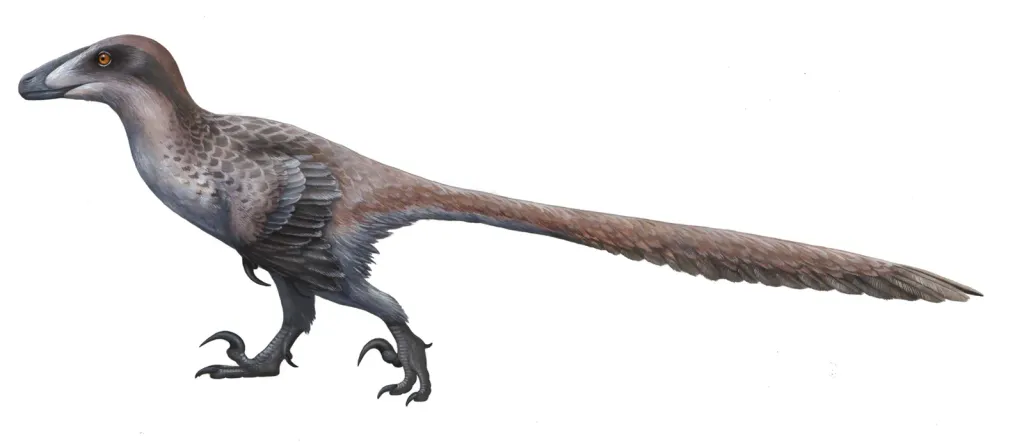
Deinonychus antirrhopus
读音: dye-NON-ih-kus an-tee-ROH-pus
Eudromaeosauria · Dromaeosauridae
A wolf-sized dromaeosaurid with a large sickle claw from the Early Cretaceous of Montana. Its 1969 description started the "dinosaur renaissance" and the idea that birds descend from dinosaurs; it was the model for the films' "raptors".
- Feathered
- Bipedal
- Sickle claw
- Possible pack behavior
- Eggs known
- Movie icon
- 时代
- 白垩纪· 阿普特阶
- 食性
- 肉食性
- 体长
- 3.3–3.4 m
- 体重
- 60–100 kg
- 地点
- Montana, Wyoming
快速问答
- Deinonychus antirrhopus有多大?
- Deinonychus antirrhopus体长约3.3–3.4 m。髋部高约0.8–1 m。体重约60–100 kg。 (Ostrom 1969; Paul 2010)
- Deinonychus antirrhopus生活在什么时候?
- Deinonychus antirrhopus生活在早白垩世,约1.214亿至1.005亿年前。 (Cohen et al. 2023; Ostrom 1969)
- 在哪里发现过Deinonychus antirrhopus的化石?
- Deinonychus antirrhopus的化石发现于Cloverly Formation (Montana)和Wyoming。 (Ostrom 1969; Ostrom 1969)
- Deinonychus antirrhopus吃什么?
- Deinonychus antirrhopus是肉食性。 (Ostrom 1969; Ostrom 1969)
- Deinonychus antirrhopus由谁命名,何时命名?
- Deinonychus antirrhopus由John H. Ostrom于1969年描述。 (Ostrom 1969; Ostrom 1969)
本页内容

dye-NON-ih-kus an-tee-ROH-pus
- 时代
- 白垩纪121.4–100.5 Ma
- 食性
- 肉食性
- 体长
- 3.3–3.4 m
- 体重
- 0.1–0.1 t
- 分类
- Eudromaeosauria · Dromaeosauridae
- 命名
- 1969, John H. Ostrom
概览
此内容目前仅提供英文版。
Deinonychus antirrhopus lived in western North America in the Early Cretaceous, about 115 to 108 million years ago. John Ostrom and Grant Meyer found its remains in the Cloverly Formation of Montana in 1964, and Ostrom named it in 1969.
It was a light, agile predator about 3 m long, with a stiffened tail, grasping hands and an enlarged, raised claw on the second toe of each foot. Ostrom argued that such an animal must have been active and warm-blooded, and noticed its many similarities with Archaeopteryx and birds. This work revived the idea that birds are living dinosaurs.
Several Deinonychus have been found with skeletons of the plant-eater Tenontosaurus, which led to the idea of pack hunting. Roach and Brinkman (2007) argued instead for mobbing behaviour like that of modern crocodiles or Komodo dragons. The "Velociraptor" of Jurassic Park was modelled largely on Deinonychus.
名称含义
From Greek deinos ("terrible") and onyx ("claw"); antirrhopus, "counterbalancing", for the stiff tail (Ostrom 1969).
生物学与证据
科学家对这种动物生活方式的看法,以及每种观点的证据有多充分。
羽毛
Deinonychus had feathers.
证据等级:有力证据No feathers are preserved with Deinonychus, but its close relatives had them, some with quill knobs on the arm; it is bracketed on both sides by feathered animals.
支持 / 反对证据 · 1
支持证据
系统发育推断 · Dromaeosaur quill knobs and feathered relatives
Close relatives are preserved with feathers, and Velociraptor shows quill knobs; Deinonychus sits inside this feathered group.
繁殖
Deinonychus laid hard-shelled eggs and may have brooded them like birds.
证据等级:假说An egg found against the belly ribs of a Deinonychus suggests it was brooding or about to lay. The link between egg and skeleton is not certain.
支持 / 反对证据 · 1
支持证据
标本 · Deinonychus egg with gastralia
An egg associated with a Deinonychus skeleton, with shell structure like other maniraptorans.
标本: AMNH 3015-egg
生物力学
Deinonychus used its sickle claws to pin down prey.
证据等级:假说Comparisons with hawks and eagles suggest the claw held struggling prey down while the animal fed, rather than slashing it.
支持 / 反对证据 · 1
支持证据
比较解剖学 · Raptor prey restraint model
Comparison of dromaeosaur feet with those of living birds of prey: the sickle claw pinned prey down rather than slashing it open.
社会生活
Deinonychus hunted in cooperative packs.
证据等级:有争议Several Deinonychus were found with a Tenontosaurus, suggesting group attacks. Critics argue that living relatives rarely cooperate, and that these sites fit a free-for-all mob better than a coordinated pack.
支持 / 反对证据 · 2
支持证据
标本 · Deinonychus found with Tenontosaurus skeletons
Deinonychus teeth and skeletons found at several Tenontosaurus sites, at one quarry with several Deinonychus individuals.
标本: AMNH 3015
反对证据
比较解剖学 · Theropod group-behaviour review
Comparison with living archosaurs: birds and crocodiles rarely hunt cooperatively; the Deinonychus-Tenontosaurus sites fit mobbing and cannibalism better than a coordinated pack.

体型
- 体长
- 3.3–3.4 m
- 身高
- 0.9 m文献范围 0.8–1 m
- 体重
- 60–100 kg
(11.2 英尺)
(3 英尺)
依据 YPM 5205 and referred (femur c. 0.34 m)
时间线
时代: 阿普特阶 (121.4–113 Ma), 阿尔布阶 (113–100.5 Ma), 早白垩世 (145–100.5 Ma)
Ages are the ICS 2023/09 bounds of the Aptian and Albian, the stage(s) the fossils are assigned to; they bracket the record and are not dated first/last appearances. The Cloverly beds with Deinonychus are usually dated to about 115-108 Ma.
产地
地层
- Cloverly Formation · Montana
- Cloverly Formation near Bridger, Carbon County, Montana · Cloverly Formation · Montana · 位置为近似值
这些是发现化石的地点,而不是该动物生活的全部范围。
生态系统
生活于: Antlers
120–112 百万年前 · 泛滥平原, 河流水系, 沿海平原
Early Cretaceous plains of the Trinity Group in Oklahoma, Arkansas and north-east Texas.

生活于: Cloverly
115–108 百万年前 · 泛滥平原, 河流水系, 森林
Early Cretaceous river floodplains of Montana and Wyoming, with seasonal climate and conifer forests; the plant-eater Tenontosaurus was the commonest large dinosaur.
分类
- 演化支Dinosauria
- 演化支Saurischia
- 演化支Theropoda
- 演化支Coelurosauria
- 演化支Maniraptora
- 科Dromaeosauridae
- 演化支Eudromaeosauria
- 属Deinonychus
- 种Deinonychus antirrhopus
分类地位: 有效
化石记录

| 编号 | 类型 | 收藏机构 | 发现年份 |
|---|---|---|---|
| YPM 5205 | 正模标本 | Yale Peabody Museum (YPM) | 1964 |
| AMNH 3015 | 归入标本 | American Museum of Natural History (AMNH) | 1931 |
| AMNH 3015-egg | 标本 | American Museum of Natural History (AMNH) | — |
已发现的部分
正模标本: YPM 5205
- 保存
- 部分保存
- 复原
- 未知 / 未记录
正模标本: YPM 5205
按部位查看(表格)
| 部位 | 状态 |
|---|---|
| Skull | 未知 / 未记录 |
| Mandible | 未知 / 未记录 |
| Teeth | 未知 / 未记录 |
| Cervical vertebrae | 未知 / 未记录 |
| Dorsal vertebrae | 未知 / 未记录 |
| Sacrum | 未知 / 未记录 |
| Caudal vertebrae | 未知 / 未记录 |
| Ribs | 未知 / 未记录 |
| Gastralia | 未知 / 未记录 |
| Scapula / shoulder girdle | 未知 / 未记录 |
| Humerus | 未知 / 未记录 |
| Forearm (radius / ulna) | 未知 / 未记录 |
| Hand (manus) | 未知 / 未记录 |
| Pelvis | 未知 / 未记录 |
| Femur | 未知 / 未记录 |
| Tibia / fibula | 未知 / 未记录 |
| Foot (pes) | 保存 · Left foot with sickle claw. |
归入标本: AMNH 3015
按部位查看(表格)
| 部位 | 状态 |
|---|---|
| Skull | 未知 / 未记录 |
| Mandible | 未知 / 未记录 |
| Teeth | 未知 / 未记录 |
| Cervical vertebrae | 未知 / 未记录 |
| Dorsal vertebrae | 部分保存 |
| Sacrum | 未知 / 未记录 |
| Caudal vertebrae | 未知 / 未记录 |
| Ribs | 未知 / 未记录 |
| Gastralia | 未知 / 未记录 |
| Scapula / shoulder girdle | 未知 / 未记录 |
| Humerus | 未知 / 未记录 |
| Forearm (radius / ulna) | 未知 / 未记录 |
| Hand (manus) | 部分保存 |
| Pelvis | 未知 / 未记录 |
| Femur | 未知 / 未记录 |
| Tibia / fibula | 未知 / 未记录 |
| Foot (pes) | 部分保存 |
标本: AMNH 3015-egg
按部位查看(表格)
| 部位 | 状态 |
|---|---|
| Skull | 未知 / 未记录 |
| Mandible | 未知 / 未记录 |
| Teeth | 未知 / 未记录 |
| Cervical vertebrae | 未知 / 未记录 |
| Dorsal vertebrae | 未知 / 未记录 |
| Sacrum | 未知 / 未记录 |
| Caudal vertebrae | 未知 / 未记录 |
| Ribs | 未知 / 未记录 |
| Gastralia | 部分保存 |
| Scapula / shoulder girdle | 未知 / 未记录 |
| Humerus | 未知 / 未记录 |
| Forearm (radius / ulna) | 未知 / 未记录 |
| Hand (manus) | 未知 / 未记录 |
| Pelvis | 未知 / 未记录 |
| Femur | 未知 / 未记录 |
| Tibia / fibula | 未知 / 未记录 |
| Foot (pes) | 未知 / 未记录 |

发现
- 命名年份
- 1969
- 命名者
- John H. Ostrom
- 模式标本
- YPM 5205
发现时间线
1931 · 首次发现材料
Barnum Brown collects an undescribed raptor
Brown collects a small theropod with a Tenontosaurus in Montana, informally called "Daptosaurus", but never publishes it.
人物:Barnum Brown
1964 · 标本出土
Ostrom and Meyer find Deinonychus
A Yale expedition finds the claw and skeletons near Bridger, Montana.
人物:John H. Ostrom, Grant E. Meyer
1969 · 正式命名
Ostrom names Deinonychus antirrhopus
The description and the full osteology later the same year start the "dinosaur renaissance".
人物:John H. Ostrom
2006 · 重要研究
Deinonychus egg described
An egg found with a Deinonychus is described.
参考文献
- Cohen, K. M., Harper, D. A. T., Gibbard, P. L. & Car, N. (2023). International Chronostratigraphic Chart (v2023/09). International Commission on Stratigraphy. https://stratigraphy.org/ICSchart/ChronostratChart2023-09.pdf(在新标签页中打开)
- Fowler, D. W., Freedman, E. A., Scannella, J. B. & Kambic, R. E. (2011). The predatory ecology of Deinonychus and the origin of flapping in birds. PLoS ONE 6(12): e28964. doi:10.1371/journal.pone.0028964(在新标签页中打开)
- Maxwell, W. D. & Ostrom, J. H. (1995). Taphonomy and paleobiological implications of Tenontosaurus-Deinonychus associations. Journal of Vertebrate Paleontology 15(4): 707-712. doi:10.1080/02724634.1995.10011256(在新标签页中打开)
- Ostrom, J. H. (1969). A new theropod dinosaur from the Lower Cretaceous of Montana. Postilla 128: 1-17.
- Ostrom, J. H. (1969). Osteology of Deinonychus antirrhopus, an unusual theropod from the Lower Cretaceous of Montana. Bulletin of the Peabody Museum of Natural History 30: 1-165.
- Paul, G. S. (2010). The Princeton Field Guide to Dinosaurs. Princeton University Press.
- Paul, G. S. (2016). The Princeton Field Guide to Dinosaurs (2nd edition). Princeton University Press.
- Roach, B. T. & Brinkman, D. L. (2007). A reevaluation of cooperative pack hunting and gregariousness in Deinonychus antirrhopus and other nonavian theropod dinosaurs. Bulletin of the Peabody Museum of Natural History 48(1): 103-138. doi:10.3374/0079-032X(2007)48[103:AROCPH]2.0.CO;2(在新标签页中打开)