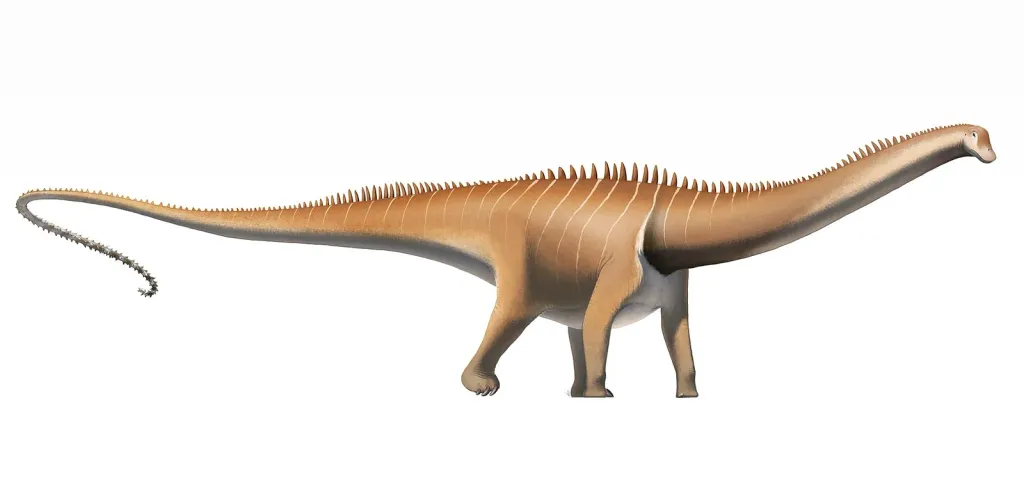
Diplodocus carnegii
读音: dih-PLOD-oh-kus kar-NEG-ee-eye
Sauropoda · Diplodocidae
A very long, slender sauropod from the Late Jurassic Morrison Formation of Wyoming, with a whip-like tail. Its skeleton, "Dippy", was cast and sent to museums around the world, making it one of the most seen dinosaurs anywhere.
- Giant
- Long necked
- Quadrupedal
- Famous specimen
- 时代
- 侏罗纪· 钦莫利阶
- 食性
- 植食性
- 体长
- 24–26 m
- 体重
- 12,000–14,800 kg
- 地点
- Wyoming, United States, Colorado
快速问答
- Diplodocus carnegii有多大?
- Diplodocus carnegii体长约24–26 m。髋部高约3–3.4 m。体重约12–14.8 t。 (Wikipedia: Diplodocus 2026; Paul 2016)
- Diplodocus carnegii生活在什么时候?
- Diplodocus carnegii生活在晚侏罗世,约1.548亿至1.431亿年前。 (Paleobiology Database: Diplodocus occurrences 2026)
- 在哪里发现过Diplodocus carnegii的化石?
- Diplodocus carnegii的化石发现于Morrison Formation (Colorado)和United States。 (Marsh 1878; Hatcher 1901)
- Diplodocus carnegii吃什么?
- Diplodocus carnegii是植食性。 (Marsh 1878; Hatcher 1901)
- Diplodocus carnegii由谁命名,何时命名?
- Diplodocus carnegii由John Bell Hatcher于1901年描述。 (Hatcher 1901; Tschopp et al. 2015)
本页内容

dih-PLOD-oh-kus kar-NEG-ee-eye
- 时代
- 侏罗纪154.8–143.1 Ma
- 食性
- 植食性
- 体长
- 24–26 m
- 体重
- 12–14.8 t
- 产地
- United States
- 分类
- Sauropoda · Diplodocidae
- 命名
- 1901, John Bell Hatcher
概览
此内容目前仅提供英文版。
Diplodocus carnegii lived in western North America in the Late Jurassic. John Bell Hatcher named it in 1901 from a skeleton (CM 84) dug up at Sheep Creek, Wyoming, by a Carnegie Museum crew, and named it after the museum's patron, Andrew Carnegie. Carnegie gave casts of the mounted skeleton, nicknamed "Dippy", to museums in Europe and Latin America.
Diplodocus was long and relatively light for a sauropod, with a horizontal neck, peg-like teeth at the front of the jaws and a tail of about 80 vertebrae ending in a thin whip. The genus is named for the double-beamed chevron bones under its tail.
The first species, D. longus (Marsh 1878), is based on poor material, and a proposal to make D. carnegii the type species was rejected by the ICZN in 2018. Whether the tail could crack like a bullwhip at supersonic speed is debated: a 1997 model said yes, a 2022 model found the tip reached only about 30 m/s.
名称含义
From Greek diploos ("double") and dokos ("beam"), for the double chevron bones under the tail (Marsh 1878); carnegii honours Andrew Carnegie (Hatcher 1901).
生物学与证据
科学家对这种动物生活方式的看法,以及每种观点的证据有多充分。
皮肤与体表覆盖
Diplodocus had a row of pointed spines along its back.
证据等级:假说Spines were found with diplodocid skin impressions, but not with a Diplodocus carnegii skeleton, and their position on the body is inferred.
支持 / 反对证据 · 1
支持证据
皮肤印痕 · Diplodocid dermal spines
Skin impressions from a diplodocid quarry in Wyoming with narrow, pointed keratinous spines, reconstructed as a row along the midline.
生物力学
Diplodocus could crack its tail like a whip at supersonic speed.
证据等级:有争议A 1997 model said the tail tip could break the sound barrier. A 2022 model including soft tissue found the tip reached only about 30 m/s and that tissues would fail at supersonic speed.
支持 / 反对证据 · 2
支持证据
生物力学模型 · Supersonic diplodocid tail model
A computer model of the Apatosaurus louisae tail reaching supersonic speed at the tip, like a bullwhip.
反对证据
生物力学模型 · Diplodocid tail multibody model
A multibody model with soft-tissue strength limits: the tail tip reaches about 30 m/s, far below the speed of sound.
其他
Diplodocus longus, not D. carnegii, is the type species of Diplodocus.
证据等级:直接证据This is a naming decision, not a biological finding: in 2018 the ICZN kept the original type species even though its fossils are poor.
支持 / 反对证据 · 1
支持证据
其他 · ICZN Opinion 2425 on the type species of Diplodocus
The Commission declined to replace D. longus with D. carnegii as the type species.
体型
- 体长
- 24–26 m
- 身高
- 3.2 m文献范围 3–3.4 m
- 体重
- 12,000–14,800 kg
(85.3 英尺)
依据 CM 84
(10.5 英尺)
依据 CM 84 (holotype, femur 1.54 m)
依据 CM 84
时间线
时代: 钦莫利阶 (154.8–149.2 Ma), 提塘阶 (149.2–145 Ma), 晚侏罗世 (161.5–145 Ma)
First and last appearance bounds of D. carnegii in PBDB (Kimmeridgian-Tithonian, PBDB time scale).
产地
地层
- Morrison Formation · Colorado
- Sheep Creek Quarry D, Albany County, Wyoming · Morrison Formation · Wyoming · 位置为近似值
这些是发现化石的地点,而不是该动物生活的全部范围。
生态系统
生活于: Morrison
156–147 百万年前 · 泛滥平原, 河流水系, 疏林, 湖泊
A vast, seasonally dry floodplain crossed by rivers in the western interior of North America in the Late Jurassic, with a wet and a dry season, conifer and fern vegetation along the water and giant sauropods in abundance.


分类
- 演化支Dinosauria
- 演化支Saurischia
- 演化支Sauropodomorpha
- 演化支Sauropoda
- 总科Diplodocoidea
- 科Diplodocidae
- 亚科Diplodocinae
- 属Diplodocus
- 种Diplodocus carnegii
分类地位: 有效
化石记录

| 编号 | 类型 | 收藏机构 | 发现年份 |
|---|---|---|---|
| CM 84 “Dippy” | 正模标本 | Carnegie Museum of Natural History (CM) | 1899 |
| CM 94 | 副模标本 | Carnegie Museum of Natural History (CM) | — |
已发现的部分
正模标本: CM 84 “Dippy”
- 保存
- 部分保存
- 复原
- 未知 / 未记录
按部位查看(表格)
| 部位 | 状态 |
|---|---|
| Skull | 未知 / 未记录 |
| Mandible | 未知 / 未记录 |
| Teeth | 未知 / 未记录 |
| Cervical vertebrae | 保存 |
| Dorsal vertebrae | 部分保存 |
| Sacrum | 未知 / 未记录 |
| Caudal vertebrae | 部分保存 |
| Ribs | 未知 / 未记录 |
| Gastralia | 未知 / 未记录 |
| Scapula / shoulder girdle | 未知 / 未记录 |
| Humerus | 未知 / 未记录 |
| Forearm (radius / ulna) | 未知 / 未记录 |
| Hand (manus) | 未知 / 未记录 |
| Pelvis | 未知 / 未记录 |
| Femur | 未知 / 未记录 |
| Tibia / fibula | 未知 / 未记录 |
| Foot (pes) | 未知 / 未记录 |

图库

发现
- 命名年份
- 1901
- 命名者
- John Bell Hatcher
- 模式标本
- CM 84

发现时间线
1878 · 正式命名
Marsh names Diplodocus
Marsh names Diplodocus longus from fragmentary material from Garden Park, Colorado.
人物:Othniel Charles Marsh
1899 · 标本出土
Carnegie Museum crew finds CM 84 at Sheep Creek
A large, well-preserved Diplodocus skeleton is excavated in Albany County, Wyoming.
1901 · 正式命名
Hatcher names Diplodocus carnegii
Hatcher names the species after Andrew Carnegie.
人物:John Bell Hatcher
2018 · 修订
ICZN keeps D. longus as the type species of Diplodocus
A proposal to make D. carnegii the type species is rejected.
参考文献
- (2026). Paleobiology Database: Diplodocus occurrences. The Paleobiology Database (paleobiodb.org), data service 1.2, accessed 2026-09-23. https://paleobiodb.org/data1.2/occs/list.txt?base_name=Diplodocus&show=coords,paleoloc,strat,loc,ref&pgm=gplates(在新标签页中打开)
- (2026). Wikipedia: Diplodocus. Wikipedia (English), accessed 2026-09-23. https://en.wikipedia.org/wiki/Diplodocus(在新标签页中打开)
- Conti, S., Tschopp, E., Mateus, O., Zanoni, A., Masarati, P. & Sala, G. (2022). Multibody analysis and soft tissue strength refute supersonic dinosaur tail. Scientific Reports 12. doi:10.1038/s41598-022-21633-2(在新标签页中打开)
- Hatcher, J. B. (1901). Diplodocus (Marsh): its osteology, taxonomy, and probable habits, with a restoration of the skeleton. Memoirs of the Carnegie Museum 1: 1-63. doi:10.5962/p.234818(在新标签页中打开)
- International Commission on Zoological Nomenclature (2018). Opinion 2425 (Case 3700) – Diplodocus Marsh, 1878 (Dinosauria, Sauropoda): Diplodocus longus Marsh, 1878 maintained as the type species. Bulletin of Zoological Nomenclature 75. https://www.biotaxa.org/bzn/article/view/44176(在新标签页中打开)
- Marsh, O. C. (1878). Principal characters of American Jurassic dinosaurs. Part I. American Journal of Science, series 3, 16: 411-416.
- Myhrvold, N. P. & Currie, P. J. (1997). Supersonic sauropods? Tail dynamics in the diplodocids. Paleobiology 23: 393-409. doi:10.1017/s0094837300019801(在新标签页中打开)
- Paul, G. S. (2016). The Princeton Field Guide to Dinosaurs (2nd edition). Princeton University Press.
- Tschopp, E., Mateus, O. & Benson, R. B. J. (2015). A specimen-level phylogenetic analysis and taxonomic revision of Diplodocidae (Dinosauria, Sauropoda). PeerJ 3: e857. doi:10.7717/peerj.857(在新标签页中打开)