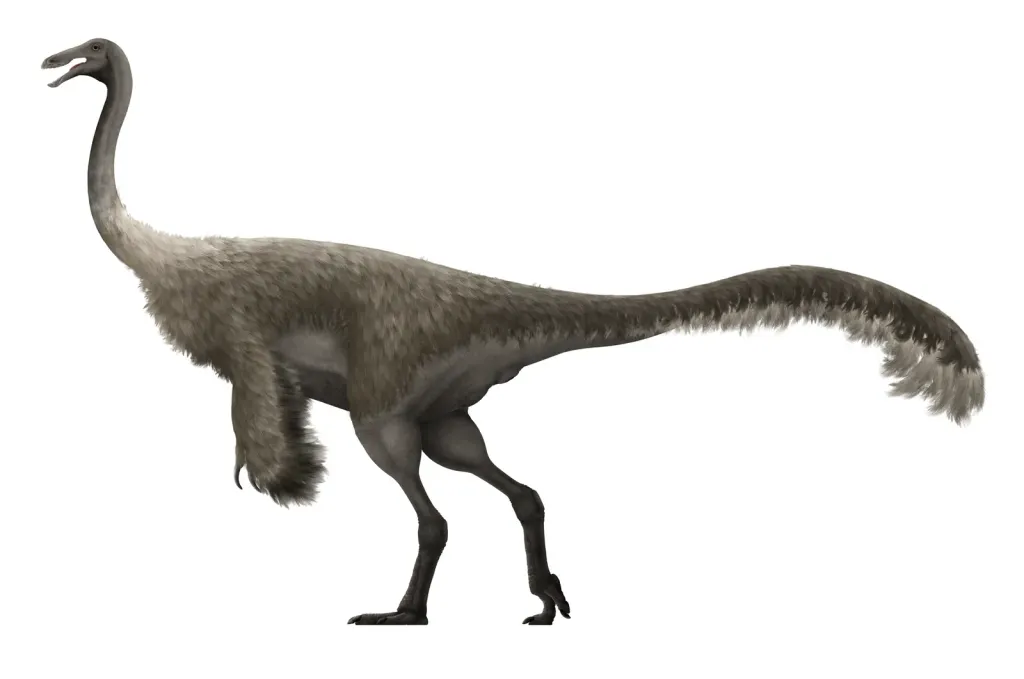
Gallimimus bullatus
读音: GAL-ih-MY-mus bul-AY-tus
Ornithomimosauria · Ornithomimidae
The largest known ornithomimid, an "ostrich dinosaur" about 6 m long from the Late Cretaceous of Mongolia. Toothless and long-legged, it was probably a fast runner, and it is famous for the flocking scene in Jurassic Park.
- Bipedal
- Movie icon
- 时代
- 白垩纪· 马斯特里赫特阶
- 食性
- 杂食性
- 体长
- 6 m
- 体重
- 400–490 kg
- 地点
- Ömnögovi Province, Mongolia, Asia
快速问答
- Gallimimus bullatus有多大?
- Gallimimus bullatus体长约6 m。髋部高约1.9 m。体重约400–490 kg。 (Wikipedia: Gallimimus 2026)
- Gallimimus bullatus生活在什么时候?
- Gallimimus bullatus生活在晚白垩世,约7210万至6600万年前。 (Paleobiology Database: Gallimimus bullatus oc… 2026; Cohen et al. 2023)
- 在哪里发现过Gallimimus bullatus的化石?
- Gallimimus bullatus的化石发现于Nemegt Formation (Ömnögovi Province)和Mongolia。 (Osmólska et al. 1972; Norell et al. 2001)
- Gallimimus bullatus吃什么?
- Gallimimus bullatus是杂食性。 (Osmólska et al. 1972; Norell et al. 2001)
- Gallimimus bullatus由谁命名,何时命名?
- Gallimimus bullatus由Halszka Osmólska, Ewa Roniewicz & Rinchen Barsbold于1972年描述。 (Osmólska et al. 1972; Paleobiology Database: Gallimimus bullatus oc… 2026)
- Gallimimus bullatus出现在《侏罗纪公园》里吗?
- 是的。Gallimimus bullatus出现在《侏罗纪公园》 (1993)、《失落的世界:侏罗纪公园》 (1997)、《侏罗纪世界》 (2015)、《侏罗纪世界2》 (2018)和《侏罗纪世界3》 (2022)中。电影有不少虚构成分;本页将其与化石证据进行了对比。 (Wikipedia: Dinosaurs in Jurassic Park 2026; Norell et al. 2001)
本页内容

GAL-ih-MY-mus bul-AY-tus
- 时代
- 白垩纪72.1–66 Ma
- 食性
- 杂食性
- 体长
- 6 m
- 体重
- 0.4–0.5 t
- 产地
- Mongolia, Asia
- 分类
- Ornithomimosauria · Ornithomimidae
- 命名
- 1972, Halszka Osmólska, Ewa Roniewicz & Rinchen Barsbold
概览
此内容目前仅提供英文版。
Gallimimus bullatus lived in the Nemegt Formation of Mongolia at the end of the Cretaceous. The Polish-Mongolian expeditions of 1963-1965 found many ornithomimid skeletons of different ages in the Nemegt Basin; the largest, found by Zofia Kielan-Jaworowska at Tsagan Khushu in 1964, became the holotype when Halszka Osmólska, Ewa Roniewicz and Rinchen Barsbold named the species in 1972.
It had a small, toothless head with a horny beak, a long neck, short arms with three clawed fingers and long hind legs built for running. Adults were about 6 m long. Feathers have not been found with Gallimimus, but they are known from its relative Ornithomimus.
What it ate is debated. Soft-tissue beaks of ornithomimids described by Norell, Makovicky and Currie (2001) suggested straining food from water or sediment, while others see an omnivore or plant-eater. It is the most common ornithomimid of the Nemegt, alongside Deinocheirus and Tarbosaurus.
名称含义
"Chicken mimic", from Latin gallus, for neck vertebrae like those of galliform birds; bullatus from the Roman bulla, for a bulb-shaped structure at the base of the skull (Osmólska et al. 1972).
生物学与证据
科学家对这种动物生活方式的看法,以及每种观点的证据有多充分。
运动方式
Gallimimus was a fast runner.
证据等级:中等证据Its long legs match those of fast-running birds; speeds of about 42-56 km/h have been estimated.
支持 / 反对证据 · 1
支持证据
比较解剖学 · Gallimimus hind-limb proportions
Long hind limbs with long shins and feet, like those of fast-running birds.
进食
Gallimimus strained small food from water or sediment with its beak.
证据等级:有争议Comb-like structures in ornithomimid beaks suggested filter-feeding; others read them as ridges for cropping tough plants, and an omnivorous diet is also proposed.
支持 / 反对证据 · 1
支持证据
标本 · Ornithomimid beaks with soft tissue
Two ornithomimid specimens preserving the soft tissue of the beak, with comb-like structures.
体型
- 体长
- 6 m
- 身高
- 1.9 m
- 体重
- 400–490 kg
(19.7 英尺)
依据 IGM 100/11
(6.2 英尺)
依据 IGM 100/11
时间线
时代: 马斯特里赫特阶 (72.1–66 Ma), 晚白垩世 (100.5–66 Ma)
Maastrichtian bounds of the type collection in PBDB.
产地
地层
- Nemegt Formation · Ömnögovi Province
- Tsagan Khushu, site 3 (Nemegt Basin) · Nemegt Formation · Ömnögovi Province · 位置为近似值
这些是发现化石的地点,而不是该动物生活的全部范围。
生态系统

生活于: Nemegt
72–68 百万年前 · 河流水系, 泛滥平原, 森林, 沼泽 / 湿地
Wetter than the Djadokhta dunes before it: braided rivers, channels and floodplain forests in the Late Cretaceous Gobi, supporting large herbivores and the tyrannosaurid Tarbosaurus.


分类
- 演化支Dinosauria
- 演化支Saurischia
- 演化支Theropoda
- 演化支Coelurosauria
- 演化支Ornithomimosauria
- 科Ornithomimidae
- 属Gallimimus
- 种Gallimimus bullatus
分类地位: 有效
化石记录

| 编号 | 类型 | 收藏机构 | 发现年份 |
|---|---|---|---|
| IGM 100/11 | 正模标本 | Institute of Paleontology, Mongolian Academy of Sciences (MPC) | 1964 |
已发现的部分
正模标本: IGM 100/11
- 保存
- 部分保存
- 复原
- 未知 / 未记录
按部位查看(表格)
| 部位 | 状态 |
|---|---|
| Skull | 部分保存 · Distorted snout. |
| Mandible | 部分保存 |
| Teeth | 未知 / 未记录 |
| Cervical vertebrae | 未知 / 未记录 |
| Dorsal vertebrae | 未知 / 未记录 |
| Sacrum | 未知 / 未记录 |
| Caudal vertebrae | 未知 / 未记录 |
| Ribs | 未知 / 未记录 |
| Gastralia | 未知 / 未记录 |
| Scapula / shoulder girdle | 未知 / 未记录 |
| Humerus | 未知 / 未记录 |
| Forearm (radius / ulna) | 未知 / 未记录 |
| Hand (manus) | 未知 / 未记录 |
| Pelvis | 保存 |
| Femur | 未知 / 未记录 |
| Tibia / fibula | 未知 / 未记录 |
| Foot (pes) | 未知 / 未记录 |

发现
- 命名年份
- 1972
- 命名者
- Halszka Osmólska, Ewa Roniewicz & Rinchen Barsbold
- 模式标本
- IGM 100/11
发现时间线
1964 · 首次发现材料
Kielan-Jaworowska finds the Gallimimus holotype
The largest of several ornithomimid skeletons is found at Tsagan Khushu.
人物:Zofia Kielan-Jaworowska
1972 · 正式命名
Osmólska, Roniewicz and Barsbold name Gallimimus
Named in Palaeontologia Polonica, then the best-preserved ornithomimid known.
人物:Halszka Osmólska, Ewa Roniewicz, Rinchen Barsbold
《侏罗纪公园》与《侏罗纪世界》中的形象
电影
- 侏罗纪公园 (1993)
- 失落的世界:侏罗纪公园 (1997)
- 侏罗纪世界 (2015)
- 侏罗纪世界2 (2018)
- 侏罗纪世界3 (2022)
此内容目前仅提供英文版。
银幕形象
The flock that stampedes past Alan Grant and the children in the first film, modelled on ostriches.
电影与化石对比
- Gallimimus had a toothless beak, probably for a plant-heavy or mixed diet; the films show it only as fleeing prey.
- Like its ostrich-dinosaur relatives it was probably feathered; the film animals are scaly.
电影名称仅用于识别。DinoDex 与《侏罗纪公园》/《侏罗纪世界》系列无任何关联,也未获其认可。 所有在电影中出现的恐龙
参考文献
- (2026). Paleobiology Database: Gallimimus bullatus occurrences and type collection 38704. The Paleobiology Database (paleobiodb.org), data service 1.2, accessed 2026-09-23. https://paleobiodb.org/data1.2/occs/list.txt?taxon_name=Gallimimus%20bullatus&show=coords,paleoloc,strat,loc,ref&pgm=gplates(在新标签页中打开)
- (2026). Wikipedia: Gallimimus. Wikipedia (English), accessed 2026-09-24. https://en.wikipedia.org/wiki/Gallimimus(在新标签页中打开)
- (2026). Wikipedia: Dinosaurs in Jurassic Park. Wikipedia. https://en.wikipedia.org/wiki/Dinosaurs_in_Jurassic_Park(在新标签页中打开)
- Cohen, K. M., Harper, D. A. T., Gibbard, P. L. & Car, N. (2023). International Chronostratigraphic Chart (v2023/09). International Commission on Stratigraphy. https://stratigraphy.org/ICSchart/ChronostratChart2023-09.pdf(在新标签页中打开)
- Norell, M. A., Makovicky, P. J. & Currie, P. J. (2001). The beaks of ostrich dinosaurs. Nature 412: 873-874. doi:10.1038/35091139(在新标签页中打开)
- Osmólska, H., Roniewicz, E. & Barsbold, R. (1972). A new dinosaur, Gallimimus bullatus n. gen., n. sp. (Ornithomimidae) from the Upper Cretaceous of Mongolia. Palaeontologia Polonica 27: 103-143.
- Paul, G. S. (2016). The Princeton Field Guide to Dinosaurs (2nd edition). Princeton University Press.
- Shay, D. & Duncan, J. (1993). The Making of Jurassic Park. Ballantine Books.