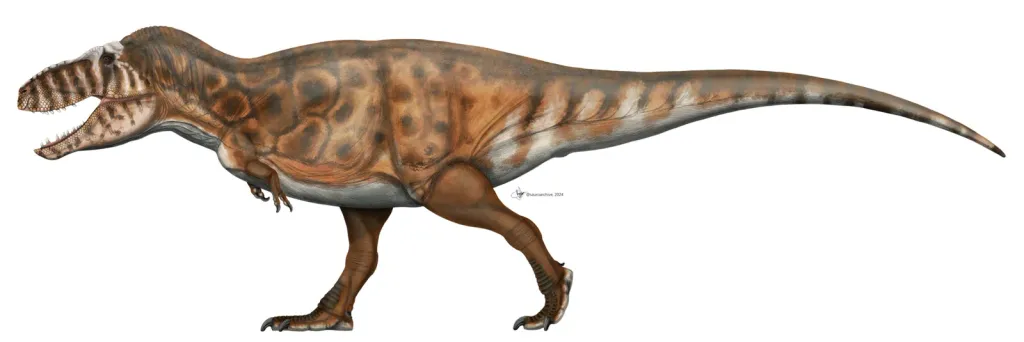
Tarbosaurus bataar
读音: TAR-boh-SORE-us bah-TAR
Coelurosauria · Tyrannosauridae
The Asian cousin of T. rex: a large tyrannosaurid from the Late Cretaceous Nemegt Formation of Mongolia, with a narrower skull, a lower-jaw locking joint and the smallest arms of its family relative to its size.
- Bipedal
- Giant
- Apex predator
- Skin impressions known
- 时代
- 白垩纪· 马斯特里赫特阶
- 食性
- 肉食性
- 体长
- 10–12 m
- 体重
- 4,500–5,000 kg
- 地点
- Ömnögovi Province, Mongolia, Asia
快速问答
- Tarbosaurus bataar有多大?
- Tarbosaurus bataar体长约10–12 m。髋部高约2.6–3 m。体重约4.5–5 t。 (Wikipedia: Tarbosaurus 2026; Currie 2003)
- Tarbosaurus bataar生活在什么时候?
- Tarbosaurus bataar生活在晚白垩世,约7210万至6600万年前。 (Paleobiology Database: Tarbosaurus occurrences 2026; Hurum & Sabath 2003)
- 在哪里发现过Tarbosaurus bataar的化石?
- Tarbosaurus bataar的化石发现于Nemegt Formation (Ömnögovi Province)和Mongolia。 (Maleev 1955; Hurum & Sabath 2003)
- Tarbosaurus bataar吃什么?
- Tarbosaurus bataar是肉食性。 (Maleev 1955; Hurum & Sabath 2003)
- Tarbosaurus bataar由谁命名,何时命名?
- Tarbosaurus bataar由Evgeny A. Maleev于1955年描述。 (Maleev 1955; Hurum & Sabath 2003)
本页内容

TAR-boh-SORE-us bah-TAR
- 时代
- 白垩纪72.1–66 Ma
- 食性
- 肉食性
- 体长
- 10–12 m
- 体重
- 4.5–5 t
- 产地
- Mongolia, Asia
- 分类
- Coelurosauria · Tyrannosauridae
- 命名
- 1955, Evgeny A. Maleev
概览
此内容目前仅提供英文版。
Tarbosaurus bataar lived in what is now the Gobi Desert of Mongolia in the Late Cretaceous, among rivers and floodplains of the Nemegt Formation. Soviet-Mongolian expeditions of 1946-1949 found several tyrannosaurid skeletons in the Nemegt Basin, and Evgeny Maleev named the first one Tyrannosaurus bataar in 1955 (holotype PIN 551-1).
Maleev named several species from these skeletons; in 1965 Anatoly Rozhdestvensky merged them all into Tarbosaurus bataar. It is one of the best-known tyrannosaurids, with dozens of specimens from juveniles to adults.
Hurum and Sabath (2003) compared its skull with that of Tyrannosaurus: it is narrower, especially at the snout, and has a locking joint between two bones of the lower jaw. They proposed that Asian and North American tyrannosaurines form separate branches. A juvenile skull described in 2011 suggests that young and adult Tarbosaurus hunted different prey.
名称含义
"Alarming lizard", from Greek tarbos ("terror, alarm") and sauros ("lizard"); bataar, from Mongolian baatar ("hero") (Maleev 1955).
生物学与证据
科学家对这种动物生活方式的看法,以及每种观点的证据有多充分。
生物力学
Tarbosaurus had a locking joint in its lower jaw that T. rex lacked.
证据等级:有力证据A ridge on one lower-jaw bone fits notches on the next, stiffening the jaw. It is linked to a different way of handling a crushing bite.
支持 / 反对证据 · 1
支持证据
比较解剖学 · Tarbosaurus and Tyrannosaurus skull comparison
Bone-by-bone comparison: a narrower skull and snout, a domed nasal less attached to other bones, and a dentary-angular interlock in the lower jaw.
标本: PIN 551-1
其他
Asian and North American giant tyrannosaurs form separate branches.
证据等级:假说Hurum and Sabath proposed that Tarbosaurus groups with Alioramus in Asia, apart from Daspletosaurus and Tyrannosaurus. Other analyses place Tarbosaurus as the closest relative of T. rex.
支持 / 反对证据 · 1
支持证据
比较解剖学 · Tarbosaurus and Tyrannosaurus skull comparison
Bone-by-bone comparison: a narrower skull and snout, a domed nasal less attached to other bones, and a dentary-angular interlock in the lower jaw.
标本: PIN 551-1
体型
- 体长
- 10–12 m
- 身高
- 2.8 m文献范围 2.6–3 m
- 体重
- 4,500–5,000 kg
(39.4 英尺)
依据 PIN 551-1 (about 10 m)
(9.2 英尺)
依据 large adults (femur c. 1.1-1.2 m)
依据 PIN 551-1
时间线
时代: 马斯特里赫特阶 (72.1–66 Ma), 晚白垩世 (100.5–66 Ma)
Maastrichtian bounds of the type collection in PBDB. Hurum & Sabath give the Nemegt Formation as "?late Campanian/early Maastrichtian".
产地
地层
- Nemegt Formation · Ömnögovi Province
- Nemegt, Nemegt Basin, Ömnögovi · Nemegt Formation · Ömnögovi Province · 位置为近似值
这些是发现化石的地点,而不是该动物生活的全部范围。
生态系统

生活于: Nemegt
72–68 百万年前 · 河流水系, 泛滥平原, 森林, 沼泽 / 湿地
Wetter than the Djadokhta dunes before it: braided rivers, channels and floodplain forests in the Late Cretaceous Gobi, supporting large herbivores and the tyrannosaurid Tarbosaurus.


分类
- 演化支Dinosauria
- 演化支Saurischia
- 演化支Theropoda
- 演化支Coelurosauria
- 总科Tyrannosauroidea
- 科Tyrannosauridae
- 亚科Tyrannosaurinae
- 属Tarbosaurus
- 种Tarbosaurus bataar
分类地位: 有效
化石记录

| 编号 | 类型 | 收藏机构 | 发现年份 |
|---|---|---|---|
| PIN 551-1 | 正模标本 | Borissiak Paleontological Institute, Russian Academy of Sciences (PIN) | — |
| PIN 551-2 | 副模标本 | Borissiak Paleontological Institute, Russian Academy of Sciences (PIN) | — |
已发现的部分
正模标本: PIN 551-1
- 保存
- 部分保存
- 复原
- 未知 / 未记录
按部位查看(表格)
| 部位 | 状态 |
|---|---|
| Skull | 保存 |
| Mandible | 未知 / 未记录 |
| Teeth | 未知 / 未记录 |
| Cervical vertebrae | 未知 / 未记录 |
| Dorsal vertebrae | 未知 / 未记录 |
| Sacrum | 未知 / 未记录 |
| Caudal vertebrae | 未知 / 未记录 |
| Ribs | 未知 / 未记录 |
| Gastralia | 未知 / 未记录 |
| Scapula / shoulder girdle | 未知 / 未记录 |
| Humerus | 未知 / 未记录 |
| Forearm (radius / ulna) | 未知 / 未记录 |
| Hand (manus) | 未知 / 未记录 |
| Pelvis | 未知 / 未记录 |
| Femur | 未知 / 未记录 |
| Tibia / fibula | 未知 / 未记录 |
| Foot (pes) | 未知 / 未记录 |

发现
- 命名年份
- 1955
- 命名者
- Evgeny A. Maleev
- 模式标本
- PIN 551-1
发现时间线
1946 · 首次发现材料
Soviet-Mongolian expeditions find tyrannosaurids in the Nemegt Basin
Expeditions of 1946-1949 collect several large tyrannosaurid skeletons.
1955 · 正式命名
Maleev names Tyrannosaurus bataar
Maleev names the species, then several other Gobi tyrannosaurid species.
人物:Evgeny Maleev
2003 · 重要研究
Hurum and Sabath compare Tarbosaurus and T. rex skulls
A bone-by-bone comparison of the two giant tyrannosaurs.
人物:Jørn H. Hurum, Karol Sabath
参考文献
- (2026). Paleobiology Database: Tarbosaurus occurrences. The Paleobiology Database (paleobiodb.org), data service 1.2, accessed 2026-09-23. https://paleobiodb.org/data1.2/occs/list.txt?base_name=Tarbosaurus&show=coords,paleoloc,strat,loc,ref&pgm=gplates(在新标签页中打开)
- (2026). Wikipedia: Tarbosaurus. Wikipedia (English), accessed 2026-09-23. https://en.wikipedia.org/wiki/Tarbosaurus(在新标签页中打开)
- Cohen, K. M., Harper, D. A. T., Gibbard, P. L. & Car, N. (2023). International Chronostratigraphic Chart (v2023/09). International Commission on Stratigraphy. https://stratigraphy.org/ICSchart/ChronostratChart2023-09.pdf(在新标签页中打开)
- Currie, P. J. (2003). Allometric growth in tyrannosaurids (Dinosauria: Theropoda) from the Upper Cretaceous of North America and Asia. Canadian Journal of Earth Sciences 40: 651-665. doi:10.1139/e02-083(在新标签页中打开)
- Hurum, J. H. & Sabath, K. (2003). Giant theropod dinosaurs from Asia and North America: skulls of Tarbosaurus bataar and Tyrannosaurus rex compared. Acta Palaeontologica Polonica 48(2): 161-190. https://www.app.pan.pl/archive/published/app48/app48-161.pdf(在新标签页中打开)
- Maleev, E. A. (1955). Giant carnivorous dinosaurs of Mongolia. Doklady Akademii Nauk SSSR 104(4): 634-637 (in Russian).
- Paul, G. S. (2016). The Princeton Field Guide to Dinosaurs (2nd edition). Princeton University Press.
- Tsuihiji, T., Watabe, M., Tsogtbaatar, K., Tsubamoto, T., Barsbold, R., Suzuki, S., Lee, A. H., Ridgely, R. C., Kawahara, Y. & Witmer, L. M. (2011). Cranial osteology of a juvenile specimen of Tarbosaurus bataar (Theropoda, Tyrannosauridae) from the Nemegt Formation (Upper Cretaceous) of Bugin Tsav, Mongolia. Journal of Vertebrate Paleontology 31: 497-517. doi:10.1080/02724634.2011.557116(在新标签页中打开)