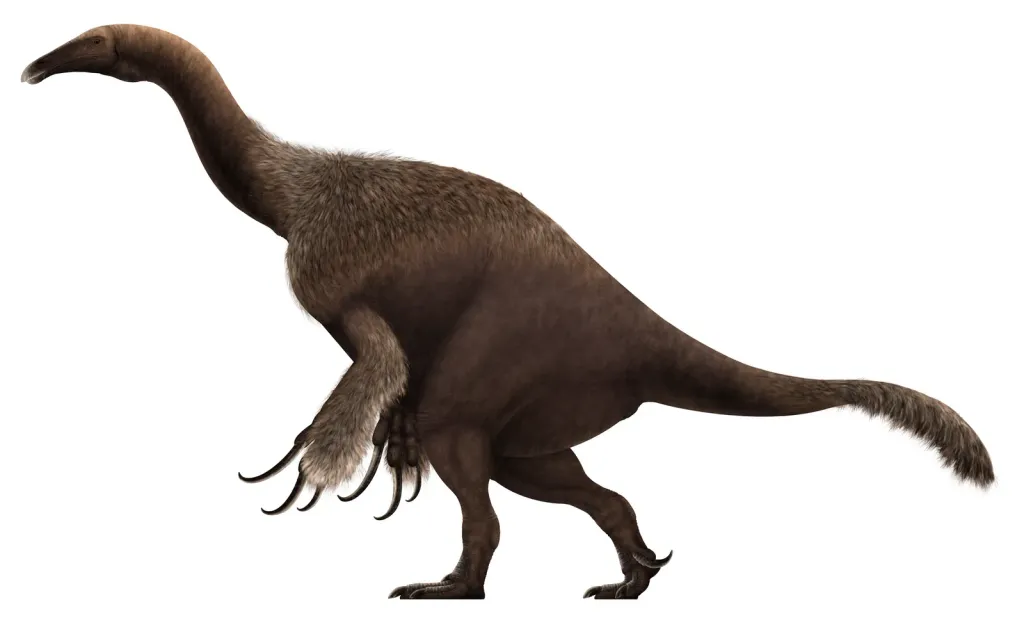
Therizinosaurus cheloniformis
读音: THER-ih-ZIN-oh-SORE-us keh-LOH-nih-FOR-mis
Therizinosauria · Therizinosauridae
A giant therizinosaur from the Late Cretaceous Nemegt Formation of Mongolia, known mainly from its arms and huge hand claws. A theropod that most likely ate plants.
- Feathered
- Bipedal
- Giant
- Giant claws
- Unusual anatomy
- 时代
- 白垩纪· 马斯特里赫特阶
- 食性
- 植食性
- 体长
- 9–10 m
- 体重
- 5,000 kg
- 地点
- Mongolia, Ömnögovi Province
快速问答
- Therizinosaurus cheloniformis有多大?
- Therizinosaurus cheloniformis体长约9–10 m。髋部高约2.8–3.5 m。体重约5 t。 (Paul 2010; Paul 2016)
- Therizinosaurus cheloniformis生活在什么时候?
- Therizinosaurus cheloniformis生活在晚白垩世,约7210万至6600万年前。 (Cohen et al. 2023; Zanno 2010)
- 在哪里发现过Therizinosaurus cheloniformis的化石?
- Therizinosaurus cheloniformis的化石发现于Nemegt Formation (Ömnögovi Province)和Mongolia。 (Maleev 1954; Zanno 2010)
- Therizinosaurus cheloniformis吃什么?
- Therizinosaurus cheloniformis是植食性。 (Maleev 1954; Zanno 2010)
- Therizinosaurus cheloniformis由谁命名,何时命名?
- Therizinosaurus cheloniformis由Evgeny Maleev于1954年描述。 (Maleev 1954; Zanno 2010)
- Therizinosaurus cheloniformis出现在《侏罗纪公园》里吗?
- 是的。Therizinosaurus cheloniformis出现在《侏罗纪世界3》 (2022)中。电影有不少虚构成分;本页将其与化石证据进行了对比。 (Wikipedia: Dinosaurs in Jurassic Park 2026; Lautenschlager 2014)
本页内容

- 时代
- 白垩纪72.1–66 Ma
- 食性
- 植食性
- 体长
- 9–10 m
- 体重
- 5 t
- 产地
- Mongolia
- 分类
- Therizinosauria · Therizinosauridae
- 命名
- 1954, Evgeny Maleev
概览
此内容目前仅提供英文版。
Therizinosaurus cheloniformis lived in what is now the Gobi Desert of Mongolia in the Late Cretaceous. Evgeny Maleev named it in 1954 from enormous flat claws found by a Soviet-Mongolian expedition in the Nemegt Formation, and he took them for the remains of a giant turtle-like reptile.
Later finds of arms and hind limbs showed it was a theropod, part of the strange group Therizinosauria (Zanno 2010). Its relatives had small heads, long necks, broad bellies and four-toed feet. Therizinosaurus itself is known only from limbs and a few other bones, so its full body is reconstructed from those relatives.
Its hand claws are among the longest of any known animal. Despite belonging to the meat-eating theropods, therizinosaurs show leaf-shaped teeth, beaks and wide guts, and Zanno and Makovicky (2011) treat the group as herbivorous. The claws were probably used for pulling down branches, display or defence rather than hunting.
名称含义
From Greek therizo ("to reap") and sauros ("lizard"): "reaping lizard", for the scythe-like claws; cheloniformis means "turtle-shaped", from Maleev's first interpretation (Maleev 1954).
生物学与证据
科学家对这种动物生活方式的看法,以及每种观点的证据有多充分。
进食
Therizinosaurus was mainly a plant-eater.
证据等级:中等证据No skull of Therizinosaurus is known, but its relatives have plant-eater teeth, beaks and wide bellies. It is inferred from them, which is why the evidence is moderate rather than strong.
支持 / 反对证据 · 1
支持证据
比较解剖学 · Therizinosaur leaf-shaped teeth and beaks
Relatives of Therizinosaurus with skulls show leaf-shaped cheek teeth and a toothless beak at the front of the jaws, as in plant-eaters.
羽毛
Therizinosaurus probably had some feathers.
证据等级:假说No skin or feathers are known from Therizinosaurus. Smaller relatives had filament feathers, but very large animals may have lost much of their coat, so this is an inference.
支持 / 反对证据 · 1
支持证据
羽毛印痕 · Filamentous feathers on Beipiaosaurus
A smaller Early Cretaceous therizinosaur from China preserved with feather-like filaments.
生物力学
The giant claws of Therizinosaurus were used to pull branches, not to dig or kill.
证据等级:假说Computer models show the long, gently curved claws would break under digging loads but could hook and pull branches. Display and defence are also possible.
支持 / 反对证据 · 1
支持证据
生物力学模型 · Therizinosaur claw finite-element models
Models of therizinosaur claws find the long, straight claws of Therizinosaurus poorly suited to digging and better for pulling vegetation or display.
标本: PIN 551-483
体型
- 体长
- 9–10 m
- 身高
- 3.1 m文献范围 2.8–3.5 m
- 体重
- 5,000 kg
(32.8 英尺)
(10.2 英尺)
依据 IGM 100/45 (partial hindlimb)
时间线
时代: 马斯特里赫特阶 (72.1–66 Ma), 晚白垩世 (100.5–66 Ma)
Ages are the ICS 2023/09 bounds of the Maastrichtian, the stage(s) the fossils are assigned to; they bracket the record and are not dated first/last appearances. The Nemegt Formation is usually considered early Maastrichtian, but it has no radiometric dates; some authors allow a late Campanian age.
产地
地层
- Nemegt Formation · Ömnögovi Province
- Nemegt Basin, Ömnögovi, Mongolia · Nemegt Formation · Ömnögovi Province · 位置为近似值
这些是发现化石的地点,而不是该动物生活的全部范围。
生态系统

生活于: Nemegt
72–68 百万年前 · 河流水系, 泛滥平原, 森林, 沼泽 / 湿地
Wetter than the Djadokhta dunes before it: braided rivers, channels and floodplain forests in the Late Cretaceous Gobi, supporting large herbivores and the tyrannosaurid Tarbosaurus.


分类
- 演化支Dinosauria
- 演化支Saurischia
- 演化支Theropoda
- 演化支Coelurosauria
- 演化支Maniraptora
- 演化支Therizinosauria
- 科Therizinosauridae
- 属Therizinosaurus
- 种Therizinosaurus cheloniformis
分类地位: 有效
化石记录

| 编号 | 类型 | 收藏机构 | 发现年份 |
|---|---|---|---|
| PIN 551-483 | 正模标本 | Borissiak Paleontological Institute, Russian Academy of Sciences (PIN) | 1948 |
| MPC-D 100/15 | 归入标本 | Institute of Paleontology, Mongolian Academy of Sciences (MPC) | — |
已发现的部分
正模标本: PIN 551-483
- 保存
- 部分保存
- 复原
- 未知 / 未记录
正模标本: PIN 551-483
按部位查看(表格)
| 部位 | 状态 |
|---|---|
| Skull | 未知 / 未记录 |
| Mandible | 未知 / 未记录 |
| Teeth | 未知 / 未记录 |
| Cervical vertebrae | 未知 / 未记录 |
| Dorsal vertebrae | 未知 / 未记录 |
| Sacrum | 未知 / 未记录 |
| Caudal vertebrae | 未知 / 未记录 |
| Ribs | 部分保存 · Rib fragment. |
| Gastralia | 未知 / 未记录 |
| Scapula / shoulder girdle | 未知 / 未记录 |
| Humerus | 未知 / 未记录 |
| Forearm (radius / ulna) | 未知 / 未记录 |
| Hand (manus) | 部分保存 · Three ungual claws. |
| Pelvis | 未知 / 未记录 |
| Femur | 未知 / 未记录 |
| Tibia / fibula | 未知 / 未记录 |
| Foot (pes) | 未知 / 未记录 |
归入标本: MPC-D 100/15
按部位查看(表格)
| 部位 | 状态 |
|---|---|
| Skull | 未知 / 未记录 |
| Mandible | 未知 / 未记录 |
| Teeth | 未知 / 未记录 |
| Cervical vertebrae | 未知 / 未记录 |
| Dorsal vertebrae | 未知 / 未记录 |
| Sacrum | 未知 / 未记录 |
| Caudal vertebrae | 未知 / 未记录 |
| Ribs | 未知 / 未记录 |
| Gastralia | 未知 / 未记录 |
| Scapula / shoulder girdle | 保存 |
| Humerus | 保存 |
| Forearm (radius / ulna) | 保存 |
| Hand (manus) | 部分保存 |
| Pelvis | 未知 / 未记录 |
| Femur | 未知 / 未记录 |
| Tibia / fibula | 未知 / 未记录 |
| Foot (pes) | 未知 / 未记录 |

发现
- 命名年份
- 1954
- 命名者
- Evgeny Maleev
- 模式标本
- PIN 551-483
发现时间线
1948 · 首次发现材料
Soviet-Mongolian expedition collects giant claws
Huge flat claws are collected in the Nemegt Basin.
1954 · 正式命名
Maleev names Therizinosaurus as a turtle-like reptile
Maleev names the animal and interprets it as a giant turtle-like reptile.
人物:Evgeny Maleev
1976 · 重要研究
Barsbold describes Therizinosaurus arms
New arm material shows Therizinosaurus was a dinosaur with enormous hands.
人物:Rinchen Barsbold
《侏罗纪公园》与《侏罗纪世界》中的形象
电影
- 侏罗纪世界3 (2022)
此内容目前仅提供英文版。
银幕形象
A feathered, near-blind giant with scythe-like claws that impales the Giganotosaurus at the climax of Dominion.
电影与化石对比
- It was a plant eater: the giant claws were probably for pulling down branches, not for fighting predators.
- Feathers are plausible: a close relative preserves feather-like filaments.
电影名称仅用于识别。DinoDex 与《侏罗纪公园》/《侏罗纪世界》系列无任何关联,也未获其认可。 所有在电影中出现的恐龙
参考文献
- (2026). Wikipedia: Dinosaurs in Jurassic Park. Wikipedia. https://en.wikipedia.org/wiki/Dinosaurs_in_Jurassic_Park(在新标签页中打开)
- Cohen, K. M., Harper, D. A. T., Gibbard, P. L. & Car, N. (2023). International Chronostratigraphic Chart (v2023/09). International Commission on Stratigraphy. https://stratigraphy.org/ICSchart/ChronostratChart2023-09.pdf(在新标签页中打开)
- Lautenschlager, S. (2014). Morphological and functional diversity in therizinosaur claws and the implications for theropod claw evolution. Proceedings of the Royal Society B 281: 20140497. doi:10.1098/rspb.2014.0497(在新标签页中打开)
- Maleev, E. A. (1954). Novyy cherepakhoobraznyy yashcher v Mongolii [New turtle-like reptile in Mongolia]. Priroda 1954(3): 106-108.
- Paul, G. S. (2010). The Princeton Field Guide to Dinosaurs. Princeton University Press.
- Paul, G. S. (2016). The Princeton Field Guide to Dinosaurs (2nd edition). Princeton University Press.
- Xu, X., Tang, Z. & Wang, X. (1999). A therizinosauroid dinosaur with integumentary structures from China. Nature 399: 350-354. doi:10.1038/20670(在新标签页中打开)
- Zanno, L. E. (2010). A taxonomic and phylogenetic re-evaluation of Therizinosauria (Dinosauria: Maniraptora). Journal of Systematic Palaeontology 8(4): 503-543. doi:10.1080/14772011003644595(在新标签页中打开)
- Zanno, L. E. & Makovicky, P. J. (2011). Herbivorous ecomorphology and specialization patterns in theropod dinosaur evolution. Proceedings of the National Academy of Sciences 108(1): 232-237. doi:10.1073/pnas.1011924108(在新标签页中打开)