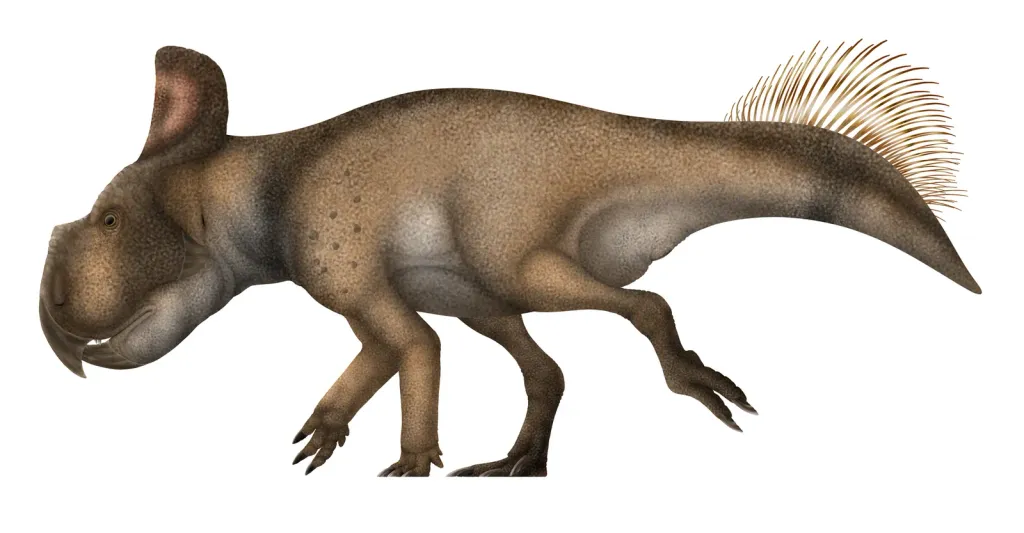
Protoceratops andrewsi
读音: PRO-toh-SERR-ah-tops AN-droo-zye
Ceratopsia · Protoceratopsidae
A sheep-sized horned dinosaur with a large frill and a parrot-like beak from the Late Cretaceous Gobi Desert of Mongolia. Hundreds of skeletons are known, including one locked in combat with a Velociraptor.
- Quadrupedal
- Eggs known
- Famous specimen
- 时代
- 白垩纪· 坎潘阶
- 食性
- 植食性
- 体长
- 2–2.5 m
- 体重
- 62–104 kg
- 地点
- Ömnögovi Province, Mongolia, Asia
快速问答
- Protoceratops andrewsi有多大?
- Protoceratops andrewsi体长约2–2.5 m。髋部高约0.6–0.8 m。体重约62–104 kg。 (Wikipedia: Protoceratops 2026; Paul 2016)
- Protoceratops andrewsi生活在什么时候?
- Protoceratops andrewsi生活在晚白垩世,约7500万至7100万年前。 (Paleobiology Database: Protoceratops andrewsi… 2026; Dashzeveg et al. 2005)
- 在哪里发现过Protoceratops andrewsi的化石?
- Protoceratops andrewsi的化石发现于Djadokhta Formation (Ömnögovi Province)和Mongolia。 (Granger & Gregory 1923; Hone et al. 2016)
- Protoceratops andrewsi吃什么?
- Protoceratops andrewsi是植食性。 (Granger & Gregory 1923; Hone et al. 2016)
- Protoceratops andrewsi由谁命名,何时命名?
- Protoceratops andrewsi由Walter Granger & William K. Gregory于1923年描述。 (Granger & Gregory 1923; Paleobiology Database: Protoceratops andrewsi… 2026)
本页内容

PRO-toh-SERR-ah-tops AN-droo-zye
- 时代
- 白垩纪75–71 Ma
- 食性
- 植食性
- 体长
- 2–2.5 m
- 体重
- 0.1–0.1 t
- 产地
- Mongolia, Asia
- 分类
- Ceratopsia · Protoceratopsidae
- 命名
- 1923, Walter Granger & William K. Gregory
概览
此内容目前仅提供英文版。
Protoceratops andrewsi lived among the sand dunes of the Djadokhta Formation in what is now the Gobi Desert of Mongolia, in the Late Cretaceous. The photographer James B. Shackelford of the American Museum's Central Asiatic Expedition found the first skull at the Flaming Cliffs (Shabarakh Usu) in 1922, and Walter Granger and William K. Gregory named it in 1923 after the expedition leader Roy Chapman Andrews.
It was an early relative of the large horned dinosaurs, about 2 m long, with a big head, a bony frill and a small bump in place of a nose horn. The frill and nasal bump grew faster than the rest of the body as the animal matured, which suggests they were used as social or sexual signals (Hone et al. 2016).
Protoceratops is one of the best known dinosaurs, with many skeletons from hatchlings to adults. Its eggs were originally soft-shelled (Norell et al. 2020), and the famous "Fighting Dinosaurs" specimen preserves one locked in combat with Velociraptor.
名称含义
"First horned face", from Greek protos, keras and ops; andrewsi after Roy Chapman Andrews, leader of the Central Asiatic Expeditions (Granger & Gregory 1923).
生物学与证据
科学家对这种动物生活方式的看法,以及每种观点的证据有多充分。
蛋
Protoceratops laid soft-shelled eggs.
证据等级:有力证据The eggshells were originally organic, not mineralised, and resemble the soft eggshells of some turtles.
支持 / 反对证据 · 1
支持证据
标本 · Protoceratops eggshell chemistry and histology
Raman spectra and histology of exceptionally preserved Protoceratops eggs cluster them with soft, non-mineralised eggshells.
行为
The frill of Protoceratops was a social or sexual signal.
证据等级:假说Structures that grow disproportionately as an animal matures are typical of signals; other uses, such as anchoring jaw muscles, are not ruled out.
支持 / 反对证据 · 1
支持证据
比较解剖学 · Protoceratops frill and nasal allometry
Frill and nasal boss grow faster than the rest of the skull through growth (positive allometry).
其他
Protoceratops was prey of Velociraptor.
证据等级:直接证据The Fighting Dinosaurs show the two in combat, and Velociraptor tooth marks on Protoceratops bones show feeding.
支持 / 反对证据 · 1
支持证据
标本 · Fighting Dinosaurs specimen
A Velociraptor and a Protoceratops buried in the middle of a fight; the raptor's sickle claw is at the neck of its prey, whose jaws grip the raptor's arm.
体型
- 体长
- 2–2.5 m
- 身高
- 0.7 m文献范围 0.6–0.8 m
- 体重
- 62–104 kg
(8.2 英尺)
(2.3 英尺)
依据 adults
时间线
时代: 坎潘阶 (83.6–72.1 Ma), 晚白垩世 (100.5–66 Ma)
Djadokhta Formation, about 75-71 Ma: magnetostratigraphy suggests, without clearly establishing, deposition during the late Campanian polarity changes (Dashzeveg et al. 2005). PBDB bins the type collection in the whole late Campanian (83.6-72.2 Ma).
产地
地层
- Djadokhta Formation · Ömnögovi Province
- Shabarakh Usu (Flaming Cliffs, Bayn Dzak), AMNH loc. 12049 · Djadokhta Formation · Ömnögovi Province · 位置为近似值
这些是发现化石的地点,而不是该动物生活的全部范围。
生态系统

生活于: Djadokhta
75–71 百万年前 · 沙漠 / 沙丘, 其他
An arid landscape of sand dunes and interdune areas in the Late Cretaceous Gobi, with occasional water. Sandslides and dune collapses buried animals alive, preserving articulated skeletons and nests.


分类
- 演化支Dinosauria
- 演化支Ornithischia
- 演化支Ceratopsia
- 科Protoceratopsidae
- 属Protoceratops
- 种Protoceratops andrewsi
分类地位: 有效
化石记录

| 编号 | 类型 | 收藏机构 | 发现年份 |
|---|---|---|---|
| AMNH 6251 | 正模标本 | American Museum of Natural History (AMNH) | 1922 |
已发现的部分
正模标本: AMNH 6251
- 保存
- 部分保存
- 复原
- 未知 / 未记录
按部位查看(表格)
| 部位 | 状态 |
|---|---|
| Skull | 部分保存 |
| Mandible | 未知 / 未记录 |
| Teeth | 未知 / 未记录 |
| Cervical vertebrae | 未知 / 未记录 |
| Dorsal vertebrae | 未知 / 未记录 |
| Sacrum | 未知 / 未记录 |
| Caudal vertebrae | 未知 / 未记录 |
| Ribs | 未知 / 未记录 |
| Gastralia | 未知 / 未记录 |
| Scapula / shoulder girdle | 未知 / 未记录 |
| Humerus | 未知 / 未记录 |
| Forearm (radius / ulna) | 未知 / 未记录 |
| Hand (manus) | 未知 / 未记录 |
| Pelvis | 未知 / 未记录 |
| Femur | 未知 / 未记录 |
| Tibia / fibula | 未知 / 未记录 |
| Foot (pes) | 未知 / 未记录 |
发现
- 命名年份
- 1923
- 命名者
- Walter Granger & William K. Gregory
- 模式标本
- AMNH 6251
发现时间线
1922 · 首次发现材料
Shackelford finds the first Protoceratops skull
The expedition photographer spots a small skull at the Flaming Cliffs.
人物:James B. Shackelford, Roy Chapman Andrews
1923 · 正式命名
Granger and Gregory name Protoceratops andrewsi
Named as a "pre-ceratopsian" in American Museum Novitates.
人物:Walter Granger, William K. Gregory
2020 · 重要研究
Protoceratops eggs shown to be soft-shelled
Norell and colleagues show the first dinosaur eggs were soft.
人物:Mark A. Norell
参考文献
- (2026). Paleobiology Database: Protoceratops andrewsi occurrences and type collection 46152. The Paleobiology Database (paleobiodb.org), data service 1.2, accessed 2026-09-23. https://paleobiodb.org/data1.2/occs/list.txt?taxon_name=Protoceratops%20andrewsi&show=coords,paleoloc,strat,loc,ref&pgm=gplates(在新标签页中打开)
- (2026). Wikipedia: Protoceratops. Wikipedia (English), accessed 2026-09-24. https://en.wikipedia.org/wiki/Protoceratops(在新标签页中打开)
- Dashzeveg, D., Dingus, L., Loope, D. B., Swisher, C. C., III, Dulam, T. & Sweeney, M. R. (2005). New stratigraphic subdivision, depositional environment, and age estimate for the Upper Cretaceous Djadokhta Formation, southern Ulan Nur Basin, Mongolia. American Museum Novitates 3498: 1-31. https://digitallibrary.amnh.org/server/api/core/bitstreams/0df4baac-12e4-44ae-8ef7-3328b22e8604/content(在新标签页中打开)
- Granger, W. & Gregory, W. K. (1923). Protoceratops andrewsi, a pre-ceratopsian dinosaur from Mongolia, with an appendix on the structural relationships of the Protoceratops beds. American Museum Novitates 72: 1-9.
- Hone, D. W. E., Wood, D. & Knell, R. J. (2016). Positive allometry for exaggerated structures in the ceratopsian dinosaur Protoceratops andrewsi supports socio-sexual signaling. Palaeontologia Electronica 19.1.5A. doi:10.26879/591(在新标签页中打开)
- Norell, M. A., Wiemann, J., Fabbri, M., Yu, C., Marsicano, C. A., Moore-Nall, A., Varricchio, D. J., Pol, D. & Zelenitsky, D. K. (2020). The first dinosaur egg was soft. Nature 583: 406-410. doi:10.1038/s41586-020-2412-8(在新标签页中打开)
- Paul, G. S. (2016). The Princeton Field Guide to Dinosaurs (2nd edition). Princeton University Press.