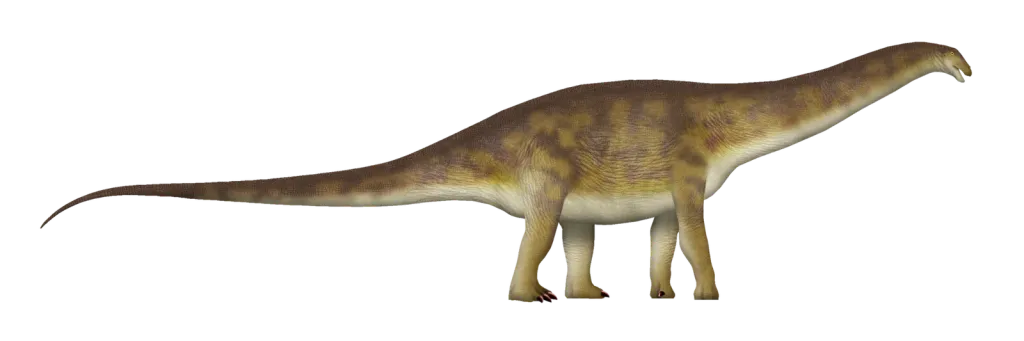
Apatosaurus ajax
Pronounced ah-PAT-oh-SORE-us AY-jax
Sauropoda · Diplodocidae
A massive, long-necked diplodocid from the Late Jurassic Morrison Formation of the western United States. For a century it absorbed Brontosaurus, and its museum skeletons wore the wrong skull until 1979.
- Giant
- Long necked
- Quadrupedal
- Period
- Jurassic· Kimmeridgian
- Diet
- Herbivore
- Length
- 21–23 m
- Mass
- 16,400–22,400 kg
- Location
- Colorado, Utah, Wyoming, United States
Quick answers
- How big was Apatosaurus ajax?
- Apatosaurus ajax was about 21–23 m long. It stood about 3.3–4 m tall at the hips. It weighed about 16.4–22.4 t. (Wikipedia: Apatosaurus 2026; Paul 2016)
- When did Apatosaurus ajax live?
- Apatosaurus ajax lived during the Late Jurassic, about 154.8–143.1 million years ago. (Paleobiology Database: Apatosaurus occurrences 2026)
- Where have Apatosaurus ajax fossils been found?
- Fossils of Apatosaurus ajax have been found in Morrison Formation (Colorado) and United States. (Marsh 1877; Holland 1915)
- What did Apatosaurus ajax eat?
- Apatosaurus ajax was a herbivore. (Marsh 1877; Holland 1915)
- Who named Apatosaurus ajax, and when?
- Apatosaurus ajax was described by Othniel Charles Marsh in 1877. (Marsh 1877; Tschopp et al. 2015)
- Was Apatosaurus ajax in Jurassic Park?
- Yes. Apatosaurus ajax appears in Jurassic World (2015), Jurassic World: Fallen Kingdom (2018), Jurassic World Dominion (2022), and Jurassic World Rebirth (2025). Gentle long-necked herds in Jurassic World, where one is killed by the Indominus rex. Diplodocid tails may have worked as whips, but the idea that their tips broke the sound barrier is disputed. (Wikipedia: Dinosaurs in Jurassic Park 2026; Myhrvold & Currie 1997)
On this page

ah-PAT-oh-SORE-us AY-jax
- Period
- Jurassic154.8–143.1 Ma
- Diet
- Herbivore
- Length
- 21–23 m
- Mass
- 16.4–22.4 t
- Location
- United States
- Classification
- Sauropoda · Diplodocidae
- Described
- 1877, Othniel Charles Marsh
Overview
Apatosaurus ajax lived in western North America in the Late Jurassic. Othniel Charles Marsh named it in 1877 from a partial skeleton (YPM 1860) collected at Morrison, Colorado. In 1903 Elmer Riggs merged Brontosaurus into it, and Apatosaurus stayed the scientific name for both until 2015.
It was a very heavy sauropod with a long, deep neck and a whip-like tail. The best skeleton belongs to a second species, A. louisae (CM 3018), found at the Carnegie Quarry in Utah; a Diplodocus-like skull found nearby (CM 11162) was long rejected, and museums mounted Camarasaurus-like heads until the 1970s, when Berman and McIntosh showed the long, low skull was correct.
Bone histology suggests it grew quickly: Curry (1999) estimated that it reached near-adult size in about ten years, while later studies proposed closer to twenty.
Name meaning
"Deceptive lizard", from Greek apatē ("deception") and sauros ("lizard"), for chevron bones Marsh thought resembled those of mosasaurs; ajax after the Greek hero (Marsh 1877).
Biology & evidence
What scientists think about how this animal lived, and how strong the evidence for each idea is.
Growth
Apatosaurus reached near-adult size in about ten years.
Evidence level: HypothesisBone tissue shows fast growth, but estimates differ: about 10 years in one study, closer to 20 in later ones.
Evidence for / against · 1
Evidence for
Histology · Apatosaurus bone histology
Growth-series histology of Apatosaurus limb bones and scapulae used to estimate growth rate.
Biomechanics
Apatosaurus could crack its tail like a whip at supersonic speed.
Evidence level: DisputedThe 1997 supersonic model was built on an Apatosaurus tail. A 2022 model including soft tissue found the tip reached only about 30 m/s.
Evidence for / against · 2
Evidence for
Biomechanical model · Supersonic diplodocid tail model
A computer model of the Apatosaurus louisae tail reaching supersonic speed at the tip, like a bullwhip.
Evidence against
Biomechanical model · Diplodocid tail multibody model
A multibody model with soft-tissue strength limits: the tail tip reaches about 30 m/s, far below the speed of sound.
Other
Apatosaurus had a long, low skull like Diplodocus, not a short, boxy one like Camarasaurus.
Evidence level: Strong evidenceA diplodocid skull was found beside the best Apatosaurus skeleton. For decades museums used Camarasaurus-like heads instead, until the skull was restudied in the 1970s.
Size
- Length
- 21–23 m
- Height
- 3.6 mpublished range 3.3–4 m
- Mass
- 16,400–22,400 kg
(75.5 ft)
(11.8 ft)
Based on YPM 1860 and referred apatosaurine hindlimbs
Timeline
Periods: Kimmeridgian (154.8–149.2 Ma), Tithonian (149.2–145 Ma), Late Jurassic (161.5–145 Ma)
Kimmeridgian-Tithonian bounds of the type collection in PBDB (Brushy Basin Member, Morrison Formation).
Location
Formations
- Morrison Formation · Colorado
- Morrison, Colorado (Dinosaur Ridge) · Morrison Formation · Colorado · position approximate
- Carnegie Quarry, Dinosaur National Monument, Utah · Morrison Formation · Utah · position approximate
These are the places where fossils have been found, not the full area where the animal lived.
Ecosystem
Lived in: Morrison
156–147 million years ago · floodplain, river system, open woodland, lake
A vast, seasonally dry floodplain crossed by rivers in the western interior of North America in the Late Jurassic, with a wet and a dry season, conifer and fern vegetation along the water and giant sauropods in abundance.
Same ecosystem

Same ecosystem

Same ecosystem

Same ecosystem

Same ecosystem

Same ecosystem

Classification
- cladeDinosauria
- cladeSaurischia
- cladeSauropodomorpha
- cladeSauropoda
- superfamilyDiplodocoidea
- familyDiplodocidae
- subfamilyApatosaurinae
- genusApatosaurus
- speciesApatosaurus ajax
Taxonomic status: Valid
Fossil record

| Catalog number | Status | Institution | Found |
|---|---|---|---|
| YPM 1860 | Holotype | Yale Peabody Museum (YPM) | 1877 |
| CM 3018 | Holotype | Carnegie Museum of Natural History (CM) | 1909 |
| CM 11162 | Referred specimen | Carnegie Museum of Natural History (CM) | — |
What has been found
Referred specimen: CM 11162
- Preserved
- Partial
- Reconstructed
- Unknown / not recorded
Region by region (table)
| Region | State |
|---|---|
| Skull | Preserved |
| Mandible | Unknown / not recorded |
| Teeth | Unknown / not recorded |
| Cervical vertebrae | Unknown / not recorded |
| Dorsal vertebrae | Unknown / not recorded |
| Sacrum | Unknown / not recorded |
| Caudal vertebrae | Unknown / not recorded |
| Ribs | Unknown / not recorded |
| Gastralia | Unknown / not recorded |
| Scapula / shoulder girdle | Unknown / not recorded |
| Humerus | Unknown / not recorded |
| Forearm (radius / ulna) | Unknown / not recorded |
| Hand (manus) | Unknown / not recorded |
| Pelvis | Unknown / not recorded |
| Femur | Unknown / not recorded |
| Tibia / fibula | Unknown / not recorded |
| Foot (pes) | Unknown / not recorded |

Discovery
- Year described
- 1877
- Described by
- Othniel Charles Marsh
- Type specimen
- YPM 1860

Discovery timeline
1877 · Formally described
Marsh names Apatosaurus ajax
Marsh names the "deceptive lizard" from a skeleton collected at Morrison, Colorado.
People: Othniel Charles Marsh, Arthur Lakes
1909 · Specimen recovered
Carnegie Quarry yields the best Apatosaurus skeleton
Earl Douglass's excavation in Utah recovers CM 3018 and, nearby, the skull CM 11162.
People: Earl Douglass
1915 · Formally described
Holland names Apatosaurus louisae
Named after Louise Carnegie.
People: William J. Holland
In Jurassic Park & Jurassic World
Films
- Jurassic World (2015)
- Jurassic World: Fallen Kingdom (2018)
- Jurassic World Dominion (2022)
- Jurassic World Rebirth (2025)
On screen
Gentle long-necked herds in Jurassic World, where one is killed by the Indominus rex.
Film vs fossils
- Diplodocid tails may have worked as whips, but the idea that their tips broke the sound barrier is disputed.
Film titles are used for identification only. DinoDex is not affiliated with or endorsed by the Jurassic Park / Jurassic World franchise. All dinosaurs seen in the films
Sources
- (2026). Paleobiology Database: Apatosaurus occurrences. The Paleobiology Database (paleobiodb.org), data service 1.2, accessed 2026-09-23. https://paleobiodb.org/data1.2/occs/list.txt?base_name=Apatosaurus&show=coords,paleoloc,strat,loc,ref&pgm=gplates (opens in a new tab)
- (2026). Wikipedia: Apatosaurus. Wikipedia (English), accessed 2026-09-23. https://en.wikipedia.org/wiki/Apatosaurus (opens in a new tab)
- (2026). Wikipedia: Dinosaurs in Jurassic Park. Wikipedia. https://en.wikipedia.org/wiki/Dinosaurs_in_Jurassic_Park (opens in a new tab)
- (2026). Wikipedia: Jurassic World Rebirth. Wikipedia. https://en.wikipedia.org/wiki/Jurassic_World_Rebirth (opens in a new tab)
- Conti, S., Tschopp, E., Mateus, O., Zanoni, A., Masarati, P. & Sala, G. (2022). Multibody analysis and soft tissue strength refute supersonic dinosaur tail. Scientific Reports 12. doi:10.1038/s41598-022-21633-2 (opens in a new tab)
- Curry, K. A. (1999). Ontogenetic histology of Apatosaurus (Dinosauria: Sauropoda): new insights on growth rates and longevity. Journal of Vertebrate Paleontology 19: 654-665. doi:10.1080/02724634.1999.10011179 (opens in a new tab)
- Holland, W. J. (1915). A new species of Apatosaurus. Annals of Carnegie Museum 10(1-2): 143-145.
- Marsh, O. C. (1877). Notice of new dinosaurian reptiles from the Jurassic formation. American Journal of Science (series 3) 14: 514-516.
- Myhrvold, N. P. & Currie, P. J. (1997). Supersonic sauropods? Tail dynamics in the diplodocids. Paleobiology 23: 393-409. doi:10.1017/s0094837300019801 (opens in a new tab)
- Paul, G. S. (2016). The Princeton Field Guide to Dinosaurs (2nd edition). Princeton University Press.
- Tschopp, E., Mateus, O. & Benson, R. B. J. (2015). A specimen-level phylogenetic analysis and taxonomic revision of Diplodocidae (Dinosauria, Sauropoda). PeerJ 3: e857. doi:10.7717/peerj.857 (opens in a new tab)