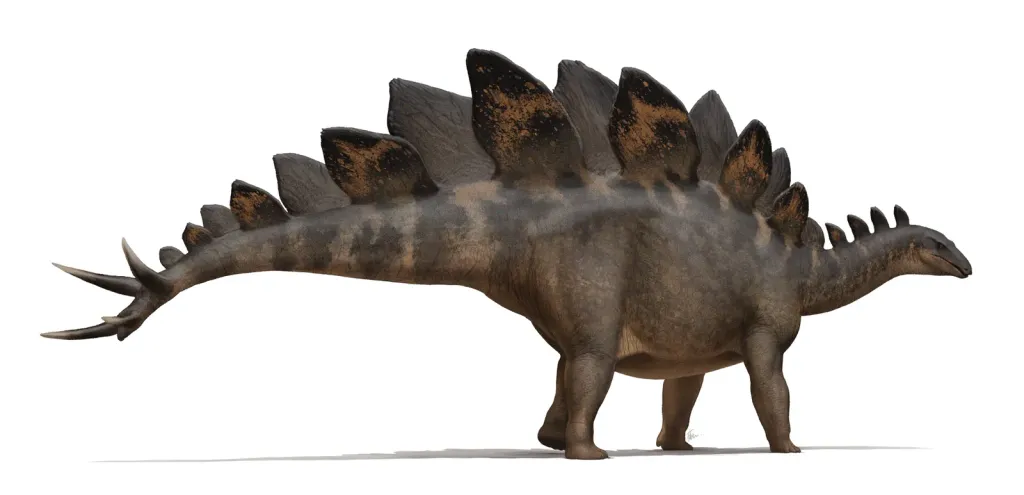
Stegosaurus stenops
Pronounced STEG-oh-SORE-us STEN-ops
Thyreophora · Stegosauridae
A plated thyreophoran from the Late Jurassic Morrison Formation of the western United States, with two rows of tall bony plates along its back and four tail spikes. Known from the exceptionally complete specimen "Sophie".
- Armored
- Quadrupedal
- Famous specimen
- Unusual anatomy
- Movie icon
- Period
- Jurassic· Kimmeridgian
- Diet
- Herbivore
- Length
- 6.5 m
- Mass
- 1,560 kgpublished range 1,080–2,260 kg
- Location
- Colorado, Wyoming
Quick answers
- How big was Stegosaurus stenops?
- Stegosaurus stenops was about 6.5 m long. It stood about 2–2.6 m tall at the hips. It weighed about 1.1–2.3 t. (Paul 2016; Brassey et al. 2015)
- When did Stegosaurus stenops live?
- Stegosaurus stenops lived during the Late Jurassic, about 154.8–145 million years ago. (Cohen et al. 2023; Maidment et al. 2015)
- Where have Stegosaurus stenops fossils been found?
- Fossils of Stegosaurus stenops have been found in Morrison Formation (Colorado) and Wyoming. (Marsh 1887; Maidment et al. 2015)
- What did Stegosaurus stenops eat?
- Stegosaurus stenops was a herbivore. (Marsh 1887; Maidment et al. 2015)
- Who named Stegosaurus stenops, and when?
- Stegosaurus stenops was described by Othniel Charles Marsh in 1887. (Marsh 1887)
- Was Stegosaurus stenops in Jurassic Park?
- Yes. Stegosaurus stenops appears in The Lost World: Jurassic Park (1997), Jurassic Park III (2001), Jurassic World (2015), Jurassic World: Fallen Kingdom (2018), and Jurassic World Dominion (2022). Plated herbivores that defend their young in The Lost World, then brief appearances in each later film. Jurassic World shows the tail dragging low; the skeleton points to a tail held more horizontally. (Wikipedia: Dinosaurs in Jurassic Park 2026; Maidment et al. 2015)
On this page

STEG-oh-SORE-us STEN-ops
- Period
- Jurassic154.8–145 Ma
- Diet
- Herbivore
- Length
- 6.5 m
- Mass
- 1.6 t
- Classification
- Thyreophora · Stegosauridae
- Described
- 1887, Othniel Charles Marsh
Overview
Stegosaurus stenops lived in western North America in the Late Jurassic, and its fossils come from the Morrison Formation. O. C. Marsh named the species in 1887 from a nearly complete, articulated skeleton (USNM 4934) collected at Garden Park, Colorado.
It was a four-legged plant eater with a small, narrow head, two alternating rows of large plates along its back and two pairs of spikes at the end of the tail. The best-known individual, NHMUK PV R36730 ("Sophie"), from Red Canyon Ranch in Wyoming, is about 85 percent complete; Maidment et al. (2015) found it was not fully grown.
Brassey et al. (2015) modelled Sophie's volume and estimated about 1.6 tonnes, noting that equations based on limb bones give much higher values. Full-grown animals were larger.
Name meaning
From Greek stegos ("roof") and sauros ("lizard"), as Marsh first thought the plates lay flat like roof tiles; stenops means "narrow face" (Marsh 1887).
Biology & evidence
What scientists think about how this animal lived, and how strong the evidence for each idea is.
Behavior
Stegosaurus used its tail spikes to defend itself against predators such as Allosaurus.
Evidence level: Strong evidenceAn Allosaurus bone has a hole that matches a Stegosaurus spike, and many spikes are broken and healed at the tip. Both show the spikes hit things hard, and the most likely targets were predators.
Evidence for / against · 2
Evidence for
Specimen · Allosaurus vertebra pierced by a Stegosaurus spike
An Allosaurus tail vertebra with a healed puncture matching the size and shape of a Stegosaurus tail spike.
Specimen · Damaged and broken Stegosaurus tail spikes
A notable share of Stegosaurus tail spikes are broken and remodelled at the tip, consistent with use in impacts.
Other
The plates of Stegosaurus were mainly for display.
Evidence level: HypothesisThe plates were probably too thin to protect and their blood vessels are what any growing bone needs. Display or recognition is the leading idea, with heat control a possible side effect, but a function cannot be observed in fossils.
Evidence for / against · 1
Evidence for
Histology · Stegosaurus plate histology
Thin sections of the plates show thin bone with many blood channels; the internal structure fits growth of a keratin-covered display structure better than a dedicated radiator.
The plates of Stegosaurus stood in two staggered rows along its back.
Evidence level: Direct evidenceSkeletons found with the plates still in position show the arrangement directly: two rows, offset from each other.
Evidence for / against · 1
Evidence for
Specimen · Articulated Stegosaurus with plates in place
Specimens found with plates still in place show two staggered rows along the back, not one row or pairs.
Specimen: USNM 4934 “Road Kill”, NHMUK PV R36730 “Sophie”
Size
- Length
- 6.5 m
- Height
- 2.3 mpublished range 2–2.6 m
- Mass
- 1,560 kgpublished range 1,080–2,260 kg
(21.3 ft)
(7.5 ft)
Based on NHMUK PV R36730 ("Sophie")
Based on NHMUK PV R36730 "Sophie" (not fully grown)
Timeline
Periods: Kimmeridgian (154.8–149.2 Ma), Tithonian (149.2–145 Ma), Late Jurassic (161.5–145 Ma)
Ages are the ICS 2023/09 bounds of the Kimmeridgian and Tithonian, the stage(s) the fossils are assigned to; they bracket the record and are not dated first/last appearances.
Location
Formations
- Morrison Formation · Colorado
- Garden Park, near Cañon City, Colorado · Morrison Formation · Colorado · position approximate
These are the places where fossils have been found, not the full area where the animal lived.
Ecosystem
Lived in: Morrison
156–147 million years ago · floodplain, river system, open woodland, lake
A vast, seasonally dry floodplain crossed by rivers in the western interior of North America in the Late Jurassic, with a wet and a dry season, conifer and fern vegetation along the water and giant sauropods in abundance.
Same ecosystem

Same ecosystem

Same ecosystem

Same ecosystem

Same ecosystem

Same ecosystem

Classification
- cladeDinosauria
- cladeOrnithischia
- cladeThyreophora
- familyStegosauridae
- genusStegosaurus
- speciesStegosaurus stenops
Taxonomic status: Valid
Fossil record

| Catalog number | Status | Institution | Found |
|---|---|---|---|
| USNM 4934 “Road Kill” | Holotype | National Museum of Natural History, Smithsonian Institution (USNM) | 1886 |
| NHMUK PV R36730 “Sophie” | Referred specimen | Natural History Museum, London (NHMUK) | 2003 |
What has been found
Holotype: USNM 4934 “Road Kill”
- Preserved
- Partial
- Reconstructed
- Unknown / not recorded
Holotype: USNM 4934 “Road Kill”
Region by region (table)
| Region | State |
|---|---|
| Skull | Preserved |
| Mandible | Unknown / not recorded |
| Teeth | Unknown / not recorded |
| Cervical vertebrae | Preserved |
| Dorsal vertebrae | Preserved |
| Sacrum | Unknown / not recorded |
| Caudal vertebrae | Partial |
| Ribs | Unknown / not recorded |
| Gastralia | Unknown / not recorded |
| Scapula / shoulder girdle | Unknown / not recorded |
| Humerus | Preserved |
| Forearm (radius / ulna) | Unknown / not recorded |
| Hand (manus) | Unknown / not recorded |
| Pelvis | Partial |
| Femur | Preserved |
| Tibia / fibula | Unknown / not recorded |
| Foot (pes) | Unknown / not recorded |
Referred specimen: NHMUK PV R36730 “Sophie”
Region by region (table)
| Region | State |
|---|---|
| Skull | Preserved |
| Mandible | Preserved |
| Teeth | Unknown / not recorded |
| Cervical vertebrae | Preserved |
| Dorsal vertebrae | Preserved |
| Sacrum | Unknown / not recorded |
| Caudal vertebrae | Preserved |
| Ribs | Preserved |
| Gastralia | Unknown / not recorded |
| Scapula / shoulder girdle | Unknown / not recorded |
| Humerus | Preserved |
| Forearm (radius / ulna) | Preserved |
| Hand (manus) | Unknown / not recorded |
| Pelvis | Preserved |
| Femur | Preserved |
| Tibia / fibula | Preserved |
| Foot (pes) | Partial |

Gallery

Discovery
- Year described
- 1887
- Described by
- Othniel Charles Marsh
- Type specimen
- USNM 4934

Discovery timeline
1886 · Specimen recovered
Felch finds the "Road Kill" Stegosaurus at Garden Park
Marshall Felch collects an articulated Stegosaurus for Marsh in Garden Park, Colorado.
People: Marshall P. Felch
1887 · Formally described
Marsh names Stegosaurus stenops
Marsh describes the skull and armour of Stegosaurus and names S. stenops.
People: Othniel Charles Marsh
2013 · Revision
S. stenops made the type species of Stegosaurus
After a petition by Galton (2010), the ICZN replaces the undiagnostic S. armatus with S. stenops as the type species.
2015 · Major study
Sophie described
The most complete Stegosaurus is described and its mass estimated.
In Jurassic Park & Jurassic World
Films
- The Lost World: Jurassic Park (1997)
- Jurassic Park III (2001)
- Jurassic World (2015)
- Jurassic World: Fallen Kingdom (2018)
- Jurassic World Dominion (2022)
On screen
Plated herbivores that defend their young in The Lost World, then brief appearances in each later film.
Film vs fossils
- Jurassic World shows the tail dragging low; the skeleton points to a tail held more horizontally.
- The tail spikes were real weapons: an Allosaurus tail bone carries a wound that matches a Stegosaurus spike.
Film titles are used for identification only. DinoDex is not affiliated with or endorsed by the Jurassic Park / Jurassic World franchise. All dinosaurs seen in the films
Sources
- (2026). Wikipedia: Dinosaurs in Jurassic Park. Wikipedia. https://en.wikipedia.org/wiki/Dinosaurs_in_Jurassic_Park (opens in a new tab)
- Brassey, C. A., Maidment, S. C. R. & Barrett, P. M. (2015). Body mass estimates of an exceptionally complete Stegosaurus (Ornithischia: Thyreophora): comparing volumetric and linear bivariate mass estimation methods. Biology Letters 11(3): 20140984. doi:10.1098/rsbl.2014.0984 (opens in a new tab)
- Carpenter, K., Sanders, F., McWhinney, L. A. & Wood, L. (2005). Evidence for predator-prey relationships: examples for Allosaurus and Stegosaurus. In Carpenter, K. (ed.), The Carnivorous Dinosaurs, Indiana University Press, pp. 325-350.
- Cohen, K. M., Harper, D. A. T., Gibbard, P. L. & Car, N. (2023). International Chronostratigraphic Chart (v2023/09). International Commission on Stratigraphy. https://stratigraphy.org/ICSchart/ChronostratChart2023-09.pdf (opens in a new tab)
- Maidment, S. C. R., Brassey, C. & Barrett, P. M. (2015). The postcranial skeleton of an exceptionally complete individual of the plated dinosaur Stegosaurus stenops (Dinosauria: Thyreophora) from the Upper Jurassic Morrison Formation of Wyoming, U.S.A.. PLoS ONE 10(10): e0138352. doi:10.1371/journal.pone.0138352 (opens in a new tab)
- Marsh, O. C. (1887). Principal characters of American Jurassic dinosaurs. Part IX. The skull and dermal armor of Stegosaurus. American Journal of Science (series 3) 34: 413-417.
- Paul, G. S. (2016). The Princeton Field Guide to Dinosaurs (2nd edition). Princeton University Press.