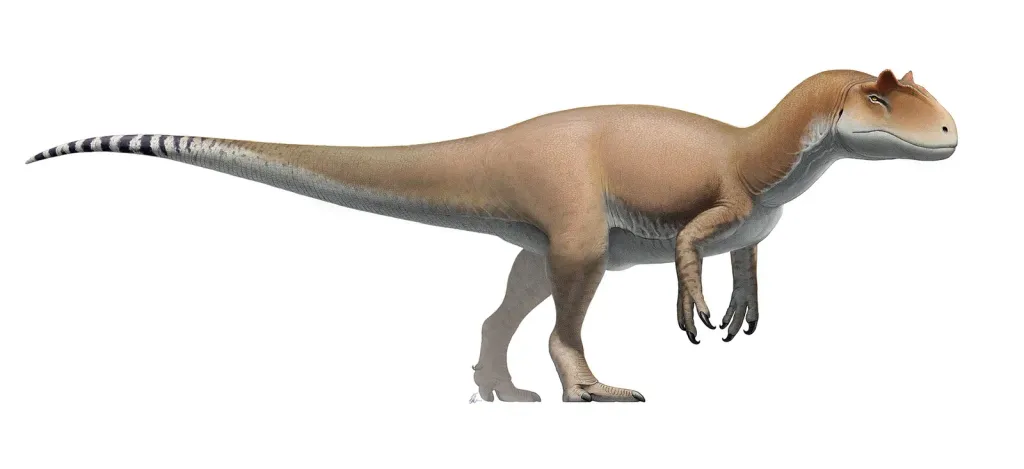
Allosaurus fragilis
Pronounced AL-oh-SORE-us FRAJ-ih-lis
Tetanurae · Allosauridae
The commonest large predator of the Late Jurassic Morrison Formation of the western United States, an allosauroid theropod known from hundreds of individuals, many from the Cleveland-Lloyd Quarry in Utah.
- Bipedal
- Apex predator
- Movie icon
- Possible pack behavior
- Period
- Jurassic· Kimmeridgian
- Diet
- Carnivore
- Length
- 8.5 m
- Mass
- 1,500–1,700 kg
- Location
- Colorado, Utah, United States
Quick answers
- How big was Allosaurus fragilis?
- Allosaurus fragilis was about 8.5 m long. It stood about 1.9–2.4 m tall at the hips. It weighed about 1.5–1.7 t. (Paul 2010; Paul 2016)
- When did Allosaurus fragilis live?
- Allosaurus fragilis lived during the Late Jurassic, about 154.8–145 million years ago. (Cohen et al. 2023; Chure & Loewen 2020)
- Where have Allosaurus fragilis fossils been found?
- Fossils of Allosaurus fragilis have been found in Morrison Formation (Colorado) and United States. (Marsh 1877; Madsen 1976)
- What did Allosaurus fragilis eat?
- Allosaurus fragilis was a carnivore. (Marsh 1877; Madsen 1976)
- Who named Allosaurus fragilis, and when?
- Allosaurus fragilis was described by Othniel Charles Marsh in 1877. (Marsh 1877)
- Was Allosaurus fragilis in Jurassic Park?
- Yes. Allosaurus fragilis appears in Jurassic World: Fallen Kingdom (2018) and Jurassic World Dominion (2022). A large predator sharing the screen with Cretaceous animals in Fallen Kingdom and Dominion. Allosaurus lived in the Late Jurassic, tens of millions of years before T. rex; the films mix animals from different eras. (Wikipedia: Dinosaurs in Jurassic Park 2026; Madsen 1976)
On this page

AL-oh-SORE-us FRAJ-ih-lis
- Period
- Jurassic154.8–145 Ma
- Diet
- Carnivore
- Length
- 8.5 m
- Mass
- 1.5–1.7 t
- Location
- United States
- Classification
- Tetanurae · Allosauridae
- Described
- 1877, Othniel Charles Marsh
Overview
Allosaurus fragilis lived in western North America in the Late Jurassic, alongside Stegosaurus and giant sauropods such as Brachiosaurus. O. C. Marsh named it in 1877 from partial remains (YPM 1930) from Garden Park, Colorado, during the "Bone Wars".
It was a large, bipedal predator with a long, narrow skull, a pair of small horns in front of the eyes, three-fingered arms with large claws and serrated, blade-like teeth. The Cleveland-Lloyd Quarry in Utah has yielded bones of dozens of individuals, which James Madsen used for his 1976 monograph, still the standard description of the species.
Not every Morrison Allosaurus belongs to A. fragilis. Chure and Loewen (2020) named A. jimmadseni from the lower part of the formation, including the well-known specimen "Big Al" (MOR 693), which older size estimates used as a stand-in for A. fragilis.
Name meaning
From Greek allos ("different, other") and sauros ("lizard"), for its unusual vertebrae; Latin fragilis ("fragile") refers to the lightly built vertebrae (Marsh 1877).
Biology & evidence
What scientists think about how this animal lived, and how strong the evidence for each idea is.
Feeding
Allosaurus attacked with an open-mouthed strike, using its upper teeth like a hatchet.
Evidence level: HypothesisIts skull could withstand strong impacts though its bite was relatively weak, which led to the idea that it slammed its upper jaw into prey. This is an interpretation of a model, not an observed behaviour.
Evidence for / against · 1
Evidence for
Biomechanical model · Allosaurus skull finite-element model
A finite-element model of the Allosaurus skull finds it strong under impact but with a modest bite muscle force.
Injuries & disease
Allosaurus often survived serious injuries and infections.
Evidence level: Strong evidenceHealed fractures and infected bones are common in Allosaurus skeletons, including a young animal with injuries to many bones.
Evidence for / against · 1
Evidence for
Specimen · Injuries and infections in Allosaurus skeletons
Many Allosaurus bones, including a sub-adult with 19 injured or infected bones, show a hard, injury-prone life.
Behavior
Allosaurus preyed on or fought Stegosaurus.
Evidence level: Strong evidenceAn Allosaurus bone was wounded by a Stegosaurus spike and healed, direct proof of a violent encounter between the two.
Evidence for / against · 1
Evidence for
Specimen · Allosaurus vertebra pierced by a Stegosaurus spike
An Allosaurus tail vertebra with a healed puncture matching the size and shape of a Stegosaurus tail spike.
Social life
Allosaurus lived and hunted in groups.
Evidence level: DisputedMany Allosaurus were found together at Cleveland-Lloyd, but the site is read as a trap or a drought gathering. Mass death does not show group living.
Evidence for / against · 1
Evidence against
Other · Cleveland-Lloyd Quarry taphonomy
Tens of Allosaurus individuals mixed in one quarry, interpreted variously as a predator trap, a drought assemblage or a slow build-up.

Size
- Length
- 8.5 m
- Height
- 2.1 mpublished range 1.9–2.4 m
- Mass
- 1,500–1,700 kg
(27.9 ft)
(6.9 ft)
Based on AMNH 5753 / USNM 4734 (femur c. 0.85 m)
Based on MOR 693 "Big Al" (volumetric model); general adult (Paul 2010)
Timeline
Periods: Kimmeridgian (154.8–149.2 Ma), Tithonian (149.2–145 Ma), Late Jurassic (161.5–145 Ma)
Ages are the ICS 2023/09 bounds of the Kimmeridgian and Tithonian, the stage(s) the fossils are assigned to; they bracket the record and are not dated first/last appearances. Chure & Loewen (2020) restrict A. fragilis to the upper part of the Morrison Formation, so the real range is narrower.
Location
Formations
- Morrison Formation · Colorado
- Garden Park, near Cañon City, Colorado · Morrison Formation · Colorado · position approximate
These are the places where fossils have been found, not the full area where the animal lived.
Ecosystem
Lived in: Morrison
156–147 million years ago · floodplain, river system, open woodland, lake
A vast, seasonally dry floodplain crossed by rivers in the western interior of North America in the Late Jurassic, with a wet and a dry season, conifer and fern vegetation along the water and giant sauropods in abundance.
Same ecosystem

Same ecosystem

Same ecosystem

Same ecosystem

Same ecosystem

Same ecosystem

Classification
- cladeDinosauria
- cladeSaurischia
- cladeTheropoda
- cladeTetanurae
- superfamilyAllosauroidea
- familyAllosauridae
- genusAllosaurus
- speciesAllosaurus fragilis
Taxonomic status: Valid
Fossil record

| Catalog number | Status | Institution | Found |
|---|---|---|---|
| YPM 1930 | Holotype | Yale Peabody Museum (YPM) | 1877 |
| USNM 4734 | Referred specimen | National Museum of Natural History, Smithsonian Institution (USNM) | 1883 |
What has been found
Holotype: YPM 1930
- Preserved
- Partial
- Reconstructed
- Unknown / not recorded
Holotype: YPM 1930
Region by region (table)
| Region | State |
|---|---|
| Skull | Unknown / not recorded |
| Mandible | Unknown / not recorded |
| Teeth | Partial |
| Cervical vertebrae | Unknown / not recorded |
| Dorsal vertebrae | Partial |
| Sacrum | Unknown / not recorded |
| Caudal vertebrae | Unknown / not recorded |
| Ribs | Unknown / not recorded |
| Gastralia | Unknown / not recorded |
| Scapula / shoulder girdle | Unknown / not recorded |
| Humerus | Partial |
| Forearm (radius / ulna) | Unknown / not recorded |
| Hand (manus) | Unknown / not recorded |
| Pelvis | Unknown / not recorded |
| Femur | Unknown / not recorded |
| Tibia / fibula | Unknown / not recorded |
| Foot (pes) | Unknown / not recorded |
Referred specimen: USNM 4734
Region by region (table)
| Region | State |
|---|---|
| Skull | Preserved |
| Mandible | Preserved |
| Teeth | Unknown / not recorded |
| Cervical vertebrae | Preserved |
| Dorsal vertebrae | Preserved |
| Sacrum | Unknown / not recorded |
| Caudal vertebrae | Partial |
| Ribs | Unknown / not recorded |
| Gastralia | Unknown / not recorded |
| Scapula / shoulder girdle | Unknown / not recorded |
| Humerus | Preserved |
| Forearm (radius / ulna) | Unknown / not recorded |
| Hand (manus) | Preserved |
| Pelvis | Preserved |
| Femur | Preserved |
| Tibia / fibula | Unknown / not recorded |
| Foot (pes) | Preserved |

Gallery

Discovery
- Year described
- 1877
- Described by
- Othniel Charles Marsh
- Type specimen
- YPM 1930
Discovery timeline
1877 · Formally described
Marsh names Allosaurus fragilis
O. C. Marsh names the genus from partial remains from Garden Park, Colorado.
People: Othniel Charles Marsh
1883 · Specimen recovered
Felch collects a complete Allosaurus at Garden Park
Marshall Felch collects the skeleton later described by Gilmore (1920).
People: Marshall P. Felch
1976 · Major study
Madsen publishes the Allosaurus osteology
James Madsen describes Allosaurus from the thousands of bones of the Cleveland-Lloyd Quarry.
People: James H. Madsen Jr.
2020 · Revision
Allosaurus jimmadseni split from A. fragilis
Chure and Loewen name a second species from the lower Morrison Formation.
People: Daniel J. Chure
In Jurassic Park & Jurassic World
Films
- Jurassic World: Fallen Kingdom (2018)
- Jurassic World Dominion (2022)
On screen
A large predator sharing the screen with Cretaceous animals in Fallen Kingdom and Dominion.
Film vs fossils
- Allosaurus lived in the Late Jurassic, tens of millions of years before T. rex; the films mix animals from different eras.
- It really did clash with Stegosaurus: a spike wound in an Allosaurus tail bone shows it.
Film titles are used for identification only. DinoDex is not affiliated with or endorsed by the Jurassic Park / Jurassic World franchise. All dinosaurs seen in the films
Sources
- (2026). Wikipedia: Dinosaurs in Jurassic Park. Wikipedia. https://en.wikipedia.org/wiki/Dinosaurs_in_Jurassic_Park (opens in a new tab)
- Bates, K. T., Manning, P. L., Hodgetts, D. & Sellers, W. I. (2009). Estimating mass properties of dinosaurs using laser imaging and 3D computer modelling. PLoS ONE 4(2): e4532. doi:10.1371/journal.pone.0004532 (opens in a new tab)
- Carpenter, K., Sanders, F., McWhinney, L. A. & Wood, L. (2005). Evidence for predator-prey relationships: examples for Allosaurus and Stegosaurus. In Carpenter, K. (ed.), The Carnivorous Dinosaurs, Indiana University Press, pp. 325-350.
- Chure, D. J. & Loewen, M. A. (2020). Cranial anatomy of Allosaurus jimmadseni, a new species from the lower part of the Morrison Formation (Upper Jurassic) of Western North America. PeerJ 8: e7803. doi:10.7717/peerj.7803 (opens in a new tab)
- Cohen, K. M., Harper, D. A. T., Gibbard, P. L. & Car, N. (2023). International Chronostratigraphic Chart (v2023/09). International Commission on Stratigraphy. https://stratigraphy.org/ICSchart/ChronostratChart2023-09.pdf (opens in a new tab)
- Madsen, J. H., Jr. (1976). Allosaurus fragilis: a revised osteology. Utah Geological and Mineral Survey Bulletin 109: 1-163.
- Marsh, O. C. (1877). Notice of new dinosaurian reptiles from the Jurassic formation. American Journal of Science (series 3) 14: 514-516.
- Paul, G. S. (2010). The Princeton Field Guide to Dinosaurs. Princeton University Press.
- Paul, G. S. (2016). The Princeton Field Guide to Dinosaurs (2nd edition). Princeton University Press.