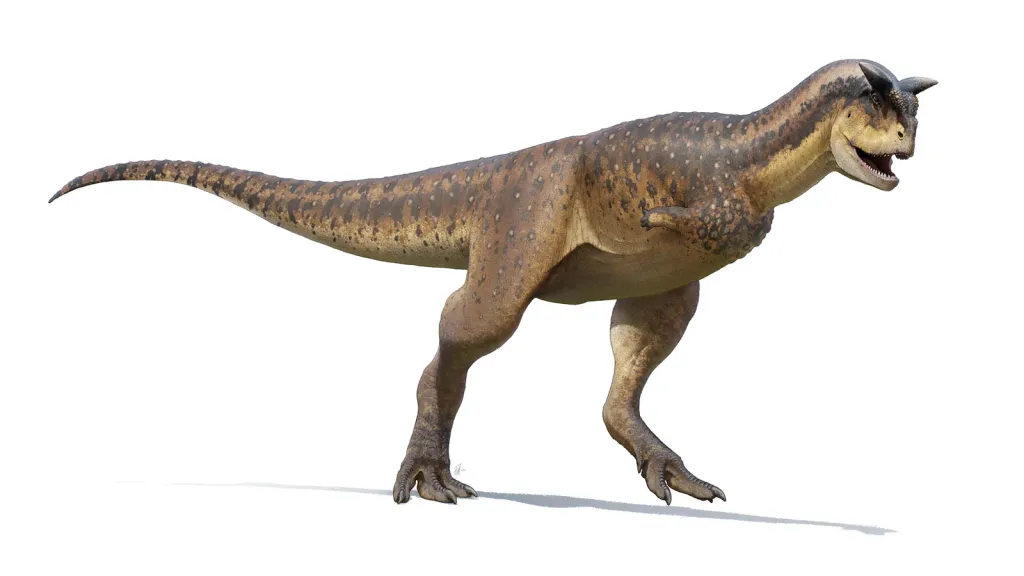
Carnotaurus sastrei
Pronounced KAR-noh-TORE-us SAS-tree-eye
Ceratosauria · Abelisauridae
A horned abelisaurid theropod from the Late Cretaceous of Patagonia, with two bull-like horns above the eyes, tiny arms and the best-known skin of any large theropod.
- Horned
- Bipedal
- Skin impressions known
- Unusual anatomy
- Movie icon
- Period
- Cretaceous· Campanian
- Diet
- Carnivore
- Length
- 7.5–8 m
- Mass
- 1,300–2,100 kg
- Location
- Chubut Province, Argentina
Quick answers
- How big was Carnotaurus sastrei?
- Carnotaurus sastrei was about 7.5–8 m long. It stood about 2.3–2.7 m tall at the hips. It weighed about 1.3–2.1 t. (Bonaparte et al. 1990; Paul 2016)
- When did Carnotaurus sastrei live?
- Carnotaurus sastrei lived during the Late Cretaceous, about 83.6–66 million years ago. (Cohen et al. 2023; Bonaparte et al. 1990)
- Where have Carnotaurus sastrei fossils been found?
- Fossils of Carnotaurus sastrei have been found in La Colonia Formation (Chubut Province) and Argentina. (Bonaparte 1985; Bonaparte et al. 1990)
- What did Carnotaurus sastrei eat?
- Carnotaurus sastrei was a carnivore. (Bonaparte 1985; Bonaparte et al. 1990)
- Who named Carnotaurus sastrei, and when?
- Carnotaurus sastrei was described by José F. Bonaparte in 1985. (Bonaparte 1985; Bonaparte et al. 1990)
- Was Carnotaurus sastrei in Jurassic Park?
- Yes. Carnotaurus sastrei appears in Jurassic World: Fallen Kingdom (2018) and Jurassic World Dominion (2022). A horned predator seen during the volcanic eruption in Fallen Kingdom. Skin impressions show it was covered in small scales, as the films show. (Wikipedia: Dinosaurs in Jurassic Park 2026; Hendrickx & Bell 2021)
On this page

KAR-noh-TORE-us SAS-tree-eye
- Period
- Cretaceous83.6–66 Ma
- Diet
- Carnivore
- Length
- 7.5–8 m
- Mass
- 1.3–2.1 t
- Location
- Argentina
- Classification
- Ceratosauria · Abelisauridae
- Described
- 1985, José F. Bonaparte
Overview
Carnotaurus sastrei lived in Patagonia, Argentina, near the end of the Cretaceous. José Bonaparte found its single known skeleton in 1984 in the La Colonia Formation of Chubut Province and named it in 1985.
It had a short, deep skull with a pair of thick horns above the eyes, and arms even more reduced than those of T. rex, with stubby forearms. The skeleton was found with large areas of skin impressions: rows of big conical bumps among small scales, and no sign of feathers (Hendrickx & Bell 2021).
Its tail had very large muscle attachments, and Persons and Currie (2011) argued it was one of the fastest large theropods in a straight line, though not agile in turns. How it used its horns, and how it hunted, remain open questions.
Name meaning
From Latin carnis ("flesh") and taurus ("bull"): "meat-eating bull", for its horns; sastrei honours Ángel Sastre, owner of the ranch where it was found (Bonaparte 1985).
Biology & evidence
What scientists think about how this animal lived, and how strong the evidence for each idea is.
Locomotion
Carnotaurus was a fast runner in a straight line but not agile.
Evidence level: Moderate evidenceIts tail had room for very large leg-retracting muscles, which suggests high speed. The same stiff tail would have made sharp turns difficult.
Evidence for / against · 1
Evidence for
Biomechanical model · Carnotaurus tail muscle reconstruction
Reconstruction of the caudofemoralis muscle, very large thanks to wide tail ribs, the main muscle for pulling the leg back.
Specimen: MACN-CH 894
Skin & covering
Carnotaurus had scaly skin with rows of large bumps and no feathers.
Evidence level: Direct evidenceIts only skeleton was found with large patches of skin impressions, showing small scales mixed with bigger cone-shaped ones on several parts of the body.
Evidence for / against · 1
Evidence for
Skin impression · Carnotaurus skin impressions
Skin from the neck, shoulder, chest and tail: small pebbly scales with scattered large conical scales, and no feathers.
Specimen: MACN-CH 894
Behavior
Carnotaurus used its horns in head-butting contests.
Evidence level: HypothesisModels show the skull could bear the loads of head-to-head shoving, but how the horns were used is not observed. Display is also possible.
Evidence for / against · 1
Evidence for
Biomechanical model · Carnotaurus skull finite-element model
Stress model of the skull and jaws: a fast but relatively weak bite; the horns and skull roof can bear head-butting loads.
Specimen: MACN-CH 894
Other
The arms of Carnotaurus were vestigial and had little use.
Evidence level: Moderate evidenceIts forearms are extremely short and its hands lack proper claws, so the arms were probably of little use for catching prey.
Evidence for / against · 1
Evidence for
Specimen · Carnotaurus reduced forelimbs
Tiny arms with forearm bones about a quarter the length of the upper arm and ball-like hand bones.
Specimen: MACN-CH 894

Size
- Length
- 7.5–8 m
- Height
- 2.5 mpublished range 2.3–2.7 m
- Mass
- 1,300–2,100 kg
(26.2 ft)
Based on MACN-CH 894 (holotype, only specimen)
(8.2 ft)
Based on MACN-CH 894 (holotype, femur c. 1.03 m)
Based on MACN-CH 894
Timeline
Periods: Campanian (83.6–72.1 Ma), Maastrichtian (72.1–66 Ma), Late Cretaceous (100.5–66 Ma)
Ages are the ICS 2023/09 bounds of the Campanian and Maastrichtian, the stage(s) the fossils are assigned to; they bracket the record and are not dated first/last appearances. The La Colonia Formation is usually cited as late Campanian to early Maastrichtian (~72-69 Ma).
Location
Formations
- La Colonia Formation · Chubut Province
Places
- Bajada Moreno, Telsen Department, Chubut · La Colonia Formation · Chubut Province · position approximate
These are the places where fossils have been found, not the full area where the animal lived.
Ecosystem
Lived in: La Colonia
72–69 million years ago · coastal plain, delta, marine margin
Late Cretaceous coastal plains, estuaries and tidal flats of Patagonia at the edge of an Atlantic incursion.
Classification
- cladeDinosauria
- cladeSaurischia
- cladeTheropoda
- cladeNeotheropoda
- cladeCeratosauria
- familyAbelisauridae
- genusCarnotaurus
- speciesCarnotaurus sastrei
Taxonomic status: Valid
Fossil record

| Catalog number | Status | Institution | Found |
|---|---|---|---|
| MACN-CH 894 | Holotype | Museo Argentino de Ciencias Naturales Bernardino Rivadavia (MACN) | 1984 |
What has been found
Holotype: MACN-CH 894
- Preserved
- Partial
- Reconstructed
- Unknown / not recorded
Region by region (table)
| Region | State |
|---|---|
| Skull | Preserved |
| Mandible | Preserved |
| Teeth | Unknown / not recorded |
| Cervical vertebrae | Preserved |
| Dorsal vertebrae | Preserved |
| Sacrum | Preserved |
| Caudal vertebrae | Partial |
| Ribs | Preserved |
| Gastralia | Unknown / not recorded |
| Scapula / shoulder girdle | Preserved |
| Humerus | Preserved |
| Forearm (radius / ulna) | Preserved |
| Hand (manus) | Partial |
| Pelvis | Preserved |
| Femur | Partial |
| Tibia / fibula | Partial |
| Foot (pes) | Unknown / not recorded · Lower legs largely missing (eroded). |

Discovery
- Year described
- 1985
- Described by
- José F. Bonaparte
- Type specimen
- MACN-CH 894
Discovery timeline
1984 · First material found
Bonaparte finds Carnotaurus in Chubut
An expedition led by José Bonaparte finds the skeleton on the Sastre ranch.
People: José F. Bonaparte
1985 · Formally described
Bonaparte names Carnotaurus sastrei
A short paper names the horned carnivore.
People: José F. Bonaparte
1990 · Major study
Full description of Carnotaurus
Bonaparte, Novas and Coria publish the detailed anatomy.
People: José F. Bonaparte
2021 · Major study
Carnotaurus skin described in detail
Hendrickx and Bell describe the skin impressions.
People: Christophe Hendrickx
In Jurassic Park & Jurassic World
Films
- Jurassic World: Fallen Kingdom (2018)
- Jurassic World Dominion (2022)
On screen
A horned predator seen during the volcanic eruption in Fallen Kingdom.
Film vs fossils
- Skin impressions show it was covered in small scales, as the films show.
- Big tail muscles suggest it was a fast runner for its size.
Film titles are used for identification only. DinoDex is not affiliated with or endorsed by the Jurassic Park / Jurassic World franchise. All dinosaurs seen in the films
Sources
- (2026). Wikipedia: Dinosaurs in Jurassic Park. Wikipedia. https://en.wikipedia.org/wiki/Dinosaurs_in_Jurassic_Park (opens in a new tab)
- Bonaparte, J. F. (1985). A horned Cretaceous carnosaur from Patagonia. National Geographic Research 1(1): 149-151.
- Bonaparte, J. F., Novas, F. E. & Coria, R. A. (1990). Carnotaurus sastrei Bonaparte, the horned, lightly built carnosaur from the Middle Cretaceous of Patagonia. Natural History Museum of Los Angeles County Contributions in Science 416: 1-42.
- Cohen, K. M., Harper, D. A. T., Gibbard, P. L. & Car, N. (2023). International Chronostratigraphic Chart (v2023/09). International Commission on Stratigraphy. https://stratigraphy.org/ICSchart/ChronostratChart2023-09.pdf (opens in a new tab)
- Hendrickx, C. & Bell, P. R. (2021). The scaly skin of the abelisaurid Carnotaurus sastrei (Theropoda: Ceratosauria) from the Upper Cretaceous of Patagonia. Cretaceous Research 128: 104994. doi:10.1016/j.cretres.2021.104994 (opens in a new tab)
- Mazzetta, G. V., Cisilino, A. P., Blanco, R. E. & Calvo, N. (2009). Cranial mechanics and functional interpretation of the horned carnivorous dinosaur Carnotaurus sastrei. Journal of Vertebrate Paleontology 29(3): 822-830. doi:10.1671/039.029.0313 (opens in a new tab)
- Paul, G. S. (2016). The Princeton Field Guide to Dinosaurs (2nd edition). Princeton University Press.
- Persons, W. S. & Currie, P. J. (2011). Dinosaur speed demon: the caudal musculature of Carnotaurus sastrei and implications for the evolution of South American abelisaurids. PLoS ONE 6(10): e25763. doi:10.1371/journal.pone.0025763 (opens in a new tab)