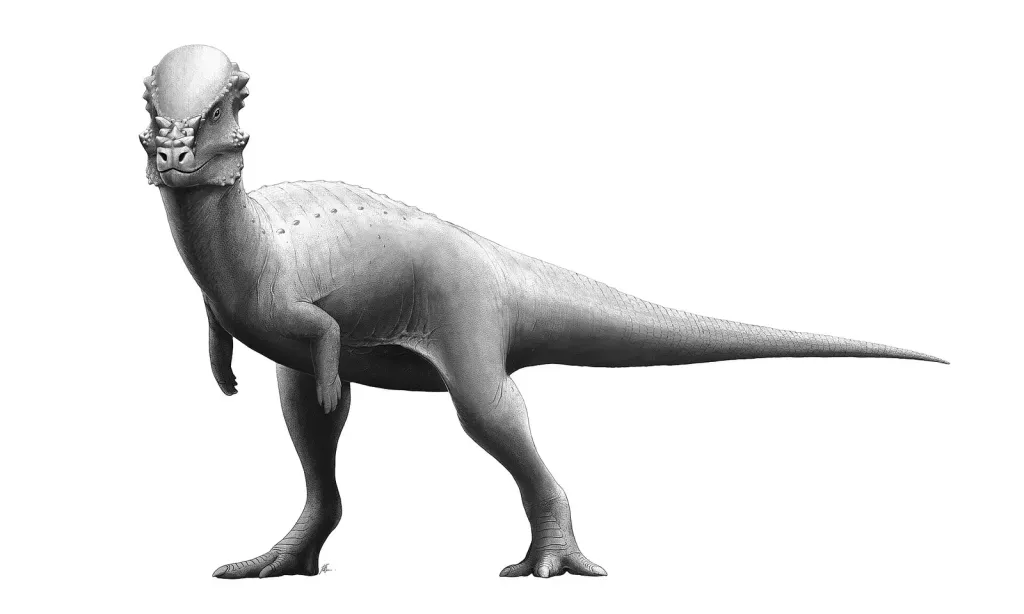
Pachycephalosaurus wyomingensis
Pronounced PAK-ee-SEF-ah-loh-SORE-us wye-oh-ming-EN-sis
Pachycephalosauria · Pachycephalosauridae
A dome-headed dinosaur from the latest Cretaceous of western North America, a neighbour of T. rex. Its skull roof was a thick dome of solid bone; injuries on many domes suggest that pachycephalosaurs butted heads.
- Bipedal
- Unusual anatomy
- Period
- Cretaceous· Maastrichtian
- Diet
- Herbivore
- Length
- 4.5 m
- Mass
- 370–450 kg
- Location
- Montana, Wyoming, South Dakota, North Dakota, United States
Quick answers
- How big was Pachycephalosaurus wyomingensis?
- Pachycephalosaurus wyomingensis was about 4.5 m long. It stood about 1.2–1.6 m tall at the hips. It weighed about 370–450 kg. (Wikipedia: Pachycephalosaurus 2026; Paul 2016)
- When did Pachycephalosaurus wyomingensis live?
- Pachycephalosaurus wyomingensis lived during the Late Cretaceous, about 72.1–66 million years ago. (Paleobiology Database: Pachycephalosaurus occ… 2026; Cohen et al. 2023)
- Where have Pachycephalosaurus wyomingensis fossils been found?
- Fossils of Pachycephalosaurus wyomingensis have been found in Hell Creek Formation (Montana), Lance Formation (Wyoming), and United States. (Gilmore 1931; Brown & Schlaikjer 1943)
- What did Pachycephalosaurus wyomingensis eat?
- Pachycephalosaurus wyomingensis was a herbivore. (Gilmore 1931; Brown & Schlaikjer 1943)
- Who named Pachycephalosaurus wyomingensis, and when?
- Pachycephalosaurus wyomingensis was described by Charles W. Gilmore in 1931. (Gilmore 1931; Paleobiology Database: Pachycephalosaurus occ… 2026)
- Was Pachycephalosaurus wyomingensis in Jurassic Park?
- Yes. Pachycephalosaurus wyomingensis appears in The Lost World: Jurassic Park (1997). Rams a hunters' vehicle with its domed skull in The Lost World. The film animal is about half the length of the real one. (Wikipedia: Dinosaurs in Jurassic Park 2026; Peterson et al. 2013)
On this page

- Period
- Cretaceous72.1–66 Ma
- Diet
- Herbivore
- Length
- 4.5 m
- Mass
- 0.4–0.5 t
- Location
- United States
- Classification
- Pachycephalosauria · Pachycephalosauridae
- Described
- 1931, Charles W. Gilmore
Overview
Pachycephalosaurus wyomingensis lived in western North America at the end of the Cretaceous, in the Hell Creek and Lance formations. Charles Gilmore named the species in 1931 as Troodon wyomingensis, from a skull dome found in Niobrara County, Wyoming; Barnum Brown and Erich Schlaikjer created the genus Pachycephalosaurus in 1943.
It is known mostly from skulls. The skull roof formed a high dome of dense bone, ringed with bony knobs and spikes. Jack Horner and Mark Goodwin (2009) argued that the flat-headed, spiky "Dracorex" and "Stygimoloch" are younger growth stages of Pachycephalosaurus, whose dome inflated and spikes shrank as it grew.
How the dome was used is debated. A survey of 109 pachycephalosaurid skulls found healed lesions on 22% of the domes, clustered at the top, which fits head-to-head butting (Peterson et al. 2013). Flat-headed individuals had no such injuries.
Name meaning
"Thick-headed lizard", from Greek pachys ("thick"), kephalē ("head") and sauros ("lizard") (Brown & Schlaikjer 1943); wyomingensis for Wyoming (Gilmore 1931).
Biology & evidence
What scientists think about how this animal lived, and how strong the evidence for each idea is.
Growth
Dracorex and Stygimoloch are young Pachycephalosaurus.
Evidence level: Moderate evidenceTheir skulls show immature features and fit a growth series in which the dome inflates and the spikes shrink. The idea is widely followed but not universally accepted.
Evidence for / against · 1
Evidence for
Comparative anatomy · Pachycephalosaurus cranial growth series
CT and histology of "Dracorex" and "Stygimoloch" skulls show open sutures and juvenile tissue; their spikes and flat heads match early stages of Pachycephalosaurus skulls such as AMNH 1696.
Specimen: AMNH 1696
Behavior
Pachycephalosaurus used its dome to butt heads.
Evidence level: Moderate evidenceHealed injuries on about a fifth of domes, concentrated at the top, fit head-to-head impacts as in some living hoofed mammals. The dome may also have served for display.
Evidence for / against · 1
Evidence for
Specimen · Pachycephalosaurid dome lesion survey
Of 109 pachycephalosaurid domes, 24 (22%) from at least 9 species have lesions consistent with healed trauma and infection, clustered near the top of the dome; flat-headed specimens have none.
Other
The Pachycephalosaurus dome was made of dense bone.
Evidence level: Direct evidenceThin sections of an adult dome show solid, dense bone tissue.
Evidence for / against · 1
Evidence for
Histology · Pachycephalosaurus dome histology
Sections of an adult dome show dense metaplastic bone with fibrous, acellular tissue.

Size
- Length
- 4.5 m
- Height
- 1.4 mpublished range 1.2–1.6 m
- Mass
- 370–450 kg
(14.8 ft)
(4.6 ft)
Timeline
Periods: Maastrichtian (72.1–66 Ma), Late Cretaceous (100.5–66 Ma)
Maastrichtian bounds of the last-appearance interval in PBDB. PBDB also lists a single Campanian occurrence from Alberta (first appearance 83.6 Ma), left out here as doubtful.
Location
Formations
- Hell Creek Formation · Montana
- Lance Formation · Wyoming
- 9 mi SW of Warren Post Office, Niobrara County, Wyoming · Lance Formation · Wyoming · position approximate
These are the places where fossils have been found, not the full area where the animal lived.
Ecosystem

Lived in: Hell Creek
68–66 million years ago · floodplain, river system, forest, coastal plain
Warm, humid coastal lowlands and river floodplains west of the retreating Western Interior Seaway at the very end of the Cretaceous, with forests of conifers and flowering plants. The ecosystem ends at the Cretaceous-Paleogene extinction.
Same ecosystem

Same ecosystem


Classification
- cladeDinosauria
- cladeOrnithischia
- cladePachycephalosauria
- familyPachycephalosauridae
- genusPachycephalosaurus
- speciesPachycephalosaurus wyomingensis
Taxonomic status: Valid
Fossil record

| Catalog number | Status | Institution | Found |
|---|---|---|---|
| USNM 12031 | Holotype | National Museum of Natural History, Smithsonian Institution (USNM) | — |
| AMNH 1696 | Referred specimen | American Museum of Natural History (AMNH) | — |
What has been found
Holotype: USNM 12031
- Preserved
- Partial
- Reconstructed
- Unknown / not recorded
Holotype: USNM 12031
Region by region (table)
| Region | State |
|---|---|
| Skull | Partial · Frontoparietal dome. |
| Mandible | Unknown / not recorded |
| Teeth | Unknown / not recorded |
| Cervical vertebrae | Unknown / not recorded |
| Dorsal vertebrae | Unknown / not recorded |
| Sacrum | Unknown / not recorded |
| Caudal vertebrae | Unknown / not recorded |
| Ribs | Unknown / not recorded |
| Gastralia | Unknown / not recorded |
| Scapula / shoulder girdle | Unknown / not recorded |
| Humerus | Unknown / not recorded |
| Forearm (radius / ulna) | Unknown / not recorded |
| Hand (manus) | Unknown / not recorded |
| Pelvis | Unknown / not recorded |
| Femur | Unknown / not recorded |
| Tibia / fibula | Unknown / not recorded |
| Foot (pes) | Unknown / not recorded |
Referred specimen: AMNH 1696
Region by region (table)
| Region | State |
|---|---|
| Skull | Preserved |
| Mandible | Unknown / not recorded |
| Teeth | Unknown / not recorded |
| Cervical vertebrae | Unknown / not recorded |
| Dorsal vertebrae | Unknown / not recorded |
| Sacrum | Unknown / not recorded |
| Caudal vertebrae | Unknown / not recorded |
| Ribs | Unknown / not recorded |
| Gastralia | Unknown / not recorded |
| Scapula / shoulder girdle | Unknown / not recorded |
| Humerus | Unknown / not recorded |
| Forearm (radius / ulna) | Unknown / not recorded |
| Hand (manus) | Unknown / not recorded |
| Pelvis | Unknown / not recorded |
| Femur | Unknown / not recorded |
| Tibia / fibula | Unknown / not recorded |
| Foot (pes) | Unknown / not recorded |
Discovery
- Year described
- 1931
- Described by
- Charles W. Gilmore
- Type specimen
- USNM 12031
Discovery timeline
1931 · Formally described
Gilmore names Troodon wyomingensis
Gilmore describes a thick skull dome from the Lance Formation of Wyoming as a new species of Troodon.
People: Charles W. Gilmore
1943 · Renamed
Brown and Schlaikjer name Pachycephalosaurus
A study of dome-headed dinosaurs creates the genus Pachycephalosaurus and moves wyomingensis into it.
People: Barnum Brown, Erich M. Schlaikjer
2009 · Major study
Horner and Goodwin link Dracorex and Stygimoloch to Pachycephalosaurus
Histology and CT scans are used to build a growth series.
People: John R. Horner, Mark B. Goodwin
2013 · Major study
Survey of dome injuries in pachycephalosaurs
Peterson, Dischler and Longrich count lesions on 109 domes.
People: Joseph E. Peterson
In Jurassic Park & Jurassic World
Films
- The Lost World: Jurassic Park (1997)
On screen
Rams a hunters' vehicle with its domed skull in The Lost World.
Film vs fossils
- The film animal is about half the length of the real one.
- Whether the dome was used for ramming is debated; injuries on domes support some head-to-head combat.
Film titles are used for identification only. DinoDex is not affiliated with or endorsed by the Jurassic Park / Jurassic World franchise. All dinosaurs seen in the films
Sources
- (2026). Paleobiology Database: Pachycephalosaurus occurrences. The Paleobiology Database (paleobiodb.org), data service 1.2, accessed 2026-09-23. https://paleobiodb.org/data1.2/occs/list.txt?base_name=Pachycephalosaurus&show=coords,paleoloc,strat,loc,ref&pgm=gplates (opens in a new tab)
- (2026). Wikipedia: Pachycephalosaurus. Wikipedia (English), accessed 2026-09-23. https://en.wikipedia.org/wiki/Pachycephalosaurus (opens in a new tab)
- (2026). Wikipedia: Dinosaurs in Jurassic Park. Wikipedia. https://en.wikipedia.org/wiki/Dinosaurs_in_Jurassic_Park (opens in a new tab)
- Brown, B. & Schlaikjer, E. M. (1943). A study of the troödont dinosaurs with the description of a new genus and four new species. Bulletin of the American Museum of Natural History 82(5): 115-150.
- Cohen, K. M., Harper, D. A. T., Gibbard, P. L. & Car, N. (2023). International Chronostratigraphic Chart (v2023/09). International Commission on Stratigraphy. https://stratigraphy.org/ICSchart/ChronostratChart2023-09.pdf (opens in a new tab)
- Gilmore, C. W. (1931). A new species of troödont dinosaur from the Lance formation of Wyoming. Proceedings of the United States National Museum 79(9): 1-6. doi:10.5479/si.00963801.79-2875.1 (opens in a new tab)
- Horner, J. R. & Goodwin, M. B. (2009). Extreme cranial ontogeny in the Upper Cretaceous dinosaur Pachycephalosaurus. PLoS ONE 4: e7626. doi:10.1371/journal.pone.0007626 (opens in a new tab)
- Paul, G. S. (2016). The Princeton Field Guide to Dinosaurs (2nd edition). Princeton University Press.
- Peterson, J. E., Dischler, C. & Longrich, N. R. (2013). Distributions of cranial pathologies provide evidence for head-butting in dome-headed dinosaurs (Pachycephalosauridae). PLoS ONE 8: e68620. doi:10.1371/journal.pone.0068620 (opens in a new tab)