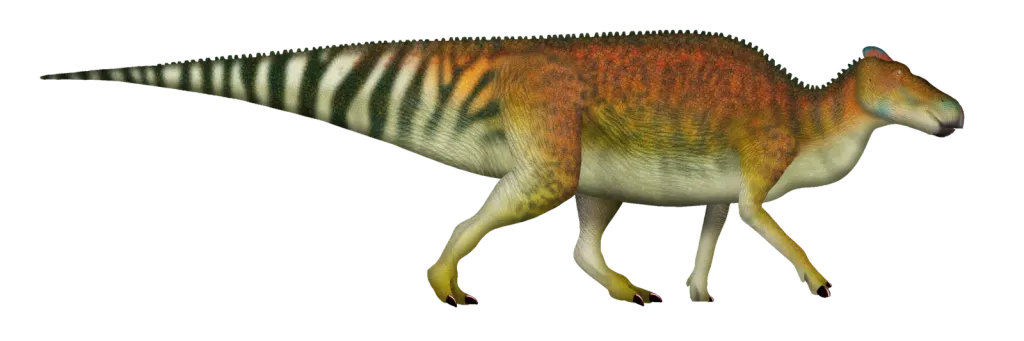
Edmontosaurus annectens
Pronounced ed-MON-toh-SORE-us ah-NEK-tenz
Ornithopoda · Hadrosauridae
A large duck-billed dinosaur from the very end of the Cretaceous in western North America, a common plant-eater of the Hell Creek and Lance formations and prey of T. rex. Several "mummies" preserve its skin.
- Skin impressions known
- Exceptional preservation
- Famous specimen
- Period
- Cretaceous· Maastrichtian
- Diet
- Herbivore
- Length
- 12–15 m
- Mass
- 5,600–15,900 kg
- Location
- Wyoming, Montana, South Dakota, North Dakota, Saskatchewan, United States, Canada
Quick answers
- How big was Edmontosaurus annectens?
- Edmontosaurus annectens was about 12–15 m long. It stood about 2.6–3.4 m tall at the hips. It weighed about 5.6–15.9 t. (Wikipedia: Edmontosaurus 2026; Paul 2016)
- When did Edmontosaurus annectens live?
- Edmontosaurus annectens lived during the Late Cretaceous, about 72.1–66 million years ago. (Paleobiology Database: Edmontosaurus occurrences 2026; Campione & Evans 2011)
- Where have Edmontosaurus annectens fossils been found?
- Fossils of Edmontosaurus annectens have been found in Lance Formation (Wyoming), Hell Creek Formation (Montana), Frenchman Formation (Saskatchewan), United States, and Canada. (Marsh 1892; Lambe 1917)
- What did Edmontosaurus annectens eat?
- Edmontosaurus annectens was a herbivore. (Marsh 1892; Lambe 1917)
- Who named Edmontosaurus annectens, and when?
- Edmontosaurus annectens was described by Othniel Charles Marsh in 1892. (Marsh 1892; Campione & Evans 2011)
On this page

ed-MON-toh-SORE-us ah-NEK-tenz
- Period
- Cretaceous72.1–66 Ma
- Diet
- Herbivore
- Length
- 12–15 m
- Mass
- 5.6–15.9 t
- Location
- United States, Canada
- Classification
- Ornithopoda · Hadrosauridae
- Described
- 1892, Othniel Charles Marsh
Overview
Edmontosaurus annectens lived in western North America in the late Maastrichtian, alongside Tyrannosaurus and Triceratops. Othniel Charles Marsh named it Claosaurus annectens in 1892 from a skeleton from the Lance Formation of Wyoming (USNM 2414). The genus Edmontosaurus had been named by Lawrence Lambe in 1917 for the older species E. regalis from Alberta.
It was a big, flat-headed hadrosaur that walked on four or two legs and chewed plants with batteries of hundreds of teeth. Several naturally mummified specimens, the first found by the Sternberg family in 1908, preserve large areas of scaly skin. Campione and Evans (2011) showed that the giant "Anatotitan" was just a large E. annectens, leaving two species in the genus.
A Tyrannosaurus tooth embedded in two fused, healed tail vertebrae of a hadrosaur like Edmontosaurus shows that T. rex attacked living animals and that this one escaped (DePalma et al. 2013).
Name meaning
"Edmonton lizard", after the Edmonton Formation of Alberta where the type species was found (Lambe 1917); annectens, Latin for "connecting" (Marsh 1892).
Biology & evidence
What scientists think about how this animal lived, and how strong the evidence for each idea is.
Skin & covering
Edmontosaurus had scaly skin.
Evidence level: Direct evidenceSeveral mummified specimens preserve large areas of skin with small, pebbly scales.
Evidence for / against · 1
Evidence for
Skin impression · Edmontosaurus mummies
Naturally mummified skeletons with large areas of scaly skin, including AMNH 5060 (found in 1908 by the Sternbergs) and "Dakota" (NDGS 2000).
Growth
The giant "Anatotitan" was a fully grown Edmontosaurus annectens.
Evidence level: Strong evidenceIts long, flat skull falls on the growth trajectory of E. annectens, so the differences reflect size and age, not a separate species.
Evidence for / against · 1
Evidence for
Comparative anatomy · Morphometrics of edmontosaur skulls
Morphometric analysis of almost all complete edmontosaur skulls finds only two species; Anatotitan copei and other names fall within the growth series of E. annectens.
Behavior
Tyrannosaurus attacked living Edmontosaurus.
Evidence level: Moderate evidenceA T. rex tooth is embedded in a hadrosaur tail that healed afterwards, so the animal was alive and escaped. The vertebrae are compared with, not firmly identified as, Edmontosaurus annectens.
Evidence for / against · 1
Evidence for
Specimen · Healed hadrosaur tail with embedded T. rex tooth
Two fused hadrosaur tail vertebrae (compared with E. annectens) from the Hell Creek Formation of South Dakota, enclosing a Tyrannosaurus tooth crown surrounded by healed bone.

Size
- Length
- 12–15 m
- Height
- 3 mpublished range 2.6–3.4 m
- Mass
- 5,600–15,900 kg
(49.2 ft)
(9.8 ft)
Based on large adults
Timeline
Periods: Maastrichtian (72.1–66 Ma), Late Cretaceous (100.5–66 Ma)
Maastrichtian bounds in PBDB; Campione & Evans place E. annectens in the late Maastrichtian and E. regalis in the late Campanian.
Location
Formations
- Lance Formation · Wyoming
- Hell Creek Formation · Montana
- Frenchman Formation · Saskatchewan
- Lance Creek area, Niobrara County, Wyoming · Lance Formation · Wyoming · position approximate
These are the places where fossils have been found, not the full area where the animal lived.
Ecosystem

Lived in: Hell Creek
68–66 million years ago · floodplain, river system, forest, coastal plain
Warm, humid coastal lowlands and river floodplains west of the retreating Western Interior Seaway at the very end of the Cretaceous, with forests of conifers and flowering plants. The ecosystem ends at the Cretaceous-Paleogene extinction.


Classification
- cladeDinosauria
- cladeOrnithischia
- cladeOrnithopoda
- familyHadrosauridae
- subfamilySaurolophinae
- genusEdmontosaurus
- speciesEdmontosaurus annectens
Taxonomic status: Valid
Fossil record

| Catalog number | Status | Institution | Found |
|---|---|---|---|
| USNM 2414 | Holotype | National Museum of Natural History, Smithsonian Institution (USNM) | — |
| YPM 2182 | Paratype | Yale Peabody Museum (YPM) | — |
What has been found
Holotype: USNM 2414
- Preserved
- Partial
- Reconstructed
- Unknown / not recorded
Holotype: USNM 2414
Region by region (table)
| Region | State |
|---|---|
| Skull | Partial · Skull roof. |
| Mandible | Unknown / not recorded |
| Teeth | Unknown / not recorded |
| Cervical vertebrae | Unknown / not recorded |
| Dorsal vertebrae | Unknown / not recorded |
| Sacrum | Unknown / not recorded |
| Caudal vertebrae | Unknown / not recorded |
| Ribs | Unknown / not recorded |
| Gastralia | Unknown / not recorded |
| Scapula / shoulder girdle | Unknown / not recorded |
| Humerus | Unknown / not recorded |
| Forearm (radius / ulna) | Unknown / not recorded |
| Hand (manus) | Unknown / not recorded |
| Pelvis | Unknown / not recorded |
| Femur | Unknown / not recorded |
| Tibia / fibula | Unknown / not recorded |
| Foot (pes) | Unknown / not recorded |
Paratype: YPM 2182
Region by region (table)
| Region | State |
|---|---|
| Skull | Preserved |
| Mandible | Unknown / not recorded |
| Teeth | Unknown / not recorded |
| Cervical vertebrae | Unknown / not recorded |
| Dorsal vertebrae | Unknown / not recorded |
| Sacrum | Unknown / not recorded |
| Caudal vertebrae | Unknown / not recorded |
| Ribs | Unknown / not recorded |
| Gastralia | Unknown / not recorded |
| Scapula / shoulder girdle | Unknown / not recorded |
| Humerus | Unknown / not recorded |
| Forearm (radius / ulna) | Unknown / not recorded |
| Hand (manus) | Unknown / not recorded |
| Pelvis | Unknown / not recorded |
| Femur | Unknown / not recorded |
| Tibia / fibula | Unknown / not recorded |
| Foot (pes) | Unknown / not recorded |

Gallery

Discovery
- Year described
- 1892
- Described by
- Othniel Charles Marsh
- Type specimen
- USNM 2414
Discovery timeline
1892 · Formally described
Marsh names Claosaurus annectens
Marsh names a hadrosaur from the Lance Formation of Wyoming.
People: Othniel Charles Marsh
1908 · Specimen recovered
The Sternbergs find the first Edmontosaurus mummy
A mummified skeleton with skin impressions (AMNH 5060) is found in the Lance Formation of Wyoming.
1917 · Formally described
Lambe names Edmontosaurus
The genus is named for E. regalis from the Edmonton (now Horseshoe Canyon) Formation of Alberta.
People: Lawrence M. Lambe
2011 · Revision
Edmontosaur species reduced to two
Campione and Evans show that edmontosaurs include only E. regalis and E. annectens.
People: Nicolás E. Campione
2013 · Major study
Healed T. rex bite found in a hadrosaur tail
DePalma and colleagues report a tooth embedded in healed vertebrae.
Sources
- (2026). Paleobiology Database: Edmontosaurus occurrences. The Paleobiology Database (paleobiodb.org), data service 1.2, accessed 2026-09-23. https://paleobiodb.org/data1.2/occs/list.txt?base_name=Edmontosaurus&show=coords,paleoloc,strat,loc,ref&pgm=gplates (opens in a new tab)
- (2026). Wikipedia: Edmontosaurus. Wikipedia (English), accessed 2026-09-23. https://en.wikipedia.org/wiki/Edmontosaurus (opens in a new tab)
- Campione, N. E. & Evans, D. C. (2011). Cranial growth and variation in edmontosaurs (Dinosauria: Hadrosauridae): implications for latest Cretaceous megaherbivore diversity in North America. PLoS ONE 6: e25186. doi:10.1371/journal.pone.0025186 (opens in a new tab)
- Cohen, K. M., Harper, D. A. T., Gibbard, P. L. & Car, N. (2023). International Chronostratigraphic Chart (v2023/09). International Commission on Stratigraphy. https://stratigraphy.org/ICSchart/ChronostratChart2023-09.pdf (opens in a new tab)
- DePalma, R. A., Burnham, D. A., Martin, L. D., Rothschild, B. M. & Larson, P. L. (2013). Physical evidence of predatory behavior in Tyrannosaurus rex. Proceedings of the National Academy of Sciences 110. doi:10.1073/pnas.1216534110 (opens in a new tab)
- Lambe, L. M. (1917). A new genus and species of crestless hadrosaur from the Edmonton Formation of Alberta. The Ottawa Naturalist 31(7): 65-73.
- Marsh, O. C. (1892). Notice of new reptiles from the Laramie Formation. American Journal of Science 43: 449-453.
- Paul, G. S. (2016). The Princeton Field Guide to Dinosaurs (2nd edition). Princeton University Press.