Utahraptor vs Velociraptor: The Real Jurassic Park Raptor?
Utahraptor was roughly four times as long as Velociraptor. Neither exactly matches the film; the closest match in size is a third raptor, Deinonychus.
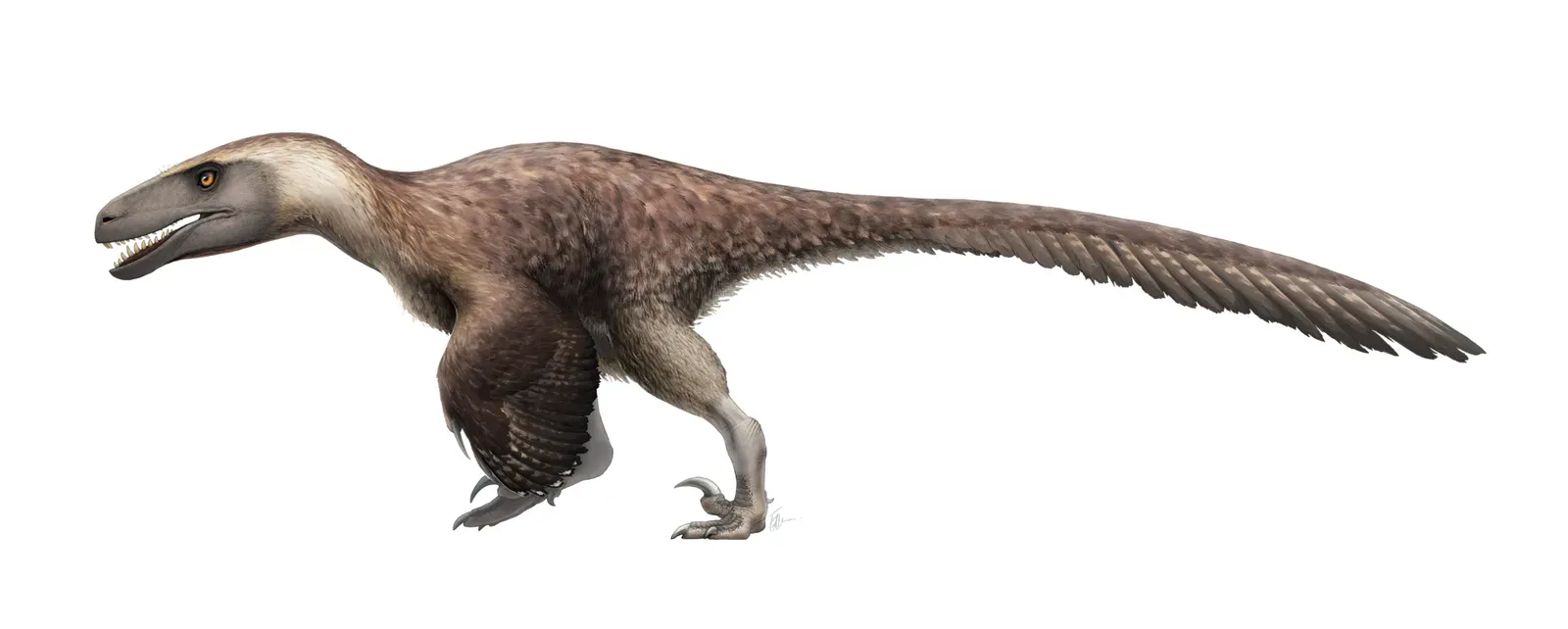
このコンテンツは英語でご覧いただけます。
Utahraptor was about 5.5 to 7 m (18 to 23 ft) long (Kirkland et al. 1993; later estimates are smaller), roughly four times the length of Velociraptor, at about 1.5 m (4.9 ft) and 15 kg (Turner et al. 2007). Neither is an exact match for the film "raptors"; in size, the closest real animal is Deinonychus, at about 3.3 to 3.4 m.
Utahraptor is the largest known dromaeosaurid. Here is how the three compare.
Utahraptor vs Velociraptor at a glance
- Length: Utahraptor about 5.5 to 7 m (18 to 23 ft), very low confidence; Velociraptor about 1.5 m (4.9 ft).
- Weight: Velociraptor about 15 kg (33 lb); no sourced mass for Utahraptor on DinoDex yet.
- Hip height (estimated): Utahraptor about 1.3 to 1.6 m (4.3 to 5.2 ft); Velociraptor about 0.45 to 0.55 m (1.5 to 1.8 ft).
- Sickle claw: Utahraptor's is over 20 cm (8 in) long.
- When: Utahraptor about 126 to 121 million years ago; Velociraptor about 75 to 71 million years ago.
- Where: Utahraptor in Utah, USA; Velociraptor in Mongolia.
How big was Utahraptor?
Utahraptor was named in 1993 by James Kirkland, Robert Gaston and Donald Burge from the Cedar Mountain Formation of Utah. The original description allowed a length of up to about 7 m; later estimates, including Paul's field guide (2010), are closer to 5.5 m. The profile keeps both ends as a range and marks it very low confidence, because the figures have not yet been re-read in the sources and the skeletons are partial.
Its estimated hip height of 1.3 to 1.6 m would put its hips at roughly the chest height of an adult person. We have not found a mass estimate we can source, so the profile leaves it empty rather than guessing; it was clearly a heavy animal, far bulkier than Velociraptor.

How big was Velociraptor?
Small. Adults were about 1.5 m long and 15 kg, figures widely reported from Turner and colleagues' 2007 study of a quill-knob specimen, with an estimated hip height of 0.45 to 0.55 m, about knee height on a person. See how tall was a Velociraptor compared to a human?
So which is the real "Jurassic Park raptor"?
Neither, strictly. The film used the name Velociraptor, but the animals on screen were sized like Deinonychus, the Montana dromaeosaurid described by John Ostrom in 1969: about 3.3 to 3.4 m long and an estimated 60 to 100 kg. Utahraptor was named in 1993, the year the film came out, and turned out to be bigger than the screen raptors.
So the film borrowed Velociraptor's name, Deinonychus's size, and none of their feathers. Real dromaeosaurids were feathered; see did Velociraptor have feathers?
Did Utahraptor and Velociraptor live together?
No. Utahraptor lived in the Early Cretaceous, in rocks usually assigned to the Barremian, about 126 to 121 million years ago, although some dating work suggests the beds may be older. Velociraptor lived in the Djadokhta Formation of Mongolia, about 75 to 71 million years ago. Roughly 46 to 55 million years and a continent separate them.
What about the sickle claw?
Every dromaeosaurid had an enlarged, curved claw on the second toe of each foot, held off the ground while walking. Deinonychus takes its name, "terrible claw", from it. Utahraptor's is over 20 cm (8 in) long, far larger than Velociraptor's. The claw scales with the animal, which makes it one of the clearest signs, even from isolated bones, of how much bigger Utahraptor was.
A family with a huge size range
Dromaeosaurids span an enormous range of sizes: from crow-sized Microraptor, under 1 m long, through Velociraptor and Deinonychus, up to Utahraptor. That range is one reason "raptor" is a poor guide to how big any one of them was. For the small end, see the smallest dinosaurs.
Quick answers
- How much bigger was Utahraptor than Velociraptor? About four times as long: 5.5 to 7 m against about 1.5 m.
- What was the biggest raptor? Utahraptor is the largest known dromaeosaurid.
- Which dinosaur were the Jurassic Park raptors based on? In size, Deinonychus; the name came from Velociraptor.
- Did Utahraptor have feathers? No feathers have been found with Utahraptor, but its close relatives had them, including quill knobs in Velociraptor, so feathers are the expected condition.

Sources
- Kirkland, J. I., Gaston, R. & Burge, D.. (1993). A large dromaeosaur (Theropoda) from the Lower Cretaceous of eastern Utah. Hunteria 2(10): 1-16
- Paul, G. S.. (2010). The Princeton Field Guide to Dinosaurs. Princeton University Press
- Paul, G. S.. (2016). The Princeton Field Guide to Dinosaurs (2nd edition). Princeton University Press
- Turner, A. H., Makovicky, P. J. & Norell, M. A.. (2007). Feather quill knobs in the dinosaur Velociraptor. Science 317(5845): 1721 doi:10.1126/science.1145076
- Ostrom, J. H.. (1969). Osteology of Deinonychus antirrhopus, an unusual theropod from the Lower Cretaceous of Montana. Bulletin of the Peabody Museum of Natural History 30: 1-165
- Cohen, K. M., Harper, D. A. T., Gibbard, P. L. & Car, N.. (2023). International Chronostratigraphic Chart (v2023/09). International Commission on Stratigraphy リンク
- Dashzeveg, D., Dingus, L., Loope, D. B., Swisher, C. C., III, Dulam, T. & Sweeney, M. R.. (2005). New stratigraphic subdivision, depositional environment, and age estimate for the Upper Cretaceous Djadokhta Formation, southern Ulan Nur Basin, Mongolia. American Museum Novitates 3498: 1-31 リンク
関連する恐竜


4 件中 4 件を表示
関連記事

Size & comparisons
How Tall Was a Velociraptor Compared to a Human?
About 1.5 metres long and 15 kilograms: closer to a large turkey than to the film monsters. Here is how a real Velociraptor measures up against a person.
DinoDex team · 2026年9月27日 · 4 分で読めます

Explainers
Did Velociraptor Have Feathers? What the Fossils Show
Yes. Bumps on a Velociraptor forearm bone show where large wing feathers were anchored. Here is the evidence, and what the feathers were probably for.
DinoDex team · 2026年9月26日 · 4 分で読めます

Size & comparisons
The Smallest Dinosaurs: Compsognathus, Microraptor and More
Crow-sized Microraptor and chicken-sized Compsognathus are among the smallest non-bird dinosaurs known from good skeletons. The true record holder is alive today.
DinoDex team · 2026年9月27日 · 3 分で読めます