Allosaurus vs T. rex: Why They Never Met
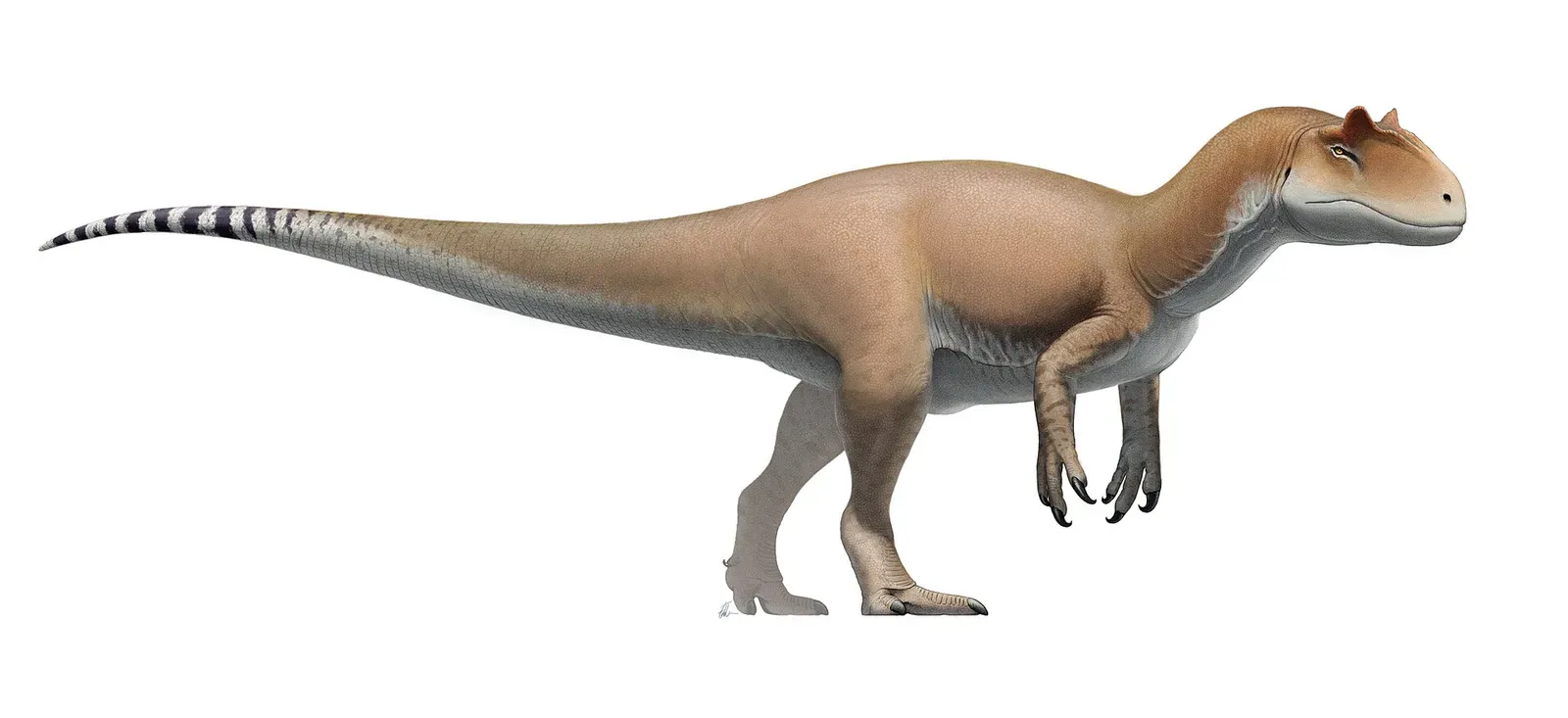
Roughly 80 million years separate them, more time than separates T. rex from us. And T. rex was several times heavier. The two predators, compared.
このコンテンツは英語でご覧いただけます。
No. Allosaurus lived in the Late Jurassic, about 155 to 145 million years ago, and T. rex at the very end of the Cretaceous, about 68 to 66 million years ago (stage ages from the ICS chart, 2023). The gap is roughly 77 to 89 million years: more time separates Allosaurus from T. rex than separates T. rex from us.
They are often shown together because both were the top predators of North America in their day. Here is how far apart they really were, in time and in size.
Allosaurus vs T. rex at a glance
- When: Allosaurus about 155 to 145 million years ago (Late Jurassic); T. rex about 68 to 66 million years ago (Maastrichtian).
- Length: Allosaurus about 8.5 m (28 ft) for a typical adult; T. rex about 12.3 to 13 m (40 to 43 ft).
- Weight: Allosaurus about 1.5 to 1.7 t (1.7 to 1.9 short tons); T. rex about 6 to 8 t for most adults, up to about 9.5 t.
- Hip height (estimated): Allosaurus about 1.9 to 2.4 m (6.2 to 7.9 ft); T. rex about 3.6 to 4 m (11.8 to 13.1 ft).
- Where: both in western North America, but in rocks tens of millions of years apart.
How far apart in time were they?
The DinoDex ages are the stage boundaries of the International Chronostratigraphic Chart (2023) for the rocks each animal is found in. Allosaurus fragilis comes from the Morrison Formation, dated to the Kimmeridgian and Tithonian, about 154.8 to 145 million years ago. Chure and Loewen (2020) restrict A. fragilis to the upper part of the Morrison, so its real range is narrower still.
T. rex comes from the Hell Creek Formation and its equivalents, at the end of the Maastrichtian, ending 66 million years ago with the asteroid impact (Fowler 2017 revised the ages of these rocks).
Subtract and the gap is roughly 77 to 89 million years. The asteroid that ended the age of dinosaurs struck 66 million years ago, so T. rex lived closer in time to us than to Allosaurus.
What lived with each of them?
Allosaurus shared its floodplains with giant sauropods such as Diplodocus and Brachiosaurus, and with Stegosaurus. None of those survived into T. rex's time. T. rex lived alongside Triceratops and Edmontosaurus, animals Allosaurus never saw.
Which was bigger?
T. rex, by a wide margin. A typical adult Allosaurus was about 8.5 m long, the figure given by Paul (2010) and marked low confidence on its profile. Its weight, about 1.5 to 1.7 tonnes, comes from a laser-scanned model of the specimen "Big Al" (Bates et al. 2009) and from Paul (2010). Chure and Loewen (2020) later referred Big Al to a close relative, Allosaurus jimmadseni, so that estimate is for a near cousin.
T. rex was about half as long again (12.3 m for "Sue", Brochu 2003) and roughly four to six times heavier (Hutchinson et al. 2011). Its estimated hip height, around 3.6 to 4 m, is roughly one and a half to two times that of Allosaurus. Both hip heights are low-confidence estimates, but the difference is far larger than the uncertainty.

How common was Allosaurus?
Very. Allosaurus is the commonest large predator of the Morrison Formation, known from hundreds of individuals, many of them from the Cleveland-Lloyd Dinosaur Quarry in Utah. That wealth of material makes it one of the best understood big theropods. The specimen "Big Al", a sub-adult from Wyoming, preserves an unusual number of injuries and infections, described by Rebecca Hanna (2002), which show how rough a predator's life could be.
Were they related?
Only distantly. Both were theropods, but Allosaurus belongs to the allosauroids, the group that later produced Giganotosaurus, while T. rex was a tyrannosaurid. The similar big-predator shape evolved separately. For how T. rex compares with that later allosauroid giant, see Giganotosaurus vs T. rex, and for all of T. rex's measurements, how big was T. rex?
Quick answers
- Did Allosaurus and T. rex live at the same time? No. Roughly 77 to 89 million years separate them.
- Which was bigger? T. rex: about 12.3 to 13 m against about 8.5 m, and roughly four to six times heavier.
- Did Allosaurus live with Stegosaurus? Yes, both are found in the Morrison Formation.

Sources
- Cohen, K. M., Harper, D. A. T., Gibbard, P. L. & Car, N.. (2023). International Chronostratigraphic Chart (v2023/09). International Commission on Stratigraphy リンク
- Chure, D. J. & Loewen, M. A.. (2020). Cranial anatomy of Allosaurus jimmadseni, a new species from the lower part of the Morrison Formation (Upper Jurassic) of Western North America. PeerJ 8: e7803 doi:10.7717/peerj.7803
- Fowler, D. W.. (2017). Revised geochronology, correlation, and dinosaur stratigraphic ranges of the Santonian-Maastrichtian (Late Cretaceous) formations of the Western Interior of North America. PLoS ONE 12(11): e0188426 doi:10.1371/journal.pone.0188426
- Paul, G. S.. (2010). The Princeton Field Guide to Dinosaurs. Princeton University Press
- Bates, K. T., Manning, P. L., Hodgetts, D. & Sellers, W. I.. (2009). Estimating mass properties of dinosaurs using laser imaging and 3D computer modelling. PLoS ONE 4(2): e4532 doi:10.1371/journal.pone.0004532
- Hanna, R. R.. (2002). Multiple injury and infection in a sub-adult theropod dinosaur Allosaurus fragilis with comparisons to allosaur pathology in the Cleveland-Lloyd Dinosaur Quarry collection. Journal of Vertebrate Paleontology 22(1): 76-90 doi:10.1671/0272-4634(2002)022[0076:MIAIIA]2.0.CO;2
- Brochu, C. A.. (2003). Osteology of Tyrannosaurus rex: insights from a nearly complete skeleton and high-resolution computed tomographic analysis of the skull. Journal of Vertebrate Paleontology 22 (sup4); Society of Vertebrate Paleontology Memoir 7 doi:10.1080/02724634.2003.10010947
- Hutchinson, J. R., Bates, K. T., Molnar, J., Allen, V. & Makovicky, P. J.. (2011). A computational analysis of limb and body dimensions in Tyrannosaurus rex with implications for locomotion, ontogeny, and growth. PLoS ONE 6(10): e26037 doi:10.1371/journal.pone.0026037
関連する恐竜

4 件中 4 件を表示
関連記事

Explainers
How Big Was T. rex? Length, Height and Weight
About 12 to 13 metres long and 6 to 8 tonnes as an adult. Here is what the best skeletons show, and why no single number tells the whole story.
DinoDex team · 2026年9月26日 · 5 分で読めます

Size & comparisons
Giganotosaurus vs T. rex: Which Was Bigger?
Almost a tie in length, at around 12 to 13 metres each. T. rex was probably the heavier animal, and it is known from much better skeletons.
DinoDex team · 2026年9月27日 · 3 分で読めます

Size & comparisons
How Long Was Diplodocus Compared to a Bus?
About 24 to 26 metres: two city buses parked end to end. Most of that was neck and tail, which is why Diplodocus was long but surprisingly light.
DinoDex team · 2026年9月27日 · 3 分で読めます