Did Velociraptor Have Feathers? What the Fossils Show
Yes. Bumps on a Velociraptor forearm bone show where large wing feathers were anchored. Here is the evidence, and what the feathers were probably for.
このコンテンツは英語でご覧いただけます。
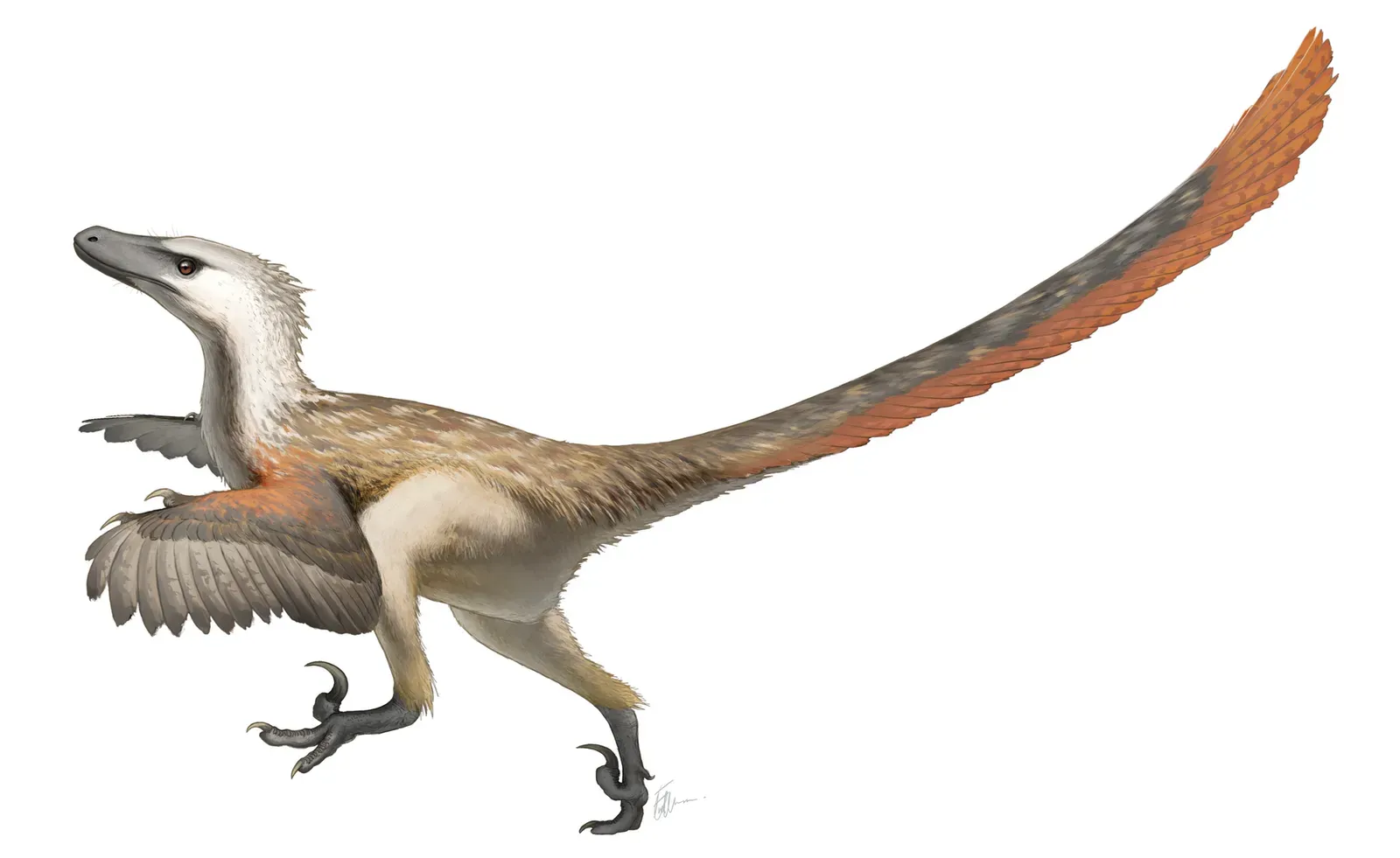
Did Velociraptor have feathers? Yes. No Velociraptor fossil preserves the feathers themselves, but a forearm bone of Velociraptor mongoliensis carries a row of small bumps called quill knobs. In living birds, these are the anchor points for large wing feathers. Together with feathered fossils of its close relatives, that makes a feathered Velociraptor the best-supported reconstruction.
Velociraptor at a glance
- Size: about 1.5 m long and roughly 15 kg; closer to a large turkey than to the film version.
- When: the Campanian age of the Late Cretaceous, roughly 84 to 72 million years ago.
- Where: the Djadokhta Formation of the Gobi Desert, in Mongolia.
- Group: dromaeosaurids, the "raptors", close relatives of birds.
- Named: by Henry Fairfield Osborn in 1924.
Where Velociraptor was found
The first Velociraptor fossils were collected in 1923 at the Flaming Cliffs in the Gobi, by the American Museum of Natural History's Central Asiatic Expeditions. Osborn named the species the next year from a crushed skull and a claw, specimen AMNH 6515.
The Djadokhta rocks formed in a dry landscape of sand dunes and seasonal streams. Many skeletons there are complete and articulated, which suggests that animals were buried quickly, perhaps by collapsing dunes or sandstorms. That fast burial is why the Gobi has produced so many well-preserved small dinosaurs, eggs and nests.

Did Velociraptor have feathers? The quill knob evidence
In 2007, Alan Turner, Peter Makovicky and Mark Norell described a forearm bone (the ulna) from an adult Velociraptor, specimen IGM 100/981. Along the back of the bone runs a line of evenly spaced bumps.
Modern birds have the same feature. In a bird's wing, the large secondary flight feathers are tied to the ulna by ligaments, and those attachments leave raised knobs on the bone. Finding them on Velociraptor means it had well-developed feathers on its arms, not just a fuzzy covering.
Quill knobs are not found on every bird, so their absence would not prove an animal lacked feathers. Their presence, though, is hard to explain any other way.
Feathered relatives preserved in stone
The second line of evidence comes from Velociraptor's relatives. In some rocks, especially fine-grained lake and lagoon deposits, feathers are preserved as dark impressions around the skeleton:
- Microraptor, a small dromaeosaurid from the Jiufotang Formation of Liaoning, China, had long flight feathers on both its arms and its legs.
- Yutyrannus, an early tyrannosaur relative from the Yixian Formation, was covered in long filaments, even though it weighed well over a tonne (Xu et al. 2012).
- Archaeopteryx, from the Late Jurassic Solnhofen limestones of Germany, shows fully formed vaned feathers (Foth et al. 2014).
Because feathered animals sit on both sides of Velociraptor in the family tree, the simplest explanation is that it inherited feathers too. Palaeontologists call this reasoning phylogenetic bracketing.

What kind of feathers?
Not all dinosaur feathers were alike. The simplest were hair-like filaments, the kind seen on Yutyrannus, which probably worked as insulation. More advanced were pennaceous feathers: a central shaft with a flat vane on each side, the design of the flight feathers in a bird's wing. Quill knobs anchor exactly this kind of large, vaned feather, so Velociraptor's arm feathers were probably pennaceous. Its body was likely covered in smaller, simpler feathers, as in its relatives, though no fossil shows Velociraptor's body covering directly.
Why doesn't Velociraptor look like the movies?
The animals in Jurassic Park were scaled up well beyond Velociraptor and shown with scaly skin. In size and build they are closer to larger dromaeosaurids such as Deinonychus, about 3.3 m long, from the Cloverly Formation of the western United States, or the even bigger Utahraptor.
A more accurate Velociraptor would look bird-like: a feathered body, a feathered tail, and arms with a fan of long feathers, ending in three clawed fingers. On each foot it had an enlarged, curved second-toe claw that it could hold off the ground.
Could Velociraptor fly?
No. Its arms were far too short relative to its body, and at around 15 kg it was much too heavy for its feathers to lift it. Its wing feathers must have had other jobs. Palaeontologists have proposed several, and they are not mutually exclusive:
- Display: showing off to rivals or mates, as many birds do today.
- Brooding: covering eggs. Fossils of oviraptorid dinosaurs, which also lived in the Gobi, have been found sitting on nests with their arms spread over the eggs (Norell et al. 1995).
- Balance while hunting: Denver Fowler and colleagues (2011) suggested that dromaeosaurids pinned prey with their feet and flapped their arms to stay steady on top of it.
These are hypotheses based on anatomy and comparisons with living animals, not direct observations.
The fighting dinosaurs
The most famous Velociraptor fossil shows one locked in combat with a Protoceratops, a sheep-sized plant eater. The two were buried together, apparently in the middle of the struggle, with Velociraptor's foot claw near the Protoceratops's throat and its arm caught in the Protoceratops's jaws.

Other finds show that Velociraptor also fed on Protoceratops carcasses: Hone and colleagues (2010) described Protoceratops bones with Velociraptor tooth marks, probably left while scavenging.
So, what did Velociraptor look like?
Picture a lean, fast, turkey-sized predator with a long, stiff tail, a narrow snout full of serrated teeth and a coat of feathers, with bigger ones on its arms. The exact colours are unknown for Velociraptor, since no pigment has been preserved.
See the evidence, fossils and sources on the Velociraptor profile, or browse all carnivorous dinosaurs on DinoDex.

Sources
- Turner, A. H., Makovicky, P. J. & Norell, M. A.. (2007). Feather quill knobs in the dinosaur Velociraptor. Science 317(5845): 1721 doi:10.1126/science.1145076
- Osborn, H. F.. (1924). Three new Theropoda, Protoceratops zone, central Mongolia. American Museum Novitates 144: 1-12
- Hone, D., Choiniere, J., Sullivan, C., Xu, X., Pittman, M. & Tan, Q.. (2010). New evidence for a trophic relationship between the dinosaurs Velociraptor and Protoceratops. Palaeogeography, Palaeoclimatology, Palaeoecology 291(3-4): 488-492 doi:10.1016/j.palaeo.2010.03.028
- Fowler, D. W., Freedman, E. A., Scannella, J. B. & Kambic, R. E.. (2011). The predatory ecology of Deinonychus and the origin of flapping in birds. PLoS ONE 6(12): e28964 doi:10.1371/journal.pone.0028964
- Norell, M. A., Clark, J. M., Chiappe, L. M. & Dashzeveg, D.. (1995). A nesting dinosaur. Nature 378: 774-776 doi:10.1038/378774a0
- Xu, X., Wang, K., Zhang, K., Ma, Q., Xing, L., Sullivan, C., Hu, D., Cheng, S. & Wang, S.. (2012). A gigantic feathered dinosaur from the Lower Cretaceous of China. Nature 484: 92-95 doi:10.1038/nature10906
- Foth, C., Tischlinger, H. & Rauhut, O. W. M.. (2014). New specimen of Archaeopteryx provides insights into the evolution of pennaceous feathers. Nature 511: 79-82 doi:10.1038/nature13467
関連する恐竜


6 件中 6 件を表示
関連記事

Explainers
How Complete Are Dinosaur Fossils? Less Than You Think
Complete dinosaur skeletons are rare, and many species are known from a skull or a handful of bones. Here is why, and what it means for the numbers you read.
DinoDex team · 2026年9月26日 · 5 分で読めます

Explainers
How Big Was T. rex? Length, Height and Weight
About 12 to 13 metres long and 6 to 8 tonnes as an adult. Here is what the best skeletons show, and why no single number tells the whole story.
DinoDex team · 2026年9月26日 · 5 分で読めます

Explainers
Which Dinosaurs Lived in Brazil? A Guide to the Fossils
Brazil has some of the oldest dinosaurs known, a spinosaur named for the irritation it caused, and giant long-necked titanosaurs. A guide to the main finds.
DinoDex team · 2026年9月26日 · 4 分で読めます