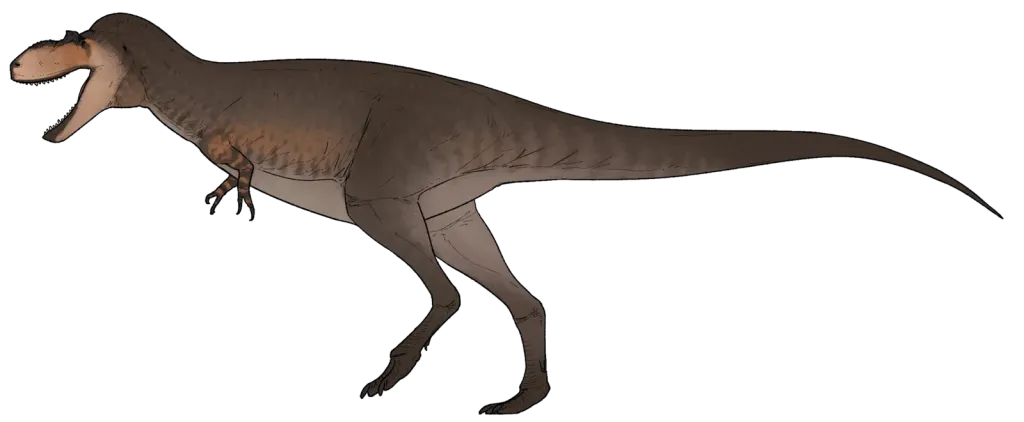
Albertosaurus sarcophagus
读音: al-BER-toh-SORE-us sar-KOF-ah-gus
Coelurosauria · Tyrannosauridae
A lighter-built relative of T. rex from the Late Cretaceous of Alberta, Canada. A single bonebed at Dry Island held more than two dozen individuals of all ages, which made it one of the best-studied tyrannosaurs.
- Bipedal
- Apex predator
- Possible pack behavior
- 时代
- 白垩纪· 马斯特里赫特阶
- 食性
- 肉食性
- 体长
- 8–9 m
- 体重
- 1,700–3,000 kg
- 地点
- Alberta, Canada
快速问答
- Albertosaurus sarcophagus有多大?
- Albertosaurus sarcophagus体长约8–9 m。髋部高约2.3–2.8 m。体重约1.7–3 t。 (Wikipedia: Albertosaurus 2026; Currie 2003)
- Albertosaurus sarcophagus生活在什么时候?
- Albertosaurus sarcophagus生活在晚白垩世,约7210万至6600万年前。 (Paleobiology Database: Albertosaurus occurrences 2026; Cohen et al. 2023)
- 在哪里发现过Albertosaurus sarcophagus的化石?
- Albertosaurus sarcophagus的化石发现于Horseshoe Canyon Formation (Alberta)和Canada。 (Osborn 1905; Currie 2003)
- Albertosaurus sarcophagus吃什么?
- Albertosaurus sarcophagus是肉食性。 (Osborn 1905; Currie 2003)
- Albertosaurus sarcophagus由谁命名,何时命名?
- Albertosaurus sarcophagus由Henry Fairfield Osborn于1905年描述。 (Osborn 1905; Paleobiology Database: Albertosaurus occurrences 2026)
本页内容

- 时代
- 白垩纪72.1–66 Ma
- 食性
- 肉食性
- 体长
- 8–9 m
- 体重
- 1.7–3 t
- 产地
- Canada
- 分类
- Coelurosauria · Tyrannosauridae
- 命名
- 1905, Henry Fairfield Osborn
概览
此内容目前仅提供英文版。
Albertosaurus sarcophagus lived in what is now Alberta about 70 million years ago, on the coastal plains and swamps of the Horseshoe Canyon Formation. Joseph Burr Tyrrell's Geological Survey of Canada party collected its first skull in 1884 on the Red Deer River, and Henry Fairfield Osborn named it in 1905.
It was a tyrannosaurid of about 8 to 9 m, lighter built than Tyrannosaurus, with longer lower legs and feet. Currie (2003) found that albertosaurines had slightly shorter, lower skulls and longer shins, metatarsals and toes than tyrannosaurines of the same size.
At Dry Island, found by Barnum Brown in 1910 and reopened by Philip Currie in 1997, a single bonebed held the remains of more than 20 individuals. Their growth rings allowed Erickson et al. (2006) to build a "life table": young Albertosaurus survived well, and mortality rose in mid-life.
名称含义
"Alberta lizard"; sarcophagus, Greek for "flesh-eater" (Osborn 1905).
生物学与证据
科学家对这种动物生活方式的看法,以及每种观点的证据有多充分。
生长
Young Albertosaurus survived well, and mortality rose in mid-life.
证据等级:中等证据Ages from growth rings of many individuals give a survival curve like those of long-lived birds and mammals, which also explains why juvenile fossils are rare.
支持 / 反对证据 · 1
支持证据
组织学 · Tyrannosaur age-structure analysis
Growth-ring ages of four tyrannosaur assemblages, including Albertosaurus, show high juvenile survival and higher mortality at mid-life and near maximum lifespan.
社会生活
Albertosaurus lived or hunted in groups.
证据等级:假说Many individuals of all ages died at one site, which suggests they were together. The bones could also have been gathered by other causes over time.
支持 / 反对证据 · 1
支持证据
标本 · Dry Island Albertosaurus bonebed
A bonebed with the remains of about two dozen Albertosaurus of different ages.
其他
Albertosaurus was more lightly built than Tyrannosaurus.
证据等级:有力证据At the same size, albertosaurines had shorter, lower skulls and longer shins, metatarsals and toes than tyrannosaurines.
支持 / 反对证据 · 1
支持证据
比较解剖学 · Tyrannosaurid allometry
Bivariate analysis of 85 dimensions across five tyrannosaurid genera: albertosaurines are more lightly built than tyrannosaurines of the same size.
体型
- 体长
- 8–9 m
- 身高
- 2.5 m文献范围 2.3–2.8 m
- 体重
- 1,700–3,000 kg
(29.5 英尺)
(8.2 英尺)
依据 large adults (femur c. 1.0 m)
时间线
时代: 马斯特里赫特阶 (72.1–66 Ma), 晚白垩世 (100.5–66 Ma)
Early Maastrichtian bin of the type collection in PBDB; the Horseshoe Canyon fossils are usually quoted at about 70-68 Ma (secondary).
产地
地层
- Horseshoe Canyon Formation · Alberta
- Red Deer River near Kneehills Creek, Alberta · Horseshoe Canyon Formation · Alberta · 位置为近似值
这些是发现化石的地点,而不是该动物生活的全部范围。
生态系统

生活于: Horseshoe Canyon
73.1–68 百万年前 · 泛滥平原, 沿海平原, 沼泽 / 湿地
Coastal floodplains, estuarine channels and coal swamps of Alberta near the Western Interior Seaway, with periodic marine incursions.
分类
- 演化支Dinosauria
- 演化支Saurischia
- 演化支Theropoda
- 演化支Coelurosauria
- 总科Tyrannosauroidea
- 科Tyrannosauridae
- 亚科Albertosaurinae
- 属Albertosaurus
- 种Albertosaurus sarcophagus
分类地位: 有效
化石记录

| 编号 | 类型 | 收藏机构 | 发现年份 |
|---|---|---|---|
| CMN 5600 | 正模标本 | Canadian Museum of Nature (CMN) | 1884 |
已发现的部分
正模标本: CMN 5600
- 保存
- 部分保存
- 复原
- 未知 / 未记录
按部位查看(表格)
| 部位 | 状态 |
|---|---|
| Skull | 部分保存 |
| Mandible | 未知 / 未记录 |
| Teeth | 未知 / 未记录 |
| Cervical vertebrae | 未知 / 未记录 |
| Dorsal vertebrae | 未知 / 未记录 |
| Sacrum | 未知 / 未记录 |
| Caudal vertebrae | 未知 / 未记录 |
| Ribs | 未知 / 未记录 |
| Gastralia | 未知 / 未记录 |
| Scapula / shoulder girdle | 未知 / 未记录 |
| Humerus | 未知 / 未记录 |
| Forearm (radius / ulna) | 未知 / 未记录 |
| Hand (manus) | 未知 / 未记录 |
| Pelvis | 未知 / 未记录 |
| Femur | 未知 / 未记录 |
| Tibia / fibula | 未知 / 未记录 |
| Foot (pes) | 未知 / 未记录 |

发现
- 命名年份
- 1905
- 命名者
- Henry Fairfield Osborn
- 模式标本
- CMN 5600
发现时间线
1884 · 首次发现材料
Tyrrell's party collects the first Albertosaurus skull
A partial skull is collected on the Red Deer River, Alberta.
人物:Joseph Burr Tyrrell
1905 · 正式命名
Osborn names Albertosaurus sarcophagus
Named in the same paper that named Tyrannosaurus rex.
人物:Henry Fairfield Osborn
1910 · 标本出土
Barnum Brown finds the Dry Island bonebed
Brown collects Albertosaurus bones from a bonebed that Philip Currie reopened in 1997.
人物:Barnum Brown, Philip J. Currie
2006 · 重要研究
Tyrannosaur life tables published
Erickson and colleagues describe tyrannosaur survival patterns from growth rings.
人物:Gregory M. Erickson, Philip J. Currie
参考文献
- (2026). Paleobiology Database: Albertosaurus occurrences. The Paleobiology Database (paleobiodb.org), data service 1.2, accessed 2026-09-23. https://paleobiodb.org/data1.2/occs/list.txt?base_name=Albertosaurus&show=coords,paleoloc,strat,loc,ref&pgm=gplates(在新标签页中打开)
- (2026). Wikipedia: Albertosaurus. Wikipedia (English), accessed 2026-09-23. https://en.wikipedia.org/wiki/Albertosaurus(在新标签页中打开)
- Cohen, K. M., Harper, D. A. T., Gibbard, P. L. & Car, N. (2023). International Chronostratigraphic Chart (v2023/09). International Commission on Stratigraphy. https://stratigraphy.org/ICSchart/ChronostratChart2023-09.pdf(在新标签页中打开)
- Currie, P. J. (2003). Allometric growth in tyrannosaurids (Dinosauria: Theropoda) from the Upper Cretaceous of North America and Asia. Canadian Journal of Earth Sciences 40: 651-665. doi:10.1139/e02-083(在新标签页中打开)
- Erickson, G. M., Currie, P. J., Inouye, B. D. & Winn, A. A. (2006). Tyrannosaur life tables: an example of nonavian dinosaur population biology. Science 313: 213-217. doi:10.1126/science.1125721(在新标签页中打开)
- Osborn, H. F. (1905). Tyrannosaurus and other Cretaceous carnivorous dinosaurs. Bulletin of the American Museum of Natural History 21: 259-265. https://digitallibrary.amnh.org/handle/2246/1464(在新标签页中打开)
- Paul, G. S. (2016). The Princeton Field Guide to Dinosaurs (2nd edition). Princeton University Press.