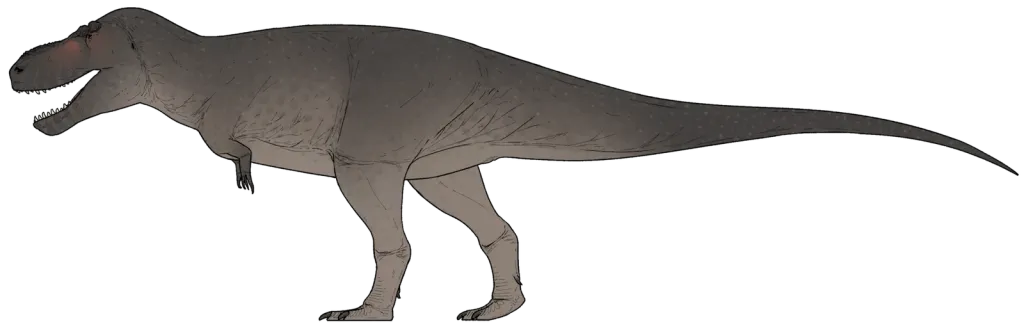
Tyrannosaurus rex
读音: tie-RAN-oh-SORE-us REKS
Coelurosauria · Tyrannosauridae
A giant tyrannosaurid theropod from the very end of the Cretaceous in western North America, and one of the largest land predators known. Adults probably weighed around 6 to 8 tonnes.
- Bipedal
- Giant
- Apex predator
- Famous specimen
- Movie icon
- Skin impressions known
- 时代
- 白垩纪· 马斯特里赫特阶
- 食性
- 肉食性
- 体长
- 12.3 m文献范围 12.3–13 m
- 体重
- 6,000–9,500 kg
- 地点
- Montana, South Dakota, North Dakota, Wyoming, Alberta, Saskatchewan
快速问答
- Tyrannosaurus rex有多大?
- Tyrannosaurus rex体长约12.3–13 m。髋部高约3.6–4 m。体重约6–9.5 t。 (Brochu 2003; Persons et al. 2020)
- Tyrannosaurus rex生活在什么时候?
- Tyrannosaurus rex生活在晚白垩世,约6800万至6600万年前。 (Cohen et al. 2023; Fowler 2017)
- 在哪里发现过Tyrannosaurus rex的化石?
- Tyrannosaurus rex的化石发现于Hell Creek Formation (Montana)、Lance Formation (Wyoming)、Scollard Formation (Alberta)、Frenchman Formation (Saskatchewan)、South Dakota和North Dakota。 (Osborn 1905; Brochu 2003)
- Tyrannosaurus rex吃什么?
- Tyrannosaurus rex是肉食性。 (Osborn 1905; Brochu 2003)
- Tyrannosaurus rex由谁命名,何时命名?
- Tyrannosaurus rex由Henry Fairfield Osborn于1905年描述。 (Osborn 1905)
- Tyrannosaurus rex出现在《侏罗纪公园》里吗?
- 是的。Tyrannosaurus rex出现在《侏罗纪公园》 (1993)、《失落的世界:侏罗纪公园》 (1997)、《侏罗纪公园3》 (2001)、《侏罗纪世界》 (2015)、《侏罗纪世界2》 (2018)、《侏罗纪世界3》 (2022)和《侏罗纪世界:重生》 (2025)中。电影有不少虚构成分;本页将其与化石证据进行了对比。 (Wikipedia: Dinosaurs in Jurassic Park 2026; Stevens 2006)
本页内容

tie-RAN-oh-SORE-us REKS
- 时代
- 白垩纪68–66 Ma
- 食性
- 肉食性
- 体长
- 12.3 m
- 体重
- 6–9.5 t
- 分类
- Coelurosauria · Tyrannosauridae
- 命名
- 1905, Henry Fairfield Osborn
概览
此内容目前仅提供英文版。
Tyrannosaurus rex lived in western North America during the Maastrichtian, the last age of the Cretaceous, and its fossils come from rock units such as the Hell Creek, Lance, Scollard and Frenchman formations. It was named by Henry Fairfield Osborn in 1905.
It is known from many specimens, including nearly complete skeletons such as FMNH PR 2081 ("Sue") and RSM P2523.8 ("Scotty"). Computer models of mounted skeletons put typical adults at roughly 6 to 8 tonnes, with the largest individuals likely heavier.
Estimates of size vary between studies and between individuals. The figures on this page are given as ranges, each with the study it comes from.
名称含义
From Greek tyrannos ("tyrant") and sauros ("lizard"), with Latin rex ("king"): "tyrant lizard king" (Osborn 1905).
生物学与证据
科学家对这种动物生活方式的看法,以及每种观点的证据有多充分。
运动方式
An adult Tyrannosaurus rex could walk fast but could not truly run.
证据等级:中等证据To run, an animal needs enough leg muscle and bones strong enough for the impact. Models of a 6-9 tonne adult say T. rex had neither for a real run, so estimated top speeds are those of a brisk walk. Juveniles, being lighter, were probably faster.
支持 / 反对证据 · 1
支持证据
生物力学模型 · T. rex limb muscle models limit running speed
Models of leg muscle mass needed for fast running (Hutchinson & Garcia 2002) and multibody simulations with bone-stress limits (Sellers et al. 2017) both find that a large adult could not run fast.
进食
Tyrannosaurus rex had one of the strongest bites of any land animal and could crush and eat bone.
证据等级:有力证据Three kinds of evidence agree: bitten bones with deep punctures, droppings full of crushed bone, and computer models of the jaw muscles. Together they show a bite strong enough to shatter bone, unusual among dinosaurs.
支持 / 反对证据 · 3
支持证据
遗迹化石 · Tooth-marked Triceratops and Edmontosaurus bones
Deep punctures and drag marks attributed to T. rex teeth on a Triceratops pelvis, used to estimate bite force experimentally.
遗迹化石 · Bone-filled tyrannosaur coprolite (Saskatchewan)
A large coprolite full of crushed bone fragments of a juvenile dinosaur, attributed to T. rex by size and age.
生物力学模型 · Bite force simulations for T. rex
Muscle reconstruction and multibody dynamics giving bite forces in the tens of kilonewtons at the back teeth.
皮肤与体表覆盖
Adult Tyrannosaurus rex had mostly scaly skin; if it had feathers, they were limited.
证据等级:中等证据The only T. rex skin found is scaly, and covers small patches from the neck, hips and tail. Its relative Yutyrannus had long feathers, so feathers on the back of T. rex cannot be ruled out, but a fluffy adult T. rex is not supported.
支持 / 反对证据 · 2
支持证据
皮肤印痕 · Scaly skin patches of a T. rex (HMNS / Wyrex)
Small patches of scaly skin from the neck, pelvis and tail of a T. rex, with no trace of feathers.
反对证据
羽毛印痕 · Feathered giant tyrannosauroid Yutyrannus
Long filamentous feathers preserved on a 9 m Early Cretaceous tyrannosauroid from China, showing large tyrannosauroids could be feathered.
生长
Tyrannosaurus rex grew very fast as a teenager and reached adult size at around 20 years old.
证据等级:有力证据Bones grow in yearly layers, like tree rings. Counting them in T. rex bones shows a growth spurt in the teens, when an individual could gain hundreds of kilograms a year, then a slowdown near 20. Sue is estimated to have died in her late twenties.
支持 / 反对证据 · 1
支持证据
组织学 · Tyrannosaurid bone histology growth curves
Growth lines counted in thin sections of long bones and ribs of several T. rex individuals, including Sue, fitted to a growth curve with a steep adolescent phase.

体型
- 体长
- 12.3 m文献范围 12.3–13 m
- 身高
- 3.9 m文献范围 3.6–4 m
- 体重
- 6,000–9,500 kg
(40.4 英尺)
依据 FMNH PR 2081 "Sue"
(12.8 英尺)
依据 FMNH PR 2081 "Sue" and other large adults
依据 FMNH PR 2081 "Sue" (largest of five mounted skeletons modelled)
时间线
时代: 马斯特里赫特阶 (72.1–66 Ma), 晚白垩世 (100.5–66 Ma)
endAgeMa 66.0 = end of the Maastrichtian (ICS 2023/09). startAgeMa left empty: no primary source verified for the first appearance.
产地
地层
- Hell Creek Formation · Montana
- Lance Formation · Wyoming
- Scollard Formation · Alberta
- Frenchman Formation · Saskatchewan
- Tyrannosaurus type locality, Hell Creek, Garfield County, Montana · Hell Creek Formation · Montana · 位置为近似值
- Sue site, Cheyenne River Indian Reservation, near Faith, South Dakota · Hell Creek Formation · South Dakota · 位置为近似值
- Stan site, Harding County, South Dakota · Hell Creek Formation · South Dakota · 位置为近似值
- Scotty site, Frenchman River valley near Eastend, Saskatchewan · Frenchman Formation · Saskatchewan · 位置为近似值
这些是发现化石的地点,而不是该动物生活的全部范围。
生态系统

生活于: Hell Creek
68–66 百万年前 · 泛滥平原, 河流水系, 森林, 沿海平原
Warm, humid coastal lowlands and river floodplains west of the retreating Western Interior Seaway at the very end of the Cretaceous, with forests of conifers and flowering plants. The ecosystem ends at the Cretaceous-Paleogene extinction.


分类
- 演化支Dinosauria
- 演化支Saurischia
- 演化支Theropoda
- 演化支Coelurosauria
- 总科Tyrannosauroidea
- 科Tyrannosauridae
- 亚科Tyrannosaurinae
- 属Tyrannosaurus
- 种Tyrannosaurus rex
分类地位: 有效
化石记录

| 编号 | 类型 | 收藏机构 | 发现年份 |
|---|---|---|---|
| CM 9380 | 正模标本 | Carnegie Museum of Natural History (CM) | 1902 |
| FMNH PR 2081 “Sue” | 归入标本 | Field Museum of Natural History (FMNH) | 1990 |
| BHI 3033 “Stan” | 归入标本 | Black Hills Institute of Geological Research (BHI) | 1987 |
| RSKM P2523.8 “Scotty” | 归入标本 | Royal Saskatchewan Museum (RSKM) | 1991 |
已发现的部分
正模标本: CM 9380
- 保存
- 部分保存
- 复原
- 未知 / 未记录
正模标本: CM 9380
按部位查看(表格)
| 部位 | 状态 |
|---|---|
| Skull | 部分保存 |
| Mandible | 部分保存 |
| Teeth | 未知 / 未记录 |
| Cervical vertebrae | 未知 / 未记录 |
| Dorsal vertebrae | 部分保存 |
| Sacrum | 未知 / 未记录 |
| Caudal vertebrae | 未知 / 未记录 |
| Ribs | 未知 / 未记录 |
| Gastralia | 未知 / 未记录 |
| Scapula / shoulder girdle | 未知 / 未记录 |
| Humerus | 未知 / 未记录 · Not reliably known for the holotype. |
| Forearm (radius / ulna) | 未知 / 未记录 |
| Hand (manus) | 未知 / 未记录 |
| Pelvis | 部分保存 |
| Femur | 保存 |
| Tibia / fibula | 部分保存 |
| Foot (pes) | 未知 / 未记录 |
归入标本: FMNH PR 2081 “Sue”
按部位查看(表格)
| 部位 | 状态 |
|---|---|
| Skull | 保存 |
| Mandible | 保存 |
| Teeth | 保存 |
| Cervical vertebrae | 保存 |
| Dorsal vertebrae | 保存 |
| Sacrum | 保存 |
| Caudal vertebrae | 部分保存 |
| Ribs | 保存 |
| Gastralia | 保存 |
| Scapula / shoulder girdle | 保存 |
| Humerus | 保存 |
| Forearm (radius / ulna) | 保存 |
| Hand (manus) | 部分保存 |
| Pelvis | 保存 |
| Femur | 保存 |
| Tibia / fibula | 保存 |
| Foot (pes) | 部分保存 |
归入标本: BHI 3033 “Stan”
按部位查看(表格)
| 部位 | 状态 |
|---|---|
| Skull | 保存 · One of the best-preserved T. rex skulls. |
| Mandible | 保存 |
| Teeth | 未知 / 未记录 |
| Cervical vertebrae | 部分保存 |
| Dorsal vertebrae | 部分保存 |
| Sacrum | 未知 / 未记录 |
| Caudal vertebrae | 未知 / 未记录 |
| Ribs | 未知 / 未记录 |
| Gastralia | 未知 / 未记录 |
| Scapula / shoulder girdle | 未知 / 未记录 |
| Humerus | 未知 / 未记录 |
| Forearm (radius / ulna) | 未知 / 未记录 |
| Hand (manus) | 未知 / 未记录 |
| Pelvis | 部分保存 |
| Femur | 部分保存 |
| Tibia / fibula | 未知 / 未记录 |
| Foot (pes) | 未知 / 未记录 |
归入标本: RSKM P2523.8 “Scotty”
按部位查看(表格)
| 部位 | 状态 |
|---|---|
| Skull | 部分保存 |
| Mandible | 未知 / 未记录 |
| Teeth | 未知 / 未记录 |
| Cervical vertebrae | 未知 / 未记录 |
| Dorsal vertebrae | 部分保存 |
| Sacrum | 未知 / 未记录 |
| Caudal vertebrae | 未知 / 未记录 |
| Ribs | 未知 / 未记录 |
| Gastralia | 未知 / 未记录 |
| Scapula / shoulder girdle | 未知 / 未记录 |
| Humerus | 未知 / 未记录 |
| Forearm (radius / ulna) | 未知 / 未记录 |
| Hand (manus) | 未知 / 未记录 |
| Pelvis | 部分保存 |
| Femur | 保存 |
| Tibia / fibula | 未知 / 未记录 |
| Foot (pes) | 未知 / 未记录 |

图库

发现
- 命名年份
- 1905
- 命名者
- Henry Fairfield Osborn
- 模式标本
- CM 9380 (holotype; originally AMNH 973)
发现时间线
1902 · 首次发现材料
Barnum Brown finds the Tyrannosaurus holotype
Barnum Brown excavates a partial skeleton in the Hell Creek badlands of Montana for the American Museum.
人物:Barnum Brown
1905 · 正式命名
Osborn names Tyrannosaurus rex (and Dynamosaurus imperiosus)
In the same paper Osborn also names Dynamosaurus imperiosus from another skeleton; he synonymized it with T. rex a year later.
人物:Henry Fairfield Osborn
1941 · 修订
Holotype sold to the Carnegie Museum
The AMNH sells the type specimen to the Carnegie Museum in Pittsburgh, reportedly to keep it safe from wartime bombing.
1990 · 标本出土
Sue found by Sue Hendrickson
The largest and most complete T. rex known at the time is found near Faith, South Dakota.
人物:Sue Hendrickson
2003 · 重要研究
Brochu publishes the osteology of Sue
The first full monograph of a nearly complete T. rex skeleton, with CT scans of the skull.
2020 · 重要研究
Scotty described as the largest known T. rex
Persons, Currie and Erickson describe Scotty as an old adult with an estimated mass above that of Sue.
《侏罗纪公园》与《侏罗纪世界》中的形象
电影
- 侏罗纪公园 (1993)
- 失落的世界:侏罗纪公园 (1997)
- 侏罗纪公园3 (2001)
- 侏罗纪世界 (2015)
- 侏罗纪世界2 (2018)
- 侏罗纪世界3 (2022)
- 侏罗纪世界:重生 (2025)
此内容目前仅提供英文版。
银幕形象
The franchise's signature predator: a huge, scaly, roaring hunter that appears in every film.
电影与化石对比
- The first film suggests it cannot see prey that stands still. Skull studies point the other way: T. rex had some of the best binocular vision of any large theropod.
- The films show it keeping pace with a speeding jeep. Biomechanical models make an adult T. rex a fast walker, not a sprinter.
- The scaly skin is broadly consistent with the fossils: skin impressions from tyrannosaurids show scales.
电影名称仅用于识别。DinoDex 与《侏罗纪公园》/《侏罗纪世界》系列无任何关联,也未获其认可。 所有在电影中出现的恐龙
参考文献
- (2026). Wikipedia: Dinosaurs in Jurassic Park. Wikipedia. https://en.wikipedia.org/wiki/Dinosaurs_in_Jurassic_Park(在新标签页中打开)
- (2026). Wikipedia: Jurassic World Rebirth. Wikipedia. https://en.wikipedia.org/wiki/Jurassic_World_Rebirth(在新标签页中打开)
- Bell, P. R., Campione, N. E., Persons, W. S., Currie, P. J., Larson, P. L., Tanke, D. H. & Bakker, R. T. (2017). Tyrannosauroid integument reveals conflicting patterns of gigantism and feather evolution. Biology Letters 13: 20170092. doi:10.1098/rsbl.2017.0092(在新标签页中打开)
- Brochu, C. A. (2003). Osteology of Tyrannosaurus rex: insights from a nearly complete skeleton and high-resolution computed tomographic analysis of the skull. Journal of Vertebrate Paleontology 22 (sup4); Society of Vertebrate Paleontology Memoir 7. doi:10.1080/02724634.2003.10010947(在新标签页中打开)
- Cohen, K. M., Harper, D. A. T., Gibbard, P. L. & Car, N. (2023). International Chronostratigraphic Chart (v2023/09). International Commission on Stratigraphy. https://stratigraphy.org/ICSchart/ChronostratChart2023-09.pdf(在新标签页中打开)
- Fowler, D. W. (2017). Revised geochronology, correlation, and dinosaur stratigraphic ranges of the Santonian-Maastrichtian (Late Cretaceous) formations of the Western Interior of North America. PLoS ONE 12(11): e0188426. doi:10.1371/journal.pone.0188426(在新标签页中打开)
- Hutchinson, J. R. & Garcia, M. (2002). Tyrannosaurus was not a fast runner. Nature 415: 1018-1021. doi:10.1038/4151018a(在新标签页中打开)
- Hutchinson, J. R., Bates, K. T., Molnar, J., Allen, V. & Makovicky, P. J. (2011). A computational analysis of limb and body dimensions in Tyrannosaurus rex with implications for locomotion, ontogeny, and growth. PLoS ONE 6(10): e26037. doi:10.1371/journal.pone.0026037(在新标签页中打开)
- Osborn, H. F. (1905). Tyrannosaurus and other Cretaceous carnivorous dinosaurs. Bulletin of the American Museum of Natural History 21: 259-265. https://digitallibrary.amnh.org/handle/2246/1464(在新标签页中打开)
- Paul, G. S. (2016). The Princeton Field Guide to Dinosaurs (2nd edition). Princeton University Press.
- Persons, W. S., Currie, P. J. & Erickson, G. M. (2020). An older and exceptionally large adult specimen of Tyrannosaurus rex. The Anatomical Record 303(4): 656-672. doi:10.1002/ar.24118(在新标签页中打开)
- Sellers, W. I., Pond, S. B., Brassey, C. A., Manning, P. L. & Bates, K. T. (2017). Investigating the running abilities of Tyrannosaurus rex using stress-constrained multibody dynamic analysis. PeerJ 5: e3420. doi:10.7717/peerj.3420(在新标签页中打开)
- Stevens, K. A. (2006). Binocular vision in theropod dinosaurs. Journal of Vertebrate Paleontology. doi:10.1671/0272-4634(2006)26[321:BVITD]2.0.CO;2(在新标签页中打开)