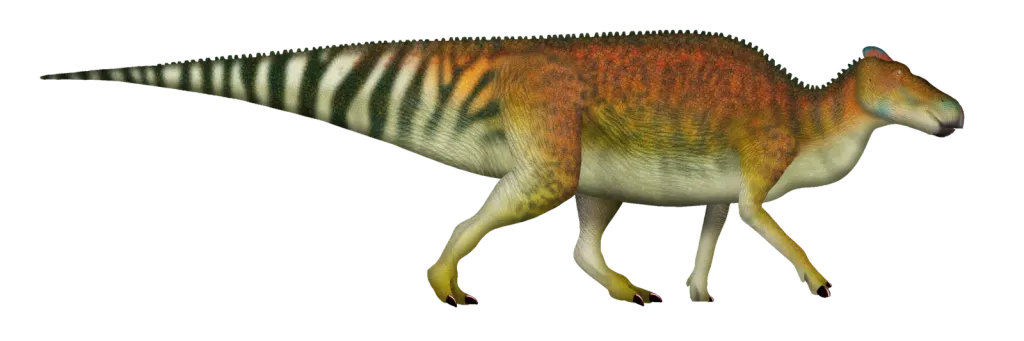
Edmontosaurus annectens
读音: ed-MON-toh-SORE-us ah-NEK-tenz
Ornithopoda · Hadrosauridae
A large duck-billed dinosaur from the very end of the Cretaceous in western North America, a common plant-eater of the Hell Creek and Lance formations and prey of T. rex. Several "mummies" preserve its skin.
- Skin impressions known
- Exceptional preservation
- Famous specimen
- 时代
- 白垩纪· 马斯特里赫特阶
- 食性
- 植食性
- 体长
- 12–15 m
- 体重
- 5,600–15,900 kg
- 地点
- Wyoming, Montana, South Dakota, North Dakota, Saskatchewan, United States, Canada
快速问答
- Edmontosaurus annectens有多大?
- Edmontosaurus annectens体长约12–15 m。髋部高约2.6–3.4 m。体重约5.6–15.9 t。 (Wikipedia: Edmontosaurus 2026; Paul 2016)
- Edmontosaurus annectens生活在什么时候?
- Edmontosaurus annectens生活在晚白垩世,约7210万至6600万年前。 (Paleobiology Database: Edmontosaurus occurrences 2026; Campione & Evans 2011)
- 在哪里发现过Edmontosaurus annectens的化石?
- Edmontosaurus annectens的化石发现于Lance Formation (Wyoming)、Hell Creek Formation (Montana)、Frenchman Formation (Saskatchewan)、United States和Canada。 (Marsh 1892; Lambe 1917)
- Edmontosaurus annectens吃什么?
- Edmontosaurus annectens是植食性。 (Marsh 1892; Lambe 1917)
- Edmontosaurus annectens由谁命名,何时命名?
- Edmontosaurus annectens由Othniel Charles Marsh于1892年描述。 (Marsh 1892; Campione & Evans 2011)
本页内容

ed-MON-toh-SORE-us ah-NEK-tenz
- 时代
- 白垩纪72.1–66 Ma
- 食性
- 植食性
- 体长
- 12–15 m
- 体重
- 5.6–15.9 t
- 产地
- United States, Canada
- 分类
- Ornithopoda · Hadrosauridae
- 命名
- 1892, Othniel Charles Marsh
概览
此内容目前仅提供英文版。
Edmontosaurus annectens lived in western North America in the late Maastrichtian, alongside Tyrannosaurus and Triceratops. Othniel Charles Marsh named it Claosaurus annectens in 1892 from a skeleton from the Lance Formation of Wyoming (USNM 2414). The genus Edmontosaurus had been named by Lawrence Lambe in 1917 for the older species E. regalis from Alberta.
It was a big, flat-headed hadrosaur that walked on four or two legs and chewed plants with batteries of hundreds of teeth. Several naturally mummified specimens, the first found by the Sternberg family in 1908, preserve large areas of scaly skin. Campione and Evans (2011) showed that the giant "Anatotitan" was just a large E. annectens, leaving two species in the genus.
A Tyrannosaurus tooth embedded in two fused, healed tail vertebrae of a hadrosaur like Edmontosaurus shows that T. rex attacked living animals and that this one escaped (DePalma et al. 2013).
名称含义
"Edmonton lizard", after the Edmonton Formation of Alberta where the type species was found (Lambe 1917); annectens, Latin for "connecting" (Marsh 1892).
生物学与证据
科学家对这种动物生活方式的看法,以及每种观点的证据有多充分。
皮肤与体表覆盖
Edmontosaurus had scaly skin.
证据等级:直接证据Several mummified specimens preserve large areas of skin with small, pebbly scales.
支持 / 反对证据 · 1
支持证据
皮肤印痕 · Edmontosaurus mummies
Naturally mummified skeletons with large areas of scaly skin, including AMNH 5060 (found in 1908 by the Sternbergs) and "Dakota" (NDGS 2000).
生长
The giant "Anatotitan" was a fully grown Edmontosaurus annectens.
证据等级:有力证据Its long, flat skull falls on the growth trajectory of E. annectens, so the differences reflect size and age, not a separate species.
支持 / 反对证据 · 1
支持证据
比较解剖学 · Morphometrics of edmontosaur skulls
Morphometric analysis of almost all complete edmontosaur skulls finds only two species; Anatotitan copei and other names fall within the growth series of E. annectens.
行为
Tyrannosaurus attacked living Edmontosaurus.
证据等级:中等证据A T. rex tooth is embedded in a hadrosaur tail that healed afterwards, so the animal was alive and escaped. The vertebrae are compared with, not firmly identified as, Edmontosaurus annectens.
支持 / 反对证据 · 1
支持证据
标本 · Healed hadrosaur tail with embedded T. rex tooth
Two fused hadrosaur tail vertebrae (compared with E. annectens) from the Hell Creek Formation of South Dakota, enclosing a Tyrannosaurus tooth crown surrounded by healed bone.

体型
- 体长
- 12–15 m
- 身高
- 3 m文献范围 2.6–3.4 m
- 体重
- 5,600–15,900 kg
(49.2 英尺)
(9.8 英尺)
依据 large adults
时间线
时代: 马斯特里赫特阶 (72.1–66 Ma), 晚白垩世 (100.5–66 Ma)
Maastrichtian bounds in PBDB; Campione & Evans place E. annectens in the late Maastrichtian and E. regalis in the late Campanian.
产地
地层
- Lance Formation · Wyoming
- Hell Creek Formation · Montana
- Frenchman Formation · Saskatchewan
- Lance Creek area, Niobrara County, Wyoming · Lance Formation · Wyoming · 位置为近似值
这些是发现化石的地点,而不是该动物生活的全部范围。
生态系统

生活于: Hell Creek
68–66 百万年前 · 泛滥平原, 河流水系, 森林, 沿海平原
Warm, humid coastal lowlands and river floodplains west of the retreating Western Interior Seaway at the very end of the Cretaceous, with forests of conifers and flowering plants. The ecosystem ends at the Cretaceous-Paleogene extinction.


分类
- 演化支Dinosauria
- 演化支Ornithischia
- 演化支Ornithopoda
- 科Hadrosauridae
- 亚科Saurolophinae
- 属Edmontosaurus
- 种Edmontosaurus annectens
分类地位: 有效
化石记录

| 编号 | 类型 | 收藏机构 | 发现年份 |
|---|---|---|---|
| USNM 2414 | 正模标本 | National Museum of Natural History, Smithsonian Institution (USNM) | — |
| YPM 2182 | 副模标本 | Yale Peabody Museum (YPM) | — |
已发现的部分
正模标本: USNM 2414
- 保存
- 部分保存
- 复原
- 未知 / 未记录
正模标本: USNM 2414
按部位查看(表格)
| 部位 | 状态 |
|---|---|
| Skull | 部分保存 · Skull roof. |
| Mandible | 未知 / 未记录 |
| Teeth | 未知 / 未记录 |
| Cervical vertebrae | 未知 / 未记录 |
| Dorsal vertebrae | 未知 / 未记录 |
| Sacrum | 未知 / 未记录 |
| Caudal vertebrae | 未知 / 未记录 |
| Ribs | 未知 / 未记录 |
| Gastralia | 未知 / 未记录 |
| Scapula / shoulder girdle | 未知 / 未记录 |
| Humerus | 未知 / 未记录 |
| Forearm (radius / ulna) | 未知 / 未记录 |
| Hand (manus) | 未知 / 未记录 |
| Pelvis | 未知 / 未记录 |
| Femur | 未知 / 未记录 |
| Tibia / fibula | 未知 / 未记录 |
| Foot (pes) | 未知 / 未记录 |
副模标本: YPM 2182
按部位查看(表格)
| 部位 | 状态 |
|---|---|
| Skull | 保存 |
| Mandible | 未知 / 未记录 |
| Teeth | 未知 / 未记录 |
| Cervical vertebrae | 未知 / 未记录 |
| Dorsal vertebrae | 未知 / 未记录 |
| Sacrum | 未知 / 未记录 |
| Caudal vertebrae | 未知 / 未记录 |
| Ribs | 未知 / 未记录 |
| Gastralia | 未知 / 未记录 |
| Scapula / shoulder girdle | 未知 / 未记录 |
| Humerus | 未知 / 未记录 |
| Forearm (radius / ulna) | 未知 / 未记录 |
| Hand (manus) | 未知 / 未记录 |
| Pelvis | 未知 / 未记录 |
| Femur | 未知 / 未记录 |
| Tibia / fibula | 未知 / 未记录 |
| Foot (pes) | 未知 / 未记录 |

图库

发现
- 命名年份
- 1892
- 命名者
- Othniel Charles Marsh
- 模式标本
- USNM 2414
发现时间线
1892 · 正式命名
Marsh names Claosaurus annectens
Marsh names a hadrosaur from the Lance Formation of Wyoming.
人物:Othniel Charles Marsh
1908 · 标本出土
The Sternbergs find the first Edmontosaurus mummy
A mummified skeleton with skin impressions (AMNH 5060) is found in the Lance Formation of Wyoming.
1917 · 正式命名
Lambe names Edmontosaurus
The genus is named for E. regalis from the Edmonton (now Horseshoe Canyon) Formation of Alberta.
人物:Lawrence M. Lambe
2011 · 修订
Edmontosaur species reduced to two
Campione and Evans show that edmontosaurs include only E. regalis and E. annectens.
人物:Nicolás E. Campione
2013 · 重要研究
Healed T. rex bite found in a hadrosaur tail
DePalma and colleagues report a tooth embedded in healed vertebrae.
参考文献
- (2026). Paleobiology Database: Edmontosaurus occurrences. The Paleobiology Database (paleobiodb.org), data service 1.2, accessed 2026-09-23. https://paleobiodb.org/data1.2/occs/list.txt?base_name=Edmontosaurus&show=coords,paleoloc,strat,loc,ref&pgm=gplates(在新标签页中打开)
- (2026). Wikipedia: Edmontosaurus. Wikipedia (English), accessed 2026-09-23. https://en.wikipedia.org/wiki/Edmontosaurus(在新标签页中打开)
- Campione, N. E. & Evans, D. C. (2011). Cranial growth and variation in edmontosaurs (Dinosauria: Hadrosauridae): implications for latest Cretaceous megaherbivore diversity in North America. PLoS ONE 6: e25186. doi:10.1371/journal.pone.0025186(在新标签页中打开)
- Cohen, K. M., Harper, D. A. T., Gibbard, P. L. & Car, N. (2023). International Chronostratigraphic Chart (v2023/09). International Commission on Stratigraphy. https://stratigraphy.org/ICSchart/ChronostratChart2023-09.pdf(在新标签页中打开)
- DePalma, R. A., Burnham, D. A., Martin, L. D., Rothschild, B. M. & Larson, P. L. (2013). Physical evidence of predatory behavior in Tyrannosaurus rex. Proceedings of the National Academy of Sciences 110. doi:10.1073/pnas.1216534110(在新标签页中打开)
- Lambe, L. M. (1917). A new genus and species of crestless hadrosaur from the Edmonton Formation of Alberta. The Ottawa Naturalist 31(7): 65-73.
- Marsh, O. C. (1892). Notice of new reptiles from the Laramie Formation. American Journal of Science 43: 449-453.
- Paul, G. S. (2016). The Princeton Field Guide to Dinosaurs (2nd edition). Princeton University Press.