Which Dinosaurs Lived in Brazil? A Guide to the Fossils
Brazil has some of the oldest dinosaurs known, a spinosaur named for the irritation it caused, and giant long-necked titanosaurs. A guide to the main finds.
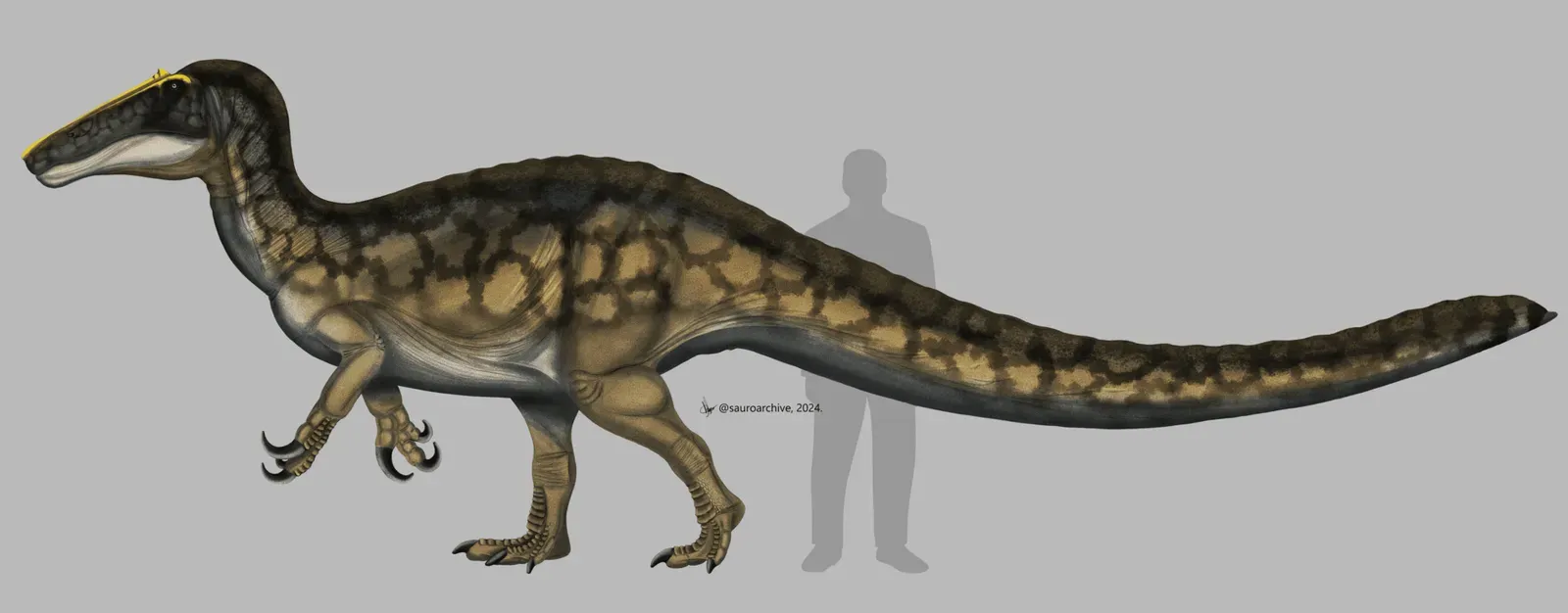
Which dinosaurs lived in Brazil? Quite a few, across almost the whole age of dinosaurs. Southern Brazil has some of the oldest dinosaurs known anywhere, from about 233 million years ago. The northeast has the spinosaur Irritator, known from a remarkable skull. And the Late Cretaceous rocks of the southeast have produced giant long-necked titanosaurs.
This guide covers the main dinosaurs in Brazil, the rocks they came from and what they tell us about South America's past.
Dinosaurs in Brazil at a glance
- Late Triassic, about 233 million years ago: early dinosaurs such as Staurikosaurus, Saturnalia and Buriolestes, from Rio Grande do Sul.
- Early Cretaceous, about 115 million years ago: the spinosaurid Irritator, from the Romualdo Formation of Ceará.
- Late Cretaceous, about 100 million years ago: the spinosaurid Oxalaia, from Maranhão.
- Late Cretaceous, later still: titanosaurs such as Austroposeidon, from the Bauru Group of São Paulo state.
Not all of these have DinoDex profiles yet. The ones that do are linked.
Some of the oldest dinosaurs on Earth
The Santa Maria Formation in Rio Grande do Sul, southern Brazil, preserves life from the Late Triassic, when all continents were joined in the supercontinent Pangaea. Its dinosaurs are among the earliest known, and they were small compared with what came later.
- Staurikosaurus pricei, described by Edwin Colbert in 1970, was a lightly built, two-legged predator a little over two metres long, according to most reconstructions. It is one of the first Triassic dinosaurs described from South America.
- Saturnalia tupiniquim, described by Max Langer and colleagues in 1999, is an early sauropodomorph: a distant, small relative of the giant long-necked sauropods.
- Buriolestes schultzi, described by Sérgio Cabreira and colleagues in 2016, is another early sauropodomorph, but with sharp, serrated teeth suggesting it still ate meat or small animals.
Across the border, the Ischigualasto Formation of Argentina holds dinosaurs of a similar age, such as Herrerasaurus. Together, these rocks make southern South America one of the best places in the world to study how dinosaurs began.
Irritator: Brazil's famous spinosaur
The best-known Brazilian dinosaur on DinoDex is Irritator challengeri. It comes from the Romualdo Formation of the Araripe Basin, in the state of Ceará, and dates to the Aptian age of the Early Cretaceous, roughly 120 to 113 million years ago.
A name born of frustration
The skull, SMNS 58022, reached a museum in Stuttgart through the fossil trade. Whoever prepared it had built up the snout with plaster to make it look more complete. When David Martill and colleagues described it in 1996, they had to remove the fake parts first, and named the animal Irritator for the feeling. The species name honours Professor Challenger, the explorer in Arthur Conan Doyle's novel *The Lost World*.

From "crested maniraptoran" to spinosaur
Martill's team first thought it was a small, crested relative of birds. In 2002, Hans-Dieter Sues and colleagues re-examined the skull and showed that it belonged to a spinosaurid, the family of Spinosaurus and Suchomimus. A CT study in 2020 (Schade et al.) found that the inner ear and brain of Irritator suited quick, precise head movements, consistent with snapping at small prey such as fish.

Because it is known mostly from the skull, Irritator's body size is uncertain. Estimates run from about 6 to 8 metres, based on its relatives. Another spinosaurid from the same rocks, Angaturama limai, may be the same animal; palaeontologists have not settled the question.
A window into an ancient lagoon
The Romualdo Formation is famous for its fossils preserved in limestone nodules: fish, pterosaurs and plants, often in three dimensions. It formed in a coastal setting during the early opening of the South Atlantic, when South America and Africa were still pulling apart. That helps explain why Irritator's closest relatives lived in Africa, in places like Niger.

Oxalaia, a second Brazilian spinosaur
Oxalaia quilombensis was described in 2011 by Alexander Kellner and colleagues from snout fragments found on Cajual Island in Maranhão, northern Brazil. It comes from the Alcântara Formation and dates to the Cenomanian, the same age as Spinosaurus in North Africa. Its anatomy is close to Spinosaurus, but it is known from very little material, so its size remains a rough estimate.
Titanosaurs of the Bauru Group
In the later part of the Late Cretaceous, the interior of southeastern Brazil was a semi-arid basin where rivers left thick layers of sand. These rocks, the Bauru Group, are rich in crocodile relatives and titanosaurs, the long-necked plant eaters that dominated South America at the time.
Austroposeidon magnificus, described by Kamila Bandeira and colleagues in 2016 from vertebrae found in São Paulo state, is one of the largest dinosaurs known from Brazil; the authors estimated a length of about 25 metres. For a sense of how big titanosaurs could get, compare the Argentine giants Argentinosaurus and Patagotitan.
Why Brazil's dinosaur record is patchy
Brazil is a huge country, but much of it is covered by deep soil and dense vegetation, so fossil-bearing rock is exposed in fewer places than in the badlands of Argentina or the western United States. Many Brazilian dinosaurs are therefore known from partial skeletons or isolated bones, and new species are still being named regularly. Our explainer on how complete dinosaur fossils are explains why that affects size estimates and reconstructions.
Where to see and explore them
Brazilian fossils are held in museums across the country and abroad. On DinoDex you can start from the Brazil page or the wider South America hub, which link to every profile, formation and specimen we have recorded there. More Brazilian dinosaurs will be added as their profiles are researched and sourced.

Sources
- Colbert, E. H.. (1970). A saurischian dinosaur from the Triassic of Brazil. American Museum Novitates 2405: 1-39
- Langer, M. C., Abdala, F., Richter, M. & Benton, M. J.. (1999). A sauropodomorph dinosaur from the Upper Triassic (Carnian) of southern Brazil. Comptes Rendus de l'Académie des Sciences, Sciences de la Terre et des Planètes 329: 511-517
- Cabreira, S. F., Kellner, A. W. A., Dias-da-Silva, S., et al.. (2016). A unique Late Triassic dinosauromorph assemblage reveals dinosaur ancestral anatomy and diet. Current Biology 26(22): 3090-3095
- Martill, D. M., Cruickshank, A. R. I., Frey, E., Small, P. G. & Clarke, M.. (1996). A new crested maniraptoran dinosaur from the Santana Formation (Lower Cretaceous) of Brazil. Journal of the Geological Society 153: 5-8 doi:10.1144/gsjgs.153.1.0005
- Sues, H.-D., Frey, E., Martill, D. M. & Scott, D. M.. (2002). Irritator challengeri, a spinosaurid (Dinosauria: Theropoda) from the Lower Cretaceous of Brazil. Journal of Vertebrate Paleontology 22: 535-547 doi:10.1671/0272-4634(2002)022[0535:ICASDT]2.0.CO;2
- Schade, M., Rauhut, O. W. M. & Evers, S. W.. (2020). Neuroanatomy of the spinosaurid Irritator challengeri (Dinosauria: Theropoda) indicates potential adaptations for piscivory. Scientific Reports 10: 9259 doi:10.1038/s41598-020-66261-w
- Kellner, A. W. A., Azevedo, S. A. K., Machado, E. B., Carvalho, L. B. & Henriques, D. D. R.. (2011). A new dinosaur (Theropoda, Spinosauridae) from the Cretaceous (Cenomanian) Alcântara Formation, Cajual Island, Brazil. Anais da Academia Brasileira de Ciências 83(1): 99-108
- Bandeira, K. L. N., Simbras, F. M., Machado, E. B., et al.. (2016). A new giant Titanosauria (Dinosauria: Sauropoda) from the Late Cretaceous Bauru Group, Brazil. PLoS ONE 11(10): e0163373 doi:10.1371/journal.pone.0163373
Related dinosaurs


Showing 4 of 4
Related posts

Explainers
Where Did Spinosaurus Live? Its World in North Africa
Spinosaurus lived in the river systems of North Africa about 100 to 94 million years ago. Here is where its fossils come from and what its world looked like.
DinoDex team · 26 September 2026 · 4 min read

Explainers
How Complete Are Dinosaur Fossils? Less Than You Think
Complete dinosaur skeletons are rare, and many species are known from a skull or a handful of bones. Here is why, and what it means for the numbers you read.
DinoDex team · 26 September 2026 · 5 min read

Explainers
T. rex vs Spinosaurus: How the Two Giants Compare
Spinosaurus was longer; T. rex was built heavier, with a bone-crushing bite. They also lived tens of millions of years and a continent apart. A fact-based comparison.
DinoDex team · 26 September 2026 · 4 min read