Where Did Spinosaurus Live? Its World in North Africa
Spinosaurus lived in the river systems of North Africa about 100 to 94 million years ago. Here is where its fossils come from and what its world looked like.
यह सामग्री अंग्रेज़ी में उपलब्ध है।
Where did Spinosaurus live? Spinosaurus aegyptiacus lived in North Africa about 100 to 94 million years ago, during the Cenomanian age of the Late Cretaceous. Its fossils come from two main areas: the Bahariya Oasis in Egypt and the Kem Kem region of eastern Morocco.
At the time, this part of Africa was a low-lying land crossed by large rivers that flowed north towards the Tethys Sea. Spinosaurus lived along those waterways, in a landscape rich in fish.
Where Spinosaurus lived: fossil sites at a glance
- Age: about 100.5 to 93.9 million years ago (Cenomanian).
- Egypt: the Bahariya Formation, where the first skeleton was found.
- Morocco: the Kem Kem Group, source of most fossils found since the 1990s.
- Environment: river channels, deltas and floodplains near the southern coast of the Tethys.
- Neighbours: other large predators, including Carcharodontosaurus.
The first Spinosaurus: Egypt, 1912
The story starts in the Egyptian desert. Fossils collected at Bahariya were described by the German palaeontologist Ernst Stromer in 1915. He named the animal Spinosaurus, "spine lizard", after the tall spines on its back vertebrae.

Stromer's original specimen, BSPG 1912 VIII 19, was kept in a museum in Munich. It was destroyed in 1944, when the building was hit during an Allied bombing raid in the Second World War. For decades, palaeontologists had only Stromer's drawings and descriptions to work from.
The Kem Kem beds of Morocco
Since the 1990s, most new Spinosaurus material has come from the Kem Kem Group, a thick sequence of sandstones and mudstones along the border between Morocco and Algeria. These rocks were deposited by rivers, and they are full of fish remains, crocodile relatives, pterosaurs and dinosaur teeth.
In 2014, Nizar Ibrahim and colleagues described a partial skeleton from Kem Kem, FSAC-KK 11888, and designated it the neotype: the new reference specimen for the species, replacing the one lost in Munich. A large review of the Kem Kem Group published by Ibrahim and colleagues in 2020 describes its geology, age and fauna in detail.
What was the environment like?
The Kem Kem rivers carried an unusual ecosystem. Fish were abundant and some were huge, including coelacanths and sawfish-like relatives of rays. Large predators were also unusually common compared with plant-eating dinosaurs, a pattern sometimes called "Stromer's riddle".

One explanation is that many of these predators fed mostly on fish and other aquatic prey rather than on land animals. That fits the anatomy of Spinosaurus: a long, narrow snout, cone-shaped teeth suited to gripping slippery prey, and nostrils set far back on the skull. There is direct evidence of a broader menu too: a spinosaur tooth found embedded in a pterosaur neck vertebra shows that these animals also caught or scavenged flying reptiles (Buffetaut et al. 2004).
Did Spinosaurus live in the water?
This is the biggest open question about the animal, and palaeontologists disagree.
The case for a swimmer
Ibrahim and colleagues (2014) argued that Spinosaurus was semi-aquatic, citing its dense limb bones and short hind legs. In 2020 they described a tall, flexible, paddle-like tail and proposed that it was used for swimming. Earlier, oxygen isotopes in spinosaurid teeth had already suggested that these animals spent a lot of time in water (Amiot et al. 2010).
The case for a wader
Other researchers see Spinosaurus as a shoreline hunter that waded rather than swam. David Hone and Thomas Holtz (2021) compared it with herons and storks. Paul Sereno and colleagues (2022) built a digital model and concluded that it would have been unstable in deep water and too slow to chase fish, and that it more likely hunted from the shallows.
There is no final answer yet. What both sides agree on is that Spinosaurus depended on rivers and their fish far more than a typical large theropod did.
What was the sail for?
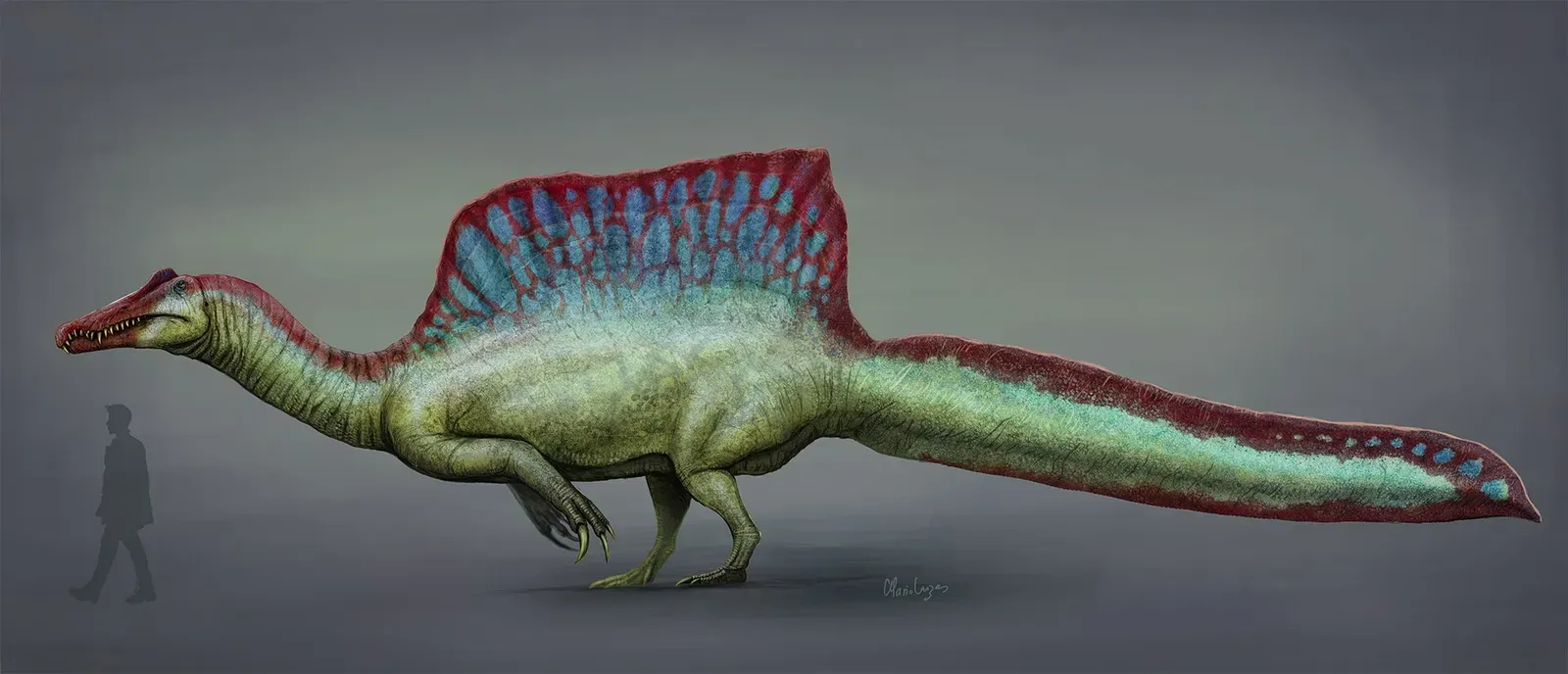
The tall spines on the back of Spinosaurus, some well over a metre long, supported a sail or hump of skin. Its purpose is still debated. Display, to rivals or mates, is the explanation most often favoured, because the sail would have been highly visible and costly to grow. Heat regulation and fat storage have also been proposed, but neither is well supported by direct evidence. In the water-hunting debate, the sail is a problem for swimmers: it would have made the animal less stable in deep water, one of the points raised by Sereno and colleagues (2022).
Crowded rivers: the neighbours of Spinosaurus
Spinosaurus was not the only giant in these rivers. Carcharodontosaurus, about 12 to 12.5 metres long, is known from the same Kem Kem and Bahariya rocks. It had a deep skull and blade-like teeth, better suited to large land prey. Living side by side, the two may have avoided competing by hunting different food: fish for one, big dinosaurs for the other.

Spinosaurus relatives around the world
Spinosaurus belongs to a family, the spinosaurids, known from several continents during the Cretaceous:
- Baryonyx from the Weald Clay Formation of southern England, one of the first spinosaurids understood from a good skeleton.
- Suchomimus from the Elrhaz Formation of Niger.
- Irritator from the Romualdo Formation of Brazil. Read more in our guide to dinosaurs that lived in Brazil.
Their spread across Africa, South America and Europe reflects a time when those landmasses were still close together, or just beginning to separate.
How big was it?
Spinosaurus is often called the longest predatory dinosaur. The reconstruction by Sereno and colleagues (2022) gives an adult length of just under 14 metres and a body mass of about 7.4 tonnes. Other studies give different figures, and because the known skeleton is incomplete, every estimate carries real uncertainty. For a side-by-side look, see T. rex vs Spinosaurus.
Explore the full Spinosaurus profile for its timeline, fossil sites and sources.

Sources
- Stromer, E.. (1915). Ergebnisse der Forschungsreisen Prof. E. Stromers in den Wüsten Ägyptens. II. Wirbeltier-Reste der Baharîje-Stufe (unterstes Cenoman). 3. Das Original des Theropoden Spinosaurus aegyptiacus nov. gen., nov. spec.. Abhandlungen der Königlich Bayerischen Akademie der Wissenschaften, Mathematisch-physikalische Klasse 28(3): 1-32
- Ibrahim, N., Sereno, P. C., Dal Sasso, C., Maganuco, S., Fabbri, M., Martill, D. M., Zouhri, S., Myhrvold, N. & Iurino, D. A.. (2014). Semiaquatic adaptations in a giant predatory dinosaur. Science 345(6204): 1613-1616 doi:10.1126/science.1258750
- Ibrahim, N., Sereno, P. C., Varricchio, D. J., Martill, D. M., Dutheil, D. B., Unwin, D. M., Baidder, L., Larsson, H. C. E., Zouhri, S. & Kaoukaya, A.. (2020). Geology and paleontology of the Upper Cretaceous Kem Kem Group of eastern Morocco. ZooKeys 928: 1-216 doi:10.3897/zookeys.928.47517
- Ibrahim, N., Maganuco, S., Dal Sasso, C., et al.. (2020). Tail-propelled aquatic locomotion in a theropod dinosaur. Nature 581: 67-70 doi:10.1038/s41586-020-2190-3
- Sereno, P. C., Myhrvold, N., Henderson, D. M., et al.. (2022). Spinosaurus is not an aquatic dinosaur. eLife 11: e80092 doi:10.7554/eLife.80092
- Hone, D. W. E. & Holtz, T. R.. (2021). Evaluating the ecology of Spinosaurus: shoreline generalist or aquatic pursuit specialist?. Palaeontologia Electronica 24(1): a03 doi:10.26879/1110
- Amiot, R., Buffetaut, E., Lécuyer, C., et al.. (2010). Oxygen isotope evidence for semi-aquatic habits among spinosaurid theropods. Geology 38(2): 139-142 doi:10.1130/G30402.1
- Buffetaut, E., Martill, D. & Escuillié, F.. (2004). Pterosaurs as part of a spinosaur diet. Nature 430: 33 doi:10.1038/430033a
संबंधित डायनासोर


5 में से 5 दिखाए जा रहे हैं
संबंधित पोस्ट

Explainers
T. rex vs Spinosaurus: How the Two Giants Compare
Spinosaurus was longer; T. rex was built heavier, with a bone-crushing bite. They also lived tens of millions of years and a continent apart. A fact-based comparison.
DinoDex team · 26 सितंबर 2026 · 4 मिनट में पढ़ें

Explainers
Which Dinosaurs Lived in Brazil? A Guide to the Fossils
Brazil has some of the oldest dinosaurs known, a spinosaur named for the irritation it caused, and giant long-necked titanosaurs. A guide to the main finds.
DinoDex team · 26 सितंबर 2026 · 4 मिनट में पढ़ें

Explainers
How Complete Are Dinosaur Fossils? Less Than You Think
Complete dinosaur skeletons are rare, and many species are known from a skull or a handful of bones. Here is why, and what it means for the numbers you read.
DinoDex team · 26 सितंबर 2026 · 5 मिनट में पढ़ें