Was Argentinosaurus the Biggest Dinosaur Ever?
By weight, Argentinosaurus is the leading candidate, at roughly 65 to 83 tonnes. But it is known from a handful of bones, and Patagotitan is close behind.
このコンテンツは英語でご覧いただけます。
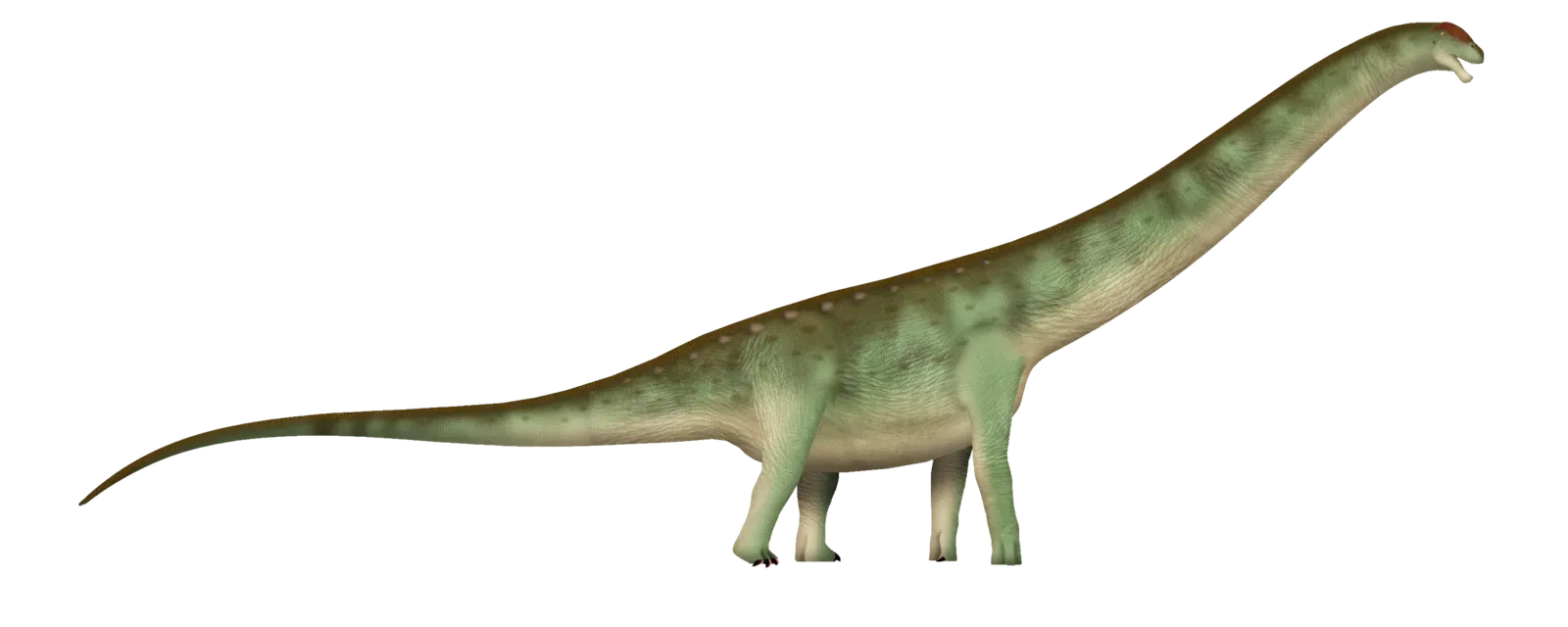
Probably, but not certainly. Argentinosaurus is the strongest candidate for the heaviest dinosaur known, at about 65 to 75 tonnes in a volumetric model (Paul 2019) and about 83 tonnes in another (Sellers et al. 2013). The catch is that it is known from only a few enormous bones, so every figure is an extrapolation.
Here is how its weight compares with the other titanosaur giants, and why the answer comes with an asterisk.
The heaviest dinosaurs at a glance
- Argentinosaurus: about 65 to 83 t (72 to 91 short tons); length about 30 to 35 m (98 to 115 ft), a widely quoted secondary figure.
- Patagotitan: about 50 to 69 t (55 to 76 short tons); length about 31 to 37 m (102 to 121 ft).
- Dreadnoughtus: estimates from 22 to 59 t (24 to 65 short tons) depending on method; about 26 m (85 ft) long for a not fully grown individual.
For scale, all three were titanosaurs, the long-necked plant eaters that dominated the southern continents in the Cretaceous.
How heavy was Argentinosaurus?
Argentinosaurus was described in 1993 by José Bonaparte and Rodolfo Coria from the Huincul Formation of Neuquén Province, Argentina. What was found is a few back vertebrae, part of the hip and a lower leg bone. There is no complete limb bone, skull or neck.
Two recent approaches give the range on its profile, and we do not average them:
- 65 to 75 tonnes: Gregory Paul (2019) built a volumetric model on a skeletal restoration and concluded Argentinosaurus was the heaviest of the giants he compared.
- About 83 tonnes: William Sellers and colleagues (2013) wrapped a convex hull around the mounted reconstruction at the Museo Carmen Funes. They also cite 60 to 88 tonnes from earlier regression methods (Mazzetta et al. 2004).
Both depend on how the missing skeleton is restored, which is borrowed from better-known relatives.

Was Patagotitan heavier?
When Patagotitan was described in 2017, José Carballido and colleagues estimated 69 tonnes from its limb bones, with a standard error of 17 tonnes. That headline briefly made it "the biggest dinosaur". Paul (2019) then modelled it at 50 to 55 tonnes, lighter than his Argentinosaurus.
Patagotitan has a big advantage in evidence: it is known from at least six individuals in one quarry in Chubut, so much more of its skeleton is known. On current estimates it was probably a little lighter than Argentinosaurus, but the ranges overlap.
Why is the biggest dinosaur so hard to pin down?
Giants are rarely found complete. A body that size is hard to bury quickly, and the bones that survive are often vertebrae and limb pieces. Dreadnoughtus shows how much method matters, even with a good skeleton: its describers estimated 59.3 tonnes from limb scaling (Lacovara et al. 2014), while a volumetric study found 22 to 38 tonnes more plausible (Bates et al. 2015). Same bones, a factor of two apart.
For Argentinosaurus, with far fewer bones, the uncertainty is larger still. Our explainer on how complete dinosaur fossils are explains why.

How long was Argentinosaurus?
No skeleton-based length has been published for such fragmentary remains. The 30 to 35 metres usually quoted is a secondary figure scaled from relatives, and the DinoDex profile marks it low confidence. For comparison, Diplodocus was about 24 to 26 m long but weighed a fraction as much; see how long was Diplodocus.
Why measure the biggest dinosaur by weight?
Length is a poor guide to size in sauropods. Much of a sauropod's length was neck and tail, which could be long and light, so a slender animal can out-measure a much heavier one. Weight captures how much animal there actually was, and it is what matters for questions like how much it ate or how strong its legs had to be. That is why "biggest" in palaeontology usually means heaviest, even though weight is also the hardest number to estimate.
Where can you see Argentinosaurus?
The original bones are at the Museo Carmen Funes in Plaza Huincul, Argentina, alongside a full-size reconstructed skeleton. That mounted reconstruction is the one Sellers and colleagues used for their 83-tonne model, so the figure depends on the choices made by the people who restored it.
When did Argentinosaurus live?
The Huincul Formation is usually placed in the late Cenomanian to early Turonian, roughly 100 to 90 million years ago. The 1993 description gave an older age, and that dispute is recorded on the profile rather than averaged away.
Quick answers
- What is the heaviest dinosaur ever found? Argentinosaurus is the leading candidate, at about 65 to 83 t, from very incomplete remains.
- Is Patagotitan bigger than Argentinosaurus? Probably not by weight: 50 to 69 t against 65 to 83 t, with overlapping uncertainty.
- How long was Argentinosaurus? A widely quoted 30 to 35 m, not based on a skeleton.

Sources
- Paul, G. S.. (2019). Determining the largest known land animal: a critical comparison of differing methods for restoring the volume and mass of extinct animals. Annals of Carnegie Museum 85(4): 335-358 doi:10.2992/007.085.0403
- Sellers, W. I., Margetts, L., Coria, R. A. & Manning, P. L.. (2013). March of the Titans: the locomotor capabilities of sauropod dinosaurs. PLoS ONE 8: e78733 doi:10.1371/journal.pone.0078733
- Mazzetta, G. V., Christiansen, P. & Fariña, R. A.. (2004). Giants and bizarres: body size of some southern South American Cretaceous dinosaurs. Historical Biology 16: 71-83 doi:10.1080/08912960410001715132
- Bonaparte, J. F. & Coria, R. A.. (1993). Un nuevo y gigantesco saurópodo titanosaurio de la Formación Río Limay (Albiano-Cenomaniano) de la Provincia del Neuquén, Argentina. Ameghiniana 30(3): 271-282
- Carballido, J. L., Pol, D., Otero, A., Cerda, I. A., Salgado, L., Garrido, A. C., Ramezani, J., Cúneo, N. R. & Krause, J. M.. (2017). A new giant titanosaur sheds light on body mass evolution among sauropod dinosaurs. Proceedings of the Royal Society B 284: 20171219 doi:10.1098/rspb.2017.1219
- Lacovara, K. J., Lamanna, M. C., Ibiricu, L. M., Poole, J. C., Schroeter, E. R., Ullmann, P. V., Voegele, K. K., Boles, Z. M., et al.. (2014). A gigantic, exceptionally complete titanosaurian sauropod dinosaur from southern Patagonia, Argentina. Scientific Reports 4: 6196 doi:10.1038/srep06196
- Bates, K. T., Falkingham, P. L., Macaulay, S., Brassey, C. & Maidment, S. C. R.. (2015). Downsizing a giant: re-evaluating Dreadnoughtus body mass. Biology Letters 11 doi:10.1098/rsbl.2015.0215
関連する恐竜

関連記事

Size & comparisons
Brachiosaurus vs Argentinosaurus: Tallest vs Heaviest
Argentinosaurus was more than twice as heavy. Brachiosaurus was built to reach high, with long front legs, but the evidence for which stood taller is thin.
DinoDex team · 2026年9月27日 · 3 分で読めます

Size & comparisons
How Long Was Diplodocus Compared to a Bus?
About 24 to 26 metres: two city buses parked end to end. Most of that was neck and tail, which is why Diplodocus was long but surprisingly light.
DinoDex team · 2026年9月27日 · 3 分で読めます

Explainers
How Complete Are Dinosaur Fossils? Less Than You Think
Complete dinosaur skeletons are rare, and many species are known from a skull or a handful of bones. Here is why, and what it means for the numbers you read.
DinoDex team · 2026年9月26日 · 5 分で読めます