Carcharodontosaurus vs Giganotosaurus: Which Was Bigger?
Two close relatives from the same age, on different continents, and almost the same size. Giganotosaurus edges ahead in most estimates, within the error bars.
此内容目前仅提供英文版。
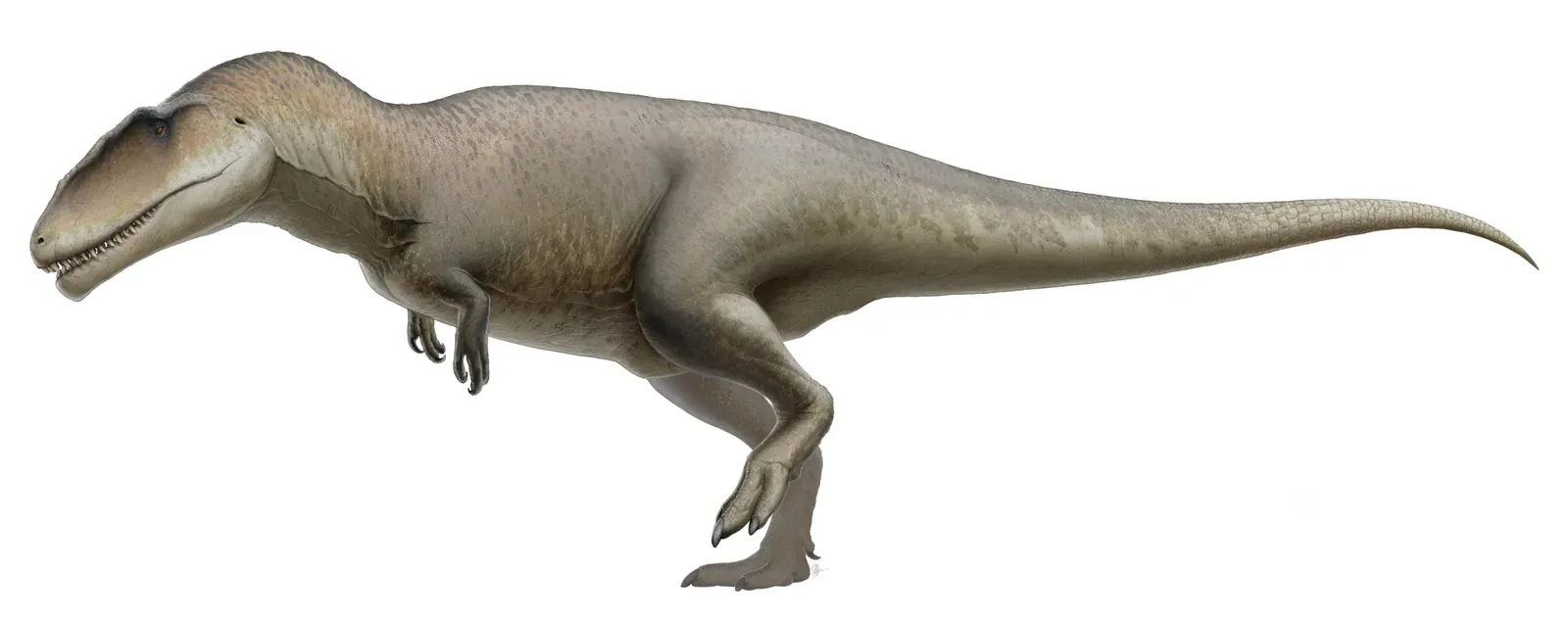
Almost a tie. Giganotosaurus is estimated at about 12.5 to 13.2 m (41 to 43 ft) and 6 to 8 tonnes (Coria & Salgado 1995; Calvo & Coria 1998); Carcharodontosaurus at about 12 to 12.5 m (39 to 41 ft) and 5 to 7 tonnes, with a skull of about 1.42 to 1.6 m (Sereno et al. 1996). Giganotosaurus comes out slightly ahead in most estimates, but the difference is within the uncertainty.
They were close relatives, lived at the same time, and are both known from incomplete skeletons.
Carcharodontosaurus vs Giganotosaurus at a glance
- Length: Giganotosaurus 12.5 to 13.2 m; Carcharodontosaurus 12 to 12.5 m.
- Weight: Giganotosaurus 6 to 8 t (6.6 to 8.8 short tons); Carcharodontosaurus 5 to 7 t (5.5 to 7.7 short tons).
- Skull (reconstructed): Giganotosaurus about 1.53 to 1.60 m (5.0 to 5.2 ft); Carcharodontosaurus about 1.42 to 1.6 m (4.7 to 5.2 ft).
- When: both in the Cenomanian, about 100 to 94 million years ago.
- Where: Giganotosaurus in Patagonia, Argentina; Carcharodontosaurus in North Africa, in Morocco and Egypt.
Which was longer?
Giganotosaurus, slightly. Its holotype from the Candeleros Formation was estimated at about 12.5 m by Coria and Salgado (1995), and about 13.2 m was proposed from a larger referred jaw (Calvo & Coria 1998). Carcharodontosaurus is usually given 12 to 12.5 m, figures from Paul (2016) and Henderson & Nicholls (2015) as summarised in secondary literature; the DinoDex profile marks them low confidence until the primary texts are checked.
Half a metre, on animals known from partial skeletons, is not a meaningful lead.
Which was heavier?
Again Giganotosaurus by a small margin: 6 to 8 tonnes in its description against 5 to 7 tonnes for Carcharodontosaurus. An outlier estimate of about 13.8 tonnes for Giganotosaurus came from a skull-length regression (Therrien & Henderson 2007), which depends on an incomplete, reconstructed skull, so we do not use it as a headline.
Which had the bigger skull?
Too close to call. Paul Sereno and colleagues (1996) reported the reconstructed skull of the Moroccan neotype at approximately 1.6 m; a later estimate put it at about 1.42 m. Giganotosaurus's reconstructed skull is about 1.53 to 1.60 m. Both skulls are incomplete, and both reconstructions have been revised downwards before.

How were they related?
Both are carcharodontosaurids, a family of large allosauroid predators named after Carcharodontosaurus, "shark-toothed lizard", for its serrated, blade-like teeth. Brusatte and Sereno (2007) revised the genus and named a second species from Niger. Their shared ancestry and similar size reflect a group that produced several giants in the mid-Cretaceous, in South America and Africa.
Did they live at the same time?
Yes, broadly: both are dated to the Cenomanian stage, about 100.5 to 93.9 million years ago (ICS 2023). But they lived on different continents, so they never met. Carcharodontosaurus shared the rivers of the Kem Kem Group with Spinosaurus (Ibrahim et al. 2020); see where did Spinosaurus live?
The first partial skeleton of Carcharodontosaurus was destroyed in Munich in 1944, like the original Spinosaurus; a skull found in Morocco in 1995 replaced it as the neotype.
How do they compare with T. rex and Spinosaurus?
- [T. rex](/dinosaurs/tyrannosaurus-rex): about 12.3 to 13 m and 6 to 9.5 t, from far more complete skeletons.
- Spinosaurus: just under 14 m and about 7.4 t in the latest model, but lighter for its length.
All four giants fall within a couple of metres and a few tonnes of each other. None of the rankings is secure, because the more fragmentary animals rely on reconstruction.
Why are there so many "biggest predator" claims?
Because the candidates are known from partial skeletons, and each new bone or new method can move an estimate by metres or tonnes. The title of Therrien and Henderson's 2007 paper, "My theropod is bigger than yours ... or not", sums up the problem. On DinoDex, each figure keeps its range, method and source, and the ranking is left open where the evidence does not settle it.
For how Giganotosaurus measures up against a very different predator, see Giganotosaurus vs T. rex.
Quick answers
- Which was bigger, Carcharodontosaurus or Giganotosaurus? Giganotosaurus by a small margin in most estimates, within the uncertainty.
- Did they live at the same time? Yes, both in the Cenomanian, but on different continents.
- Were they related? Yes, both are carcharodontosaurids.

Sources
- Sereno, P. C., Dutheil, D. B., Iarochene, M., Larsson, H. C. E., Lyon, G. H., Magwene, P. M., Sidor, C. A., Varricchio, D. J. & Wilson, J. A.. (1996). Predatory dinosaurs from the Sahara and Late Cretaceous faunal differentiation. Science 272: 986-991 doi:10.1126/science.272.5264.986
- Brusatte, S. L. & Sereno, P. C.. (2007). A new species of Carcharodontosaurus (Dinosauria: Theropoda) from the Cenomanian of Niger and a revision of the genus. Journal of Vertebrate Paleontology 27(4): 902-916 doi:10.1671/0272-4634(2007)27[902:ANSOCD]2.0.CO;2
- (2026). Wikipedia: Carcharodontosaurus. Wikipedia (English), accessed 2026-09-23 链接
- Coria, R. A. & Salgado, L.. (1995). A new giant carnivorous dinosaur from the Cretaceous of Patagonia. Nature 377: 224-226 doi:10.1038/377224a0
- Calvo, J. O. & Coria, R. A.. (1998). New specimen of Giganotosaurus carolinii (Coria & Salgado, 1995), supports it as the largest theropod ever found. Gaia 15: 117-122
- Therrien, F. & Henderson, D. M.. (2007). My theropod is bigger than yours ... or not: estimating body size from skull length in theropods. Journal of Vertebrate Paleontology 27(1): 108-115 doi:10.1671/0272-4634(2007)27[108:MTIBTY]2.0.CO;2
- Ibrahim, N., Sereno, P. C., Varricchio, D. J., Martill, D. M., Dutheil, D. B., Unwin, D. M., Baidder, L., Larsson, H. C. E., Zouhri, S. & Kaoukaya, A.. (2020). Geology and paleontology of the Upper Cretaceous Kem Kem Group of eastern Morocco. ZooKeys 928: 1-216 doi:10.3897/zookeys.928.47517
- Cohen, K. M., Harper, D. A. T., Gibbard, P. L. & Car, N.. (2023). International Chronostratigraphic Chart (v2023/09). International Commission on Stratigraphy 链接
相关恐龙

相关文章

Size & comparisons
Giganotosaurus vs T. rex: Which Was Bigger?
Almost a tie in length, at around 12 to 13 metres each. T. rex was probably the heavier animal, and it is known from much better skeletons.
DinoDex team · 2026年9月27日 · 阅读约 3 分钟

Explainers
Where Did Spinosaurus Live? Its World in North Africa
Spinosaurus lived in the river systems of North Africa about 100 to 94 million years ago. Here is where its fossils come from and what its world looked like.
DinoDex team · 2026年9月26日 · 阅读约 4 分钟

Size & comparisons
How Big Was Spinosaurus Compared to T. rex and a Human?
Just under 14 metres long and about 7.4 tonnes in the latest reconstruction: about eight people lying head to toe. Here is why that number keeps changing.
DinoDex team · 2026年9月27日 · 阅读约 4 分钟