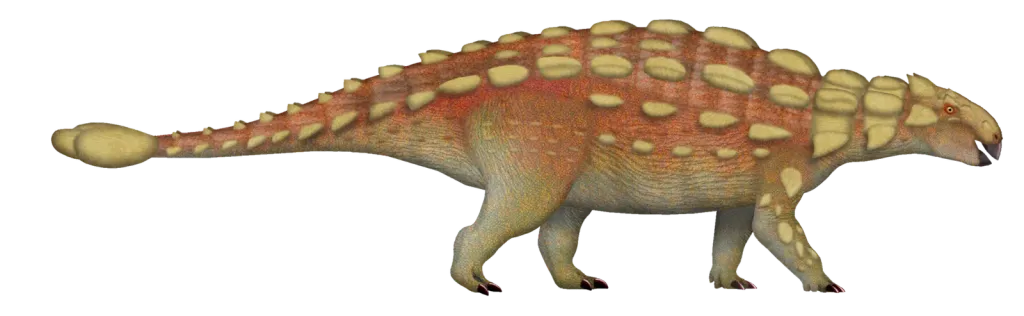
Ankylosaurus magniventris
读音: an-KY-loh-SORE-us mag-nih-VEN-tris
Ankylosauria · Ankylosauridae
A heavily armored, club-tailed ankylosaur from the very end of the Cretaceous of western North America, the largest known member of its group and a neighbour of T. rex and Triceratops.
- Armored
- Tail club
- Quadrupedal
- Giant
- Movie icon
- 时代
- 白垩纪· 马斯特里赫特阶
- 食性
- 植食性
- 体长
- 6–8 m
- 体重
- 4,800–8,000 kg
- 地点
- Montana, Wyoming, Alberta
快速问答
- Ankylosaurus magniventris有多大?
- Ankylosaurus magniventris体长约6–8 m。髋部高约1.5–1.8 m。体重约4.8–8 t。 (Arbour & Mallon 2017; Paul 2016)
- Ankylosaurus magniventris生活在什么时候?
- Ankylosaurus magniventris生活在晚白垩世,约7210万至6600万年前。 (Cohen et al. 2023; Arbour & Mallon 2017)
- 在哪里发现过Ankylosaurus magniventris的化石?
- Ankylosaurus magniventris的化石发现于Hell Creek Formation (Montana)、Lance Formation (Wyoming)和Scollard Formation (Alberta)。 (Brown 1908; Arbour & Mallon 2017)
- Ankylosaurus magniventris吃什么?
- Ankylosaurus magniventris是植食性。 (Brown 1908; Arbour & Mallon 2017)
- Ankylosaurus magniventris由谁命名,何时命名?
- Ankylosaurus magniventris由Barnum Brown于1908年描述。 (Brown 1908)
- Ankylosaurus magniventris出现在《侏罗纪公园》里吗?
- 是的。Ankylosaurus magniventris出现在《侏罗纪公园3》 (2001)、《侏罗纪世界》 (2015)、《侏罗纪世界2》 (2018)、《侏罗纪世界3》 (2022)和《侏罗纪世界:重生》 (2025)中。电影有不少虚构成分;本页将其与化石证据进行了对比。 (Wikipedia: Dinosaurs in Jurassic Park 2026; Arbour 2009)
本页内容

- 时代
- 白垩纪72.1–66 Ma
- 食性
- 植食性
- 体长
- 6–8 m
- 体重
- 4.8–8 t
- 分类
- Ankylosauria · Ankylosauridae
- 命名
- 1908, Barnum Brown
概览
此内容目前仅提供英文版。
Ankylosaurus magniventris lived in western North America at the end of the Cretaceous, in the same landscapes as Tyrannosaurus and Triceratops. Barnum Brown named it in 1908 from a skull roof and armor found in the Hell Creek Formation of Montana.
It was a low, wide, four-legged plant-eater covered in bony plates (osteoderms) set in the skin, with horns at the back of its skull and a heavy club of fused bone at the end of its tail. It is the largest known ankylosaurid, but it is also known from surprisingly few specimens: no complete skeleton has been found.
Arbour and Mallon (2017) re-examined all the material. They found an unusual nose with looping nasal passages, small leaf-shaped teeth, and estimated a length of roughly 6 to 8 m. The tail club could deliver strong blows, probably against predators or rivals.
名称含义
From Greek ankylos ("fused, bent") and sauros ("lizard"), for the fused bones of the skull and armor; magniventris, Latin for "great belly" (Brown 1908).
生物学与证据
科学家对这种动物生活方式的看法,以及每种观点的证据有多充分。
进食
Ankylosaurus fed on low plants, cropping them with a wide beak.
证据等级:中等证据A low body, a wide muzzle and small leaf-shaped teeth point to a low-level plant-eater. Its diet has not been observed directly.
皮肤与体表覆盖
Ankylosaurus was covered in bony armor plates set in its skin.
证据等级:直接证据The osteoderms themselves are fossilised with the specimens. How exactly they were arranged over the body is reconstructed from better-preserved relatives.
感官
The looping nasal passages of Ankylosaurus helped it control heat and moisture or produce sounds.
证据等级:假说The shape of the nasal passages is known; their function is inferred from similar passages in other ankylosaurs and living animals.
支持 / 反对证据 · 1
支持证据
比较解剖学 · Ankylosaurus looping nasal passages
The nostrils face sideways and lead into convoluted nasal passages, unusual among ankylosaurids.
标本: CMN 8880
行为
Ankylosaurus could swing its tail club hard enough to break bone.
证据等级:中等证据Models of ankylosaurid tail clubs show large clubs could hit hard enough to fracture bone. The club of Ankylosaurus is known from one specimen, so its exact force is estimated from relatives.
支持 / 反对证据 · 2
支持证据
标本 · Ankylosaurus tail club (AMNH 5214)
A club of large fused osteoderms at the end of a tail stiffened by interlocking vertebrae.
标本: AMNH 5214
生物力学模型 · Ankylosaurid tail club impact model
Estimates of the force of tail-club swings in ankylosaurids, large enough to break bone.
体型
- 体长
- 6–8 m
- 身高
- 1.7 m文献范围 1.5–1.8 m
- 体重
- 4,800–8,000 kg
(26.2 英尺)
依据 AMNH 5214 (smallest) to CMN 8880 (largest skull)
(5.6 英尺)
依据 AMNH 5214
时间线
时代: 马斯特里赫特阶 (72.1–66 Ma), 晚白垩世 (100.5–66 Ma)
Ages are the ICS 2023/09 bounds of the Maastrichtian, the stage(s) the fossils are assigned to; they bracket the record and are not dated first/last appearances. Known specimens come from the latest Maastrichtian (Hell Creek, Lance, Scollard), so the real range is much narrower, roughly the last 2-3 million years of the Cretaceous.
产地
地层
- Hell Creek Formation · Montana
- Lance Formation · Wyoming
- Scollard Formation · Alberta
- Gilbert Creek, Hell Creek Formation, Montana · Hell Creek Formation · Montana · 位置为近似值
- Red Deer River, Scollard Formation, Alberta · Scollard Formation · Alberta · 位置为近似值
这些是发现化石的地点,而不是该动物生活的全部范围。
生态系统
生活于: Hell Creek
68–66 百万年前 · 泛滥平原, 河流水系, 森林, 沿海平原
Warm, humid coastal lowlands and river floodplains west of the retreating Western Interior Seaway at the very end of the Cretaceous, with forests of conifers and flowering plants. The ecosystem ends at the Cretaceous-Paleogene extinction.


分类
- 演化支Dinosauria
- 演化支Ornithischia
- 演化支Thyreophora
- 演化支Ankylosauria
- 科Ankylosauridae
- 亚科Ankylosaurinae
- 属Ankylosaurus
- 种Ankylosaurus magniventris
分类地位: 有效
化石记录

| 编号 | 类型 | 收藏机构 | 发现年份 |
|---|---|---|---|
| AMNH 5895 | 正模标本 | American Museum of Natural History (AMNH) | 1906 |
| AMNH 5214 | 归入标本 | American Museum of Natural History (AMNH) | 1910 |
| CMN 8880 | 归入标本 | Canadian Museum of Nature (CMN) | — |
已发现的部分
正模标本: AMNH 5895
- 保存
- 部分保存
- 复原
- 未知 / 未记录
正模标本: AMNH 5895
按部位查看(表格)
| 部位 | 状态 |
|---|---|
| Skull | 部分保存 · Skull roof. |
| Mandible | 未知 / 未记录 |
| Teeth | 部分保存 |
| Cervical vertebrae | 部分保存 |
| Dorsal vertebrae | 部分保存 |
| Sacrum | 未知 / 未记录 |
| Caudal vertebrae | 未知 / 未记录 |
| Ribs | 部分保存 |
| Gastralia | 未知 / 未记录 |
| Scapula / shoulder girdle | 部分保存 |
| Humerus | 未知 / 未记录 |
| Forearm (radius / ulna) | 未知 / 未记录 |
| Hand (manus) | 未知 / 未记录 |
| Pelvis | 未知 / 未记录 |
| Femur | 未知 / 未记录 |
| Tibia / fibula | 未知 / 未记录 |
| Foot (pes) | 未知 / 未记录 |
归入标本: AMNH 5214
按部位查看(表格)
| 部位 | 状态 |
|---|---|
| Skull | 部分保存 |
| Mandible | 部分保存 |
| Teeth | 未知 / 未记录 |
| Cervical vertebrae | 未知 / 未记录 |
| Dorsal vertebrae | 未知 / 未记录 |
| Sacrum | 未知 / 未记录 |
| Caudal vertebrae | 部分保存 · Tail with club. |
| Ribs | 部分保存 |
| Gastralia | 未知 / 未记录 |
| Scapula / shoulder girdle | 未知 / 未记录 |
| Humerus | 部分保存 |
| Forearm (radius / ulna) | 未知 / 未记录 |
| Hand (manus) | 未知 / 未记录 |
| Pelvis | 未知 / 未记录 |
| Femur | 未知 / 未记录 |
| Tibia / fibula | 未知 / 未记录 |
| Foot (pes) | 未知 / 未记录 |
归入标本: CMN 8880
按部位查看(表格)
| 部位 | 状态 |
|---|---|
| Skull | 保存 |
| Mandible | 未知 / 未记录 |
| Teeth | 未知 / 未记录 |
| Cervical vertebrae | 未知 / 未记录 |
| Dorsal vertebrae | 未知 / 未记录 |
| Sacrum | 未知 / 未记录 |
| Caudal vertebrae | 未知 / 未记录 |
| Ribs | 未知 / 未记录 |
| Gastralia | 未知 / 未记录 |
| Scapula / shoulder girdle | 未知 / 未记录 |
| Humerus | 未知 / 未记录 |
| Forearm (radius / ulna) | 未知 / 未记录 |
| Hand (manus) | 未知 / 未记录 |
| Pelvis | 未知 / 未记录 |
| Femur | 未知 / 未记录 |
| Tibia / fibula | 未知 / 未记录 |
| Foot (pes) | 未知 / 未记录 |

发现
- 命名年份
- 1908
- 命名者
- Barnum Brown
- 模式标本
- AMNH 5895

发现时间线
1906 · 首次发现材料
Barnum Brown collects the Ankylosaurus holotype
Brown collects a partial skull and armor in the Hell Creek Formation of Montana.
人物:Barnum Brown
1908 · 正式命名
Brown names Ankylosaurus magniventris
Brown names the genus and the family Ankylosauridae.
人物:Barnum Brown
1910 · 标本出土
Tail club specimen collected in Alberta
Brown collects the specimen with the only known Ankylosaurus tail club.
人物:Barnum Brown
2017 · 重要研究
Arbour and Mallon redescribe Ankylosaurus
A full re-examination of all specimens with new size estimates.
人物:Victoria M. Arbour
《侏罗纪公园》与《侏罗纪世界》中的形象
电影
- 侏罗纪公园3 (2001)
- 侏罗纪世界 (2015)
- 侏罗纪世界2 (2018)
- 侏罗纪世界3 (2022)
- 侏罗纪世界:重生 (2025)
此内容目前仅提供英文版。
银幕形象
An armoured tank that swings its tail club, killed by the Indominus rex in Jurassic World.
电影与化石对比
- The tail club was a real weapon: models suggest strikes strong enough to break bone.
- Ankylosaurus itself is known from partial skeletons, so much of its body in any reconstruction is borrowed from relatives.
电影名称仅用于识别。DinoDex 与《侏罗纪公园》/《侏罗纪世界》系列无任何关联,也未获其认可。 所有在电影中出现的恐龙
参考文献
- (2026). Wikipedia: Dinosaurs in Jurassic Park. Wikipedia. https://en.wikipedia.org/wiki/Dinosaurs_in_Jurassic_Park(在新标签页中打开)
- (2026). Wikipedia: Jurassic World Rebirth. Wikipedia. https://en.wikipedia.org/wiki/Jurassic_World_Rebirth(在新标签页中打开)
- Arbour, V. M. (2009). Estimating impact forces of tail club strikes by ankylosaurid dinosaurs. PLoS ONE 4(8): e6738. doi:10.1371/journal.pone.0006738(在新标签页中打开)
- Arbour, V. M. & Mallon, J. C. (2017). Unusual cranial and postcranial anatomy in the archetypal ankylosaur Ankylosaurus magniventris. FACETS 2: 764-794. doi:10.1139/facets-2017-0063(在新标签页中打开)
- Brown, B. (1908). The Ankylosauridae, a new family of armored dinosaurs from the Upper Cretaceous. Bulletin of the American Museum of Natural History 24: 187-201.
- Cohen, K. M., Harper, D. A. T., Gibbard, P. L. & Car, N. (2023). International Chronostratigraphic Chart (v2023/09). International Commission on Stratigraphy. https://stratigraphy.org/ICSchart/ChronostratChart2023-09.pdf(在新标签页中打开)
- Paul, G. S. (2016). The Princeton Field Guide to Dinosaurs (2nd edition). Princeton University Press.