T. rex vs Spinosaurus: How the Two Giants Compare
Spinosaurus was longer; T. rex was built heavier, with a bone-crushing bite. They also lived tens of millions of years and a continent apart. A fact-based comparison.
このコンテンツは英語でご覧いただけます。
T. rex vs Spinosaurus is one of the most searched dinosaur match-ups, helped along by a famous film fight. The real comparison is more interesting than any fight. Spinosaurus was probably the longer animal, while Tyrannosaurus rex was more heavily built, with one of the most powerful bites of any land animal. And the two never met.
T. rex vs Spinosaurus at a glance
- Length: T. rex about 12.3 to 13 m; Spinosaurus just under 14 m in a recent reconstruction.
- Weight: T. rex about 6 to 8 tonnes for most adults, up to about 9.5 for the largest; Spinosaurus about 7.4 tonnes in one volumetric model.
- Hip height: T. rex about 3.6 to 4 m; Spinosaurus about 2.2 to 3 m, with short hind legs.
- Skull: T. rex deep and broad, built for crushing; Spinosaurus long and narrow, like a crocodile's.
- Diet: T. rex large dinosaurs, including their bones; Spinosaurus mainly fish, plus other prey.
- When: T. rex up to 66 million years ago; Spinosaurus about 100 to 94 million years ago.
- Where: T. rex western North America; Spinosaurus North Africa.
Did T. rex and Spinosaurus ever meet?
No. Spinosaurus lived during the Cenomanian, roughly 100 to 94 million years ago. T. rex lived at the very end of the Maastrichtian, ending 66 million years ago. That is a gap of nearly 30 million years, almost half the time that separates T. rex from us.
They were also on different continents. Spinosaurus lived in the rivers of what are now Egypt and Morocco; T. rex roamed the floodplains of western North America. For the full picture of Spinosaurus's world, see where did Spinosaurus live?
Size: longer vs heavier
Length is where Spinosaurus usually wins. Paul Sereno and colleagues (2022) reconstructed an adult at just under 14 metres. The longest T. rex, measured from the nearly complete skeleton Sue, is about 12.3 metres (Brochu 2003), with larger individuals reported at around 13 metres.

Weight is closer and less certain. Sereno's model gives Spinosaurus about 7.4 tonnes. For T. rex, Hutchinson and colleagues (2011) found most adults at 6 to 8 tonnes and Sue at about 9.5 tonnes. Because the two estimates come from different methods and the Spinosaurus skeleton is incomplete, a difference of a tonne or two either way is within the uncertainty.
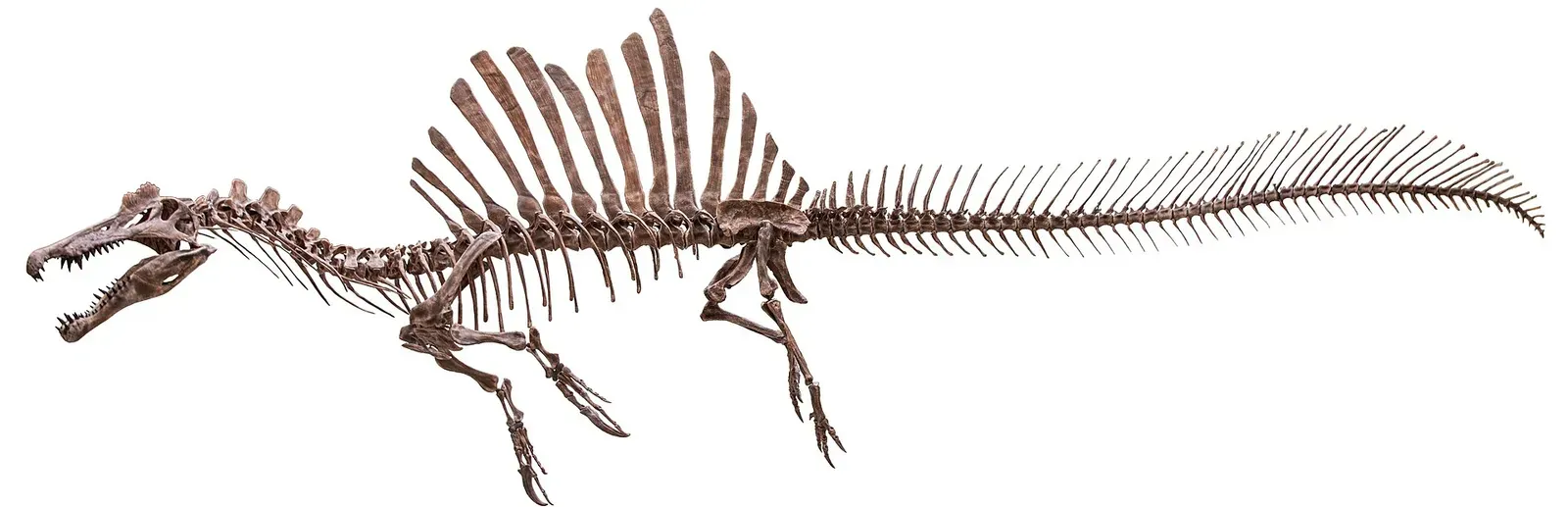
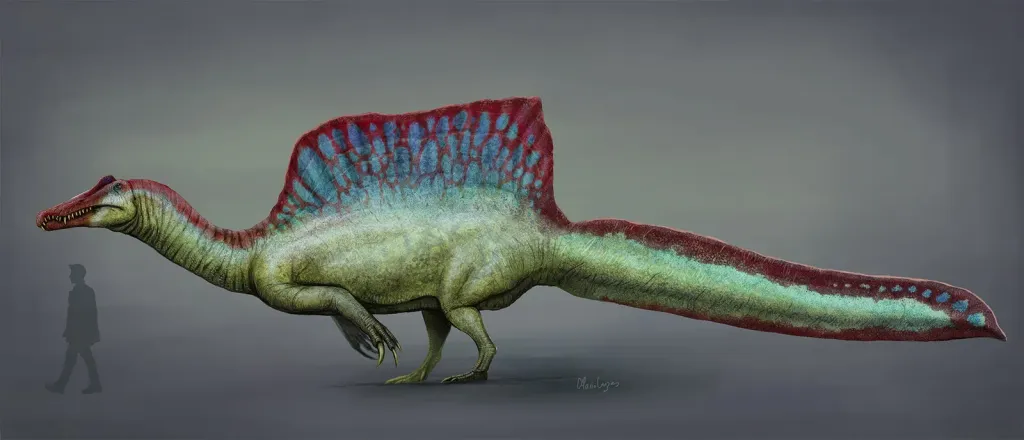
What is clear is the build. T. rex carried its weight on long, massive legs, with a deep chest and a thick neck. Spinosaurus had short hind legs, a long body and a tall sail on its back. Our deep dive on how big T. rex was explains how these estimates are made.
Skulls and bite
The two skulls reveal two different ways of hunting.
T. rex: built to crush
T. rex had a broad, deep skull with thick, banana-shaped teeth. Bite marks on fossil bones show it could bite through bone (Erickson et al. 1996). Paul Gignac and Gregory Erickson (2017) modelled its bite and concluded that it could pulverise bone, something few living predators can do. A large coprolite (fossil dung) attributed to a tyrannosaur contains abundant fragments of bone, which supports the idea (Chin et al. 1998).

Spinosaurus: built to grab
Spinosaurus had a long, low snout with straight, conical teeth, similar to a crocodile's or a gharial's. These teeth were good for gripping slippery prey rather than slicing flesh or cracking bone. The nostrils sat far back on the snout, which may have helped when the tip was in the water.
What did they eat?
T. rex hunted and scavenged large dinosaurs. A healed tooth wound in the tail of a duck-billed dinosaur, with a T. rex tooth crown embedded in it, shows that at least some of its prey were alive and escaped (DePalma et al. 2013).
Spinosaurus relied heavily on fish, which were abundant in the river systems of North Africa. It was not a strict fish eater, though: a spinosaur tooth has been found stuck in the neck vertebra of a pterosaur (Buffetaut et al. 2004).
Close relatives or distant cousins?
Both were theropods, the two-legged, mostly meat-eating dinosaurs, but they sat on very different branches. T. rex was a tyrannosaurid, part of the coelurosaurs, the group that also includes Velociraptor and birds. Its close relatives include Tarbosaurus from Mongolia and Albertosaurus from Canada.
Spinosaurus was a spinosaurid, from an older and more distant lineage. Its relatives include Baryonyx from England and Irritator from Brazil, covered in our guide to dinosaurs in Brazil. Their similar size is a case of two lineages reaching giant proportions independently.
Water vs land
T. rex was a land animal of rivers and floodplains. Spinosaurus is more debated. Some researchers argue that it swam after prey with its tall tail (Ibrahim et al. 2014 and later work); others think it was a wader that hunted from the shore, like a giant heron (Hone & Holtz 2021; Sereno et al. 2022). Either way, it depended on water far more than T. rex did.
So who would win?
There is no scientific answer, and the question hides the more interesting facts. The two never shared a landscape, their sizes overlap within the uncertainty of the estimates, and their bodies were built for different jobs: T. rex for tackling large land animals, Spinosaurus for catching prey in and around water.
A better question is which animals each one actually faced. For Spinosaurus, that includes Carcharodontosaurus, another giant predator in the same rivers. For T. rex, it includes Triceratops and Edmontosaurus from the Hell Creek Formation. And if you want another giant to compare, try Giganotosaurus.
Sources
- Brochu, C. A.. (2003). Osteology of Tyrannosaurus rex: insights from a nearly complete skeleton and high-resolution computed tomographic analysis of the skull. Journal of Vertebrate Paleontology 22 (sup4); Society of Vertebrate Paleontology Memoir 7 doi:10.1080/02724634.2003.10010947
- Hutchinson, J. R., Bates, K. T., Molnar, J., Allen, V. & Makovicky, P. J.. (2011). A computational analysis of limb and body dimensions in Tyrannosaurus rex with implications for locomotion, ontogeny, and growth. PLoS ONE 6(10): e26037 doi:10.1371/journal.pone.0026037
- Sereno, P. C., Myhrvold, N., Henderson, D. M., et al.. (2022). Spinosaurus is not an aquatic dinosaur. eLife 11: e80092 doi:10.7554/eLife.80092
- Ibrahim, N., Sereno, P. C., Dal Sasso, C., Maganuco, S., Fabbri, M., Martill, D. M., Zouhri, S., Myhrvold, N. & Iurino, D. A.. (2014). Semiaquatic adaptations in a giant predatory dinosaur. Science 345(6204): 1613-1616 doi:10.1126/science.1258750
- Erickson, G. M., Van Kirk, S. D., Su, J., Levenston, M. E., Caler, W. E. & Carter, D. R.. (1996). Bite-force estimation for Tyrannosaurus rex from tooth-marked bones. Nature 382: 706-708 doi:10.1038/382706a0
- Gignac, P. M. & Erickson, G. M.. (2017). The biomechanics behind extreme osteophagy in Tyrannosaurus rex. Scientific Reports 7: 2012 doi:10.1038/s41598-017-02161-w
- Chin, K., Tokaryk, T. T., Erickson, G. M. & Calk, L. C.. (1998). A king-sized theropod coprolite. Nature 393: 680-682 doi:10.1038/31575
- DePalma, R. A., Burnham, D. A., Martin, L. D., Rothschild, B. M. & Larson, P. L.. (2013). Physical evidence of predatory behavior in Tyrannosaurus rex. Proceedings of the National Academy of Sciences 110 doi:10.1073/pnas.1216534110
- Buffetaut, E., Martill, D. & Escuillié, F.. (2004). Pterosaurs as part of a spinosaur diet. Nature 430: 33 doi:10.1038/430033a
- Hone, D. W. E. & Holtz, T. R.. (2021). Evaluating the ecology of Spinosaurus: shoreline generalist or aquatic pursuit specialist?. Palaeontologia Electronica 24(1): a03 doi:10.26879/1110
関連する恐竜


4 件中 4 件を表示
関連記事

Explainers
How Big Was T. rex? Length, Height and Weight
About 12 to 13 metres long and 6 to 8 tonnes as an adult. Here is what the best skeletons show, and why no single number tells the whole story.
DinoDex team · 2026年9月26日 · 5 分で読めます

Explainers
Where Did Spinosaurus Live? Its World in North Africa
Spinosaurus lived in the river systems of North Africa about 100 to 94 million years ago. Here is where its fossils come from and what its world looked like.
DinoDex team · 2026年9月26日 · 4 分で読めます

Explainers
Which Dinosaurs Lived in Brazil? A Guide to the Fossils
Brazil has some of the oldest dinosaurs known, a spinosaur named for the irritation it caused, and giant long-necked titanosaurs. A guide to the main finds.
DinoDex team · 2026年9月26日 · 4 分で読めます