How Big Was T. rex? Length, Height and Weight
About 12 to 13 metres long and 6 to 8 tonnes as an adult. Here is what the best skeletons show, and why no single number tells the whole story.
此内容目前仅提供英文版。
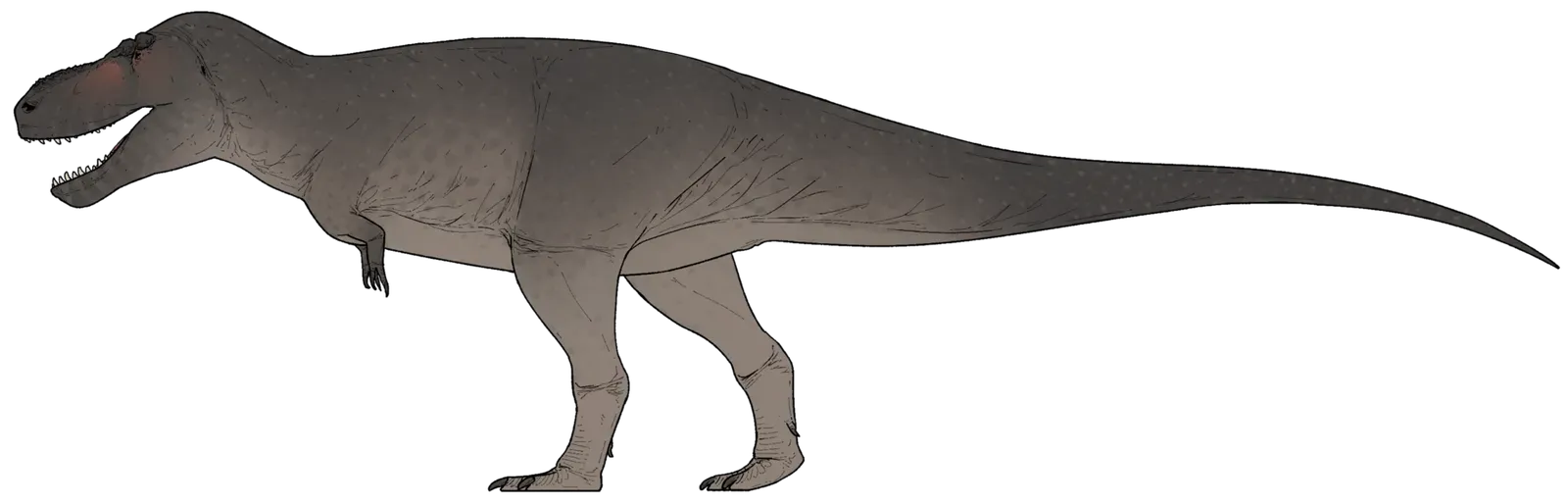
How big was T. rex? The short answer: a fully grown Tyrannosaurus rex was about 12 to 13 metres long, stood roughly 4 metres tall at the hips and probably weighed around 6 to 8 tonnes. The largest individuals may have passed 9 tonnes.
Those figures come from a handful of well-preserved skeletons, not from a single "official" measurement. Below is what each number is based on, how certain it is, and how T. rex compares with other giant predators.
How big was T. rex? The numbers at a glance
- Length: about 12.3 m for the most complete skeleton, "Sue"; about 13 m has been reported for the largest known specimen.
- Hip height: roughly 3.6 to 4 m in a standing adult.
- Weight: most adults about 6 to 8 tonnes; Sue about 9.5 tonnes in the most plausible computer models.
- When: the very end of the Late Cretaceous, in the Maastrichtian age, up to 66 million years ago.
- Where: western North America, from Montana and the Dakotas to Alberta and Saskatchewan.
How long was T. rex?
Length is the easiest figure to measure, because it comes straight from articulated bones. The benchmark is FMNH PR 2081, better known as Sue, at the Field Museum in Chicago. Christopher Brochu's 2003 monograph on this nearly complete skeleton gives a total length of about 12.3 metres.

A second giant, RSKM P2523.8 or Scotty, comes from the Frenchman Formation of Saskatchewan. Persons and colleagues (2020) described it as an older and exceptionally large adult. A length of about 13 metres is widely reported for Scotty, but that figure depends on how the missing parts are reconstructed, so treat it as an upper estimate rather than a measurement.
How tall was T. rex?
"Height" is trickier than it sounds. T. rex held its body roughly horizontal, balanced over the hips, with the tail stretched out behind. So the useful measurement is hip height, which for a large adult was around 3.6 to 4 metres. An average adult human would stand well below its hips.
Old museum mounts showed T. rex upright like a kangaroo, with the tail dragging on the ground. That pose would have dislocated its joints; it was abandoned decades ago, and it made the animal look taller than it really stood.
How much did T. rex weigh?
Weight is the least certain number, because flesh does not fossilise. Researchers build a 3D model of the skeleton, wrap it in a plausible body outline and calculate the volume. The choices about how much muscle, fat and air-filled space to add change the answer a lot.
John Hutchinson and colleagues (2011) modelled five mounted skeletons this way. Their preferred models put most adults at about 6 to 8 tonnes and Sue at about 9.5 tonnes. Their most generous model reached roughly 18.5 tonnes for Sue, but the authors treated it as an upper bound, not a best guess. Using a different method, based on the circumference of the thigh bone, Persons and colleagues (2020) estimated Scotty at about 8.9 tonnes.
How fast did T. rex grow?
Bones record growth the way tree trunks do. By counting growth lines in thin sections of T. rex bones, Gregory Erickson and colleagues (2004) found that it grew slowly for its first years, then went through a dramatic growth spurt in its teens, gaining hundreds of kilograms a year, before levelling off at around 20 years of age.
That growth curve matters for size debates: a skeleton from a teenager can look like a different, smaller animal. It is one reason why some small tyrannosaur specimens have been argued over for decades.
Was T. rex the biggest meat-eating dinosaur?
Not by every measure, but it is among the heaviest known. Here is how it compares with other giants on DinoDex:
- Giganotosaurus from Argentina was similar in length, about 12.5 to 13.2 m, and was estimated at 6 to 8 tonnes when it was described (Coria & Salgado 1995). It lived about 30 million years earlier.
- Spinosaurus from North Africa was probably longer, just under 14 m in one recent reconstruction, but more lightly built. See our T. rex vs Spinosaurus comparison.
- Tarbosaurus, a close relative from the Nemegt Formation of Mongolia, reached about 10 to 12 m.
What set T. rex apart was bulk: a deep skull, a thick neck and a massive body for its length. If you want to see the differences to scale, put two animals side by side on the compare page.

Could something that big run?
Probably not in the strict sense. Hutchinson and Garcia (2002) calculated that a running T. rex would have needed an impossible amount of leg muscle. A later study by Sellers and colleagues (2017) reached a similar conclusion: at running speeds the stresses on the skeleton would have been too high, so adults were most likely limited to a fast walk. Young, lighter individuals may have been more agile.
Was there more than one species?
In 2022, Gregory Paul and colleagues proposed splitting T. rex into three species based on differences in thigh bones and teeth. Other researchers, led by Thomas Carr, replied the same year that the evidence was insufficient and that the variation fits a single species. For now, most palaeontologists treat all these fossils as Tyrannosaurus rex, which is also how DinoDex lists them.
Where the fossils come from
T. rex fossils come from rocks laid down by rivers and floodplains in the last few million years before the end-Cretaceous extinction. The best known are the Hell Creek Formation of Montana and the Dakotas, the Lance Formation of Wyoming, and the Scollard and Frenchman formations of Canada. The type specimen, CM 9380, was described by Henry Fairfield Osborn in 1905.

Open the Tyrannosaurus rex profile to see every measurement with its range, confidence level and source.

Sources
- Brochu, C. A.. (2003). Osteology of Tyrannosaurus rex: insights from a nearly complete skeleton and high-resolution computed tomographic analysis of the skull. Journal of Vertebrate Paleontology 22 (sup4); Society of Vertebrate Paleontology Memoir 7 doi:10.1080/02724634.2003.10010947
- Hutchinson, J. R., Bates, K. T., Molnar, J., Allen, V. & Makovicky, P. J.. (2011). A computational analysis of limb and body dimensions in Tyrannosaurus rex with implications for locomotion, ontogeny, and growth. PLoS ONE 6(10): e26037 doi:10.1371/journal.pone.0026037
- Persons, W. S., Currie, P. J. & Erickson, G. M.. (2020). An older and exceptionally large adult specimen of Tyrannosaurus rex. The Anatomical Record 303(4): 656-672 doi:10.1002/ar.24118
- Erickson, G. M., Makovicky, P. J., Currie, P. J., Norell, M. A., Yerby, S. A. & Brochu, C. A.. (2004). Gigantism and comparative life-history parameters of tyrannosaurid dinosaurs. Nature 430: 772-775 doi:10.1038/nature02699
- Hutchinson, J. R. & Garcia, M.. (2002). Tyrannosaurus was not a fast runner. Nature 415: 1018-1021 doi:10.1038/4151018a
- Sellers, W. I., Pond, S. B., Brassey, C. A., Manning, P. L. & Bates, K. T.. (2017). Investigating the running abilities of Tyrannosaurus rex using stress-constrained multibody dynamic analysis. PeerJ 5: e3420 doi:10.7717/peerj.3420
- Paul, G. S., Persons, W. S. & Van Raalte, J.. (2022). The tyrant lizard king, queen and emperor: multiple lines of morphological and stratigraphic evidence support subtle evolution and probable speciation within the North American genus Tyrannosaurus. Evolutionary Biology 49: 156-179 doi:10.1007/s11692-022-09561-5
- Carr, T. D., Napoli, J. G., Brusatte, S. L., Holtz, T. R., Hone, D. W. E., Williamson, T. E. & Zanno, L. E.. (2022). Insufficient evidence for multiple species of Tyrannosaurus in the latest Cretaceous of North America: a comment on "The tyrant lizard king, queen and emperor". Evolutionary Biology 49: 314-341 doi:10.1007/s11692-022-09573-1
- Coria, R. A. & Salgado, L.. (1995). A new giant carnivorous dinosaur from the Cretaceous of Patagonia. Nature 377: 224-226 doi:10.1038/377224a0
相关恐龙


相关文章

Explainers
T. rex vs Spinosaurus: How the Two Giants Compare
Spinosaurus was longer; T. rex was built heavier, with a bone-crushing bite. They also lived tens of millions of years and a continent apart. A fact-based comparison.
DinoDex team · 2026年9月26日 · 阅读约 4 分钟

Explainers
How Complete Are Dinosaur Fossils? Less Than You Think
Complete dinosaur skeletons are rare, and many species are known from a skull or a handful of bones. Here is why, and what it means for the numbers you read.
DinoDex team · 2026年9月26日 · 阅读约 5 分钟

Explainers
Where Did Spinosaurus Live? Its World in North Africa
Spinosaurus lived in the river systems of North Africa about 100 to 94 million years ago. Here is where its fossils come from and what its world looked like.
DinoDex team · 2026年9月26日 · 阅读约 4 分钟