How Complete Are Dinosaur Fossils? Less Than You Think
Complete dinosaur skeletons are rare, and many species are known from a skull or a handful of bones. Here is why, and what it means for the numbers you read.
此内容目前仅提供英文版。
How complete are dinosaur fossils? Usually, not very. Most dinosaur species are known from partial skeletons, and a good number from just a skull, a few vertebrae or a single bone. Skeletons that are nearly complete exist, but they are rare enough that each one becomes famous.
That matters because almost every number you read about a dinosaur, from its length to its weight, depends on how much of it has actually been found.
Why so few complete skeletons?
Fossilisation is the exception, not the rule. For a skeleton to survive intact, a long chain of events has to go right:
- Quick burial. A carcass left in the open is eaten, trampled and scattered. Bodies buried fast by river sand, mud or volcanic ash have the best chance.
- The right chemistry. Minerals in groundwater must replace or fill the bone before it decays.
- Survival in the rock. Over tens of millions of years the rock can be folded, heated or eroded away.
- Being found. The layer has to reach the surface today, in a place where someone is looking, before erosion destroys it.
The study of what happens between death and discovery is called taphonomy, and it explains a lot about which parts go missing. Small bones of the hands and feet wash away easily. Skulls are made of many thin bones that come apart. Large, dense bones such as thigh bones and vertebrae survive best, which is why so many species are known mainly from them.
Measuring how complete dinosaur fossils are
Palaeontologists have tried to put numbers on the problem. Philip Mannion and Paul Upchurch (2010) proposed completeness metrics for sauropod dinosaurs and their relatives: one measures what share of the skeleton is known for a species, another what share of the anatomical features used in classification can be scored. Their work showed that the quality of the fossil record varies a lot between geological intervals and has improved as more specimens are collected.
A species can therefore be "known" in very different ways. For one it is a nearly complete skeleton; for another it is a few bones and a lot of informed comparison.
Holotypes: one specimen that defines a species
Every species is anchored to a single reference specimen, the holotype. When a new dinosaur is named, the holotype is what the name officially belongs to, even if better skeletons turn up later. Many holotypes are fragmentary, because the first find of a species is rarely its best. If a holotype is lost, a replacement called a neotype can be designated, as happened with Spinosaurus. On DinoDex, each profile lists its known specimens, so you can see which bones a species is actually based on.
Famous nearly complete skeletons
Some specimens stand out because so much of the animal survived:
- Sue ([FMNH PR 2081](/specimens/fmnh-pr-2081)), a Tyrannosaurus rex at the Field Museum, is described in Brochu's 2003 monograph as a nearly complete skeleton. It is the basis for most measurements of the species. Read more in how big was T. rex.
- "Sophie" ([NHMUK PV R36730](/specimens/nhmuk-pv-r36730)), a Stegosaurus at the Natural History Museum in London, is one of the most complete stegosaur skeletons known (Maidment et al. 2015). It comes from the Morrison Formation of the western United States.
- [Dreadnoughtus](/dinosaurs/dreadnoughtus-schrani), a giant titanosaur from the Cerro Fortaleza Formation of Argentina, was described in 2014 as exceptionally complete for such a huge animal; its holotype is MPM-PV 1156. Titanosaurs are usually known from far less.
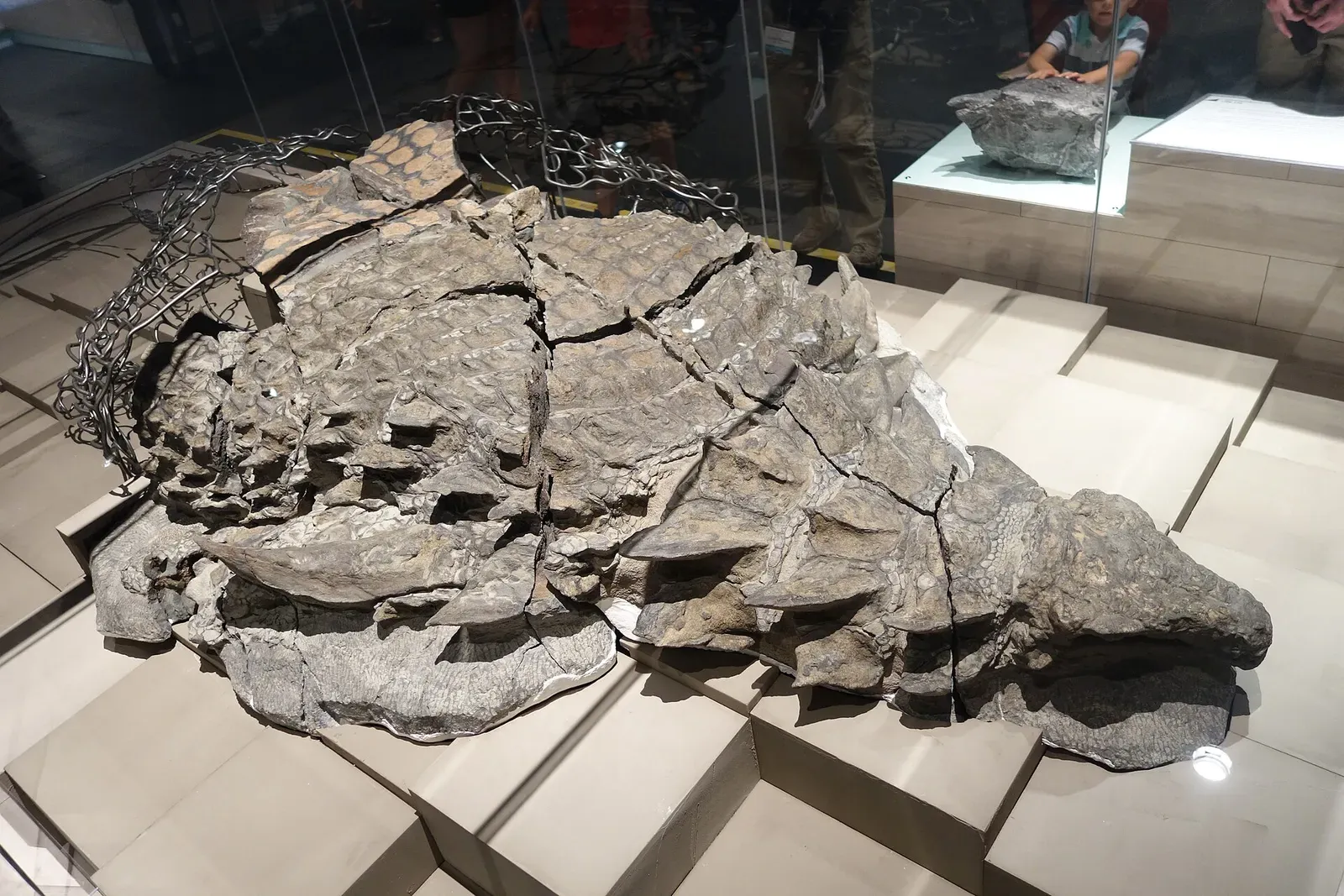
- [Borealopelta](/dinosaurs/borealopelta-markmitchelli), an armoured dinosaur from the Clearwater Formation of Alberta, is preserved in three dimensions with its armour plates and traces of skin still in place (Brown et al. 2017); see specimen TMP 2011.033.0001. It was found in marine rocks, probably after the carcass drifted out to sea.

Dinosaurs known from very little
At the other end of the scale are species built on scraps:
- Irritator from Brazil is known mainly from a single skull, SMNS 58022. Its body length of about 6 to 8 m is an estimate borrowed from better-known relatives.
- Spinosaurus lost its original skeleton, BSPG 1912 VIII 19, in a 1944 bombing raid. Today's picture of the animal rests on a partial skeleton from Morocco and many isolated bones (Ibrahim et al. 2014). See where Spinosaurus lived for the full story.

Places where fossils preserve more
Some rock layers preserve far more than bones. Geologists call them Lagerstätten, from the German for "storage places". Fine-grained sediments on quiet lake or lagoon floors can keep feathers, skin and even stomach contents.
- The Solnhofen Formation of Bavaria preserved Archaeopteryx with its feathers.
- The Yixian and Jiufotang formations of Liaoning, China, preserved feathered dinosaurs such as Microraptor. More on that in did Velociraptor have feathers?

What completeness means for the numbers
When a skeleton is incomplete, missing parts are reconstructed from related animals, and every reconstruction carries assumptions. Different methods can give very different answers. For Giganotosaurus, for example, an estimate based on skull length alone (Therrien & Henderson 2007) came out at about 13.8 tonnes, far above other estimates for the same animal.
Even complete skeletons do not settle everything. Dreadnoughtus was first estimated at about 59 tonnes; a later study using a different method brought that down to roughly 22 to 38 tonnes (Bates et al. 2015). The bones did not change, only the way the flesh around them was modelled.
How DinoDex shows completeness
This is why DinoDex never gives a single number without context. Each measurement on a profile shows its range, the specimen it comes from, how confident the estimate is and the source behind it. Specimen pages, like the one for Sue, show which parts of the skeleton are known. You can browse them all in the specimens section, or start from any dinosaur profile.
Sources
- Mannion, P. D. & Upchurch, P.. (2010). Completeness metrics and the quality of the sauropodomorph fossil record through geological and historical time. Paleobiology 36(2): 283-302
- Brochu, C. A.. (2003). Osteology of Tyrannosaurus rex: insights from a nearly complete skeleton and high-resolution computed tomographic analysis of the skull. Journal of Vertebrate Paleontology 22 (sup4); Society of Vertebrate Paleontology Memoir 7 doi:10.1080/02724634.2003.10010947
- Maidment, S. C. R., Brassey, C. & Barrett, P. M.. (2015). The postcranial skeleton of an exceptionally complete individual of the plated dinosaur Stegosaurus stenops (Dinosauria: Thyreophora) from the Upper Jurassic Morrison Formation of Wyoming, U.S.A.. PLoS ONE 10(10): e0138352 doi:10.1371/journal.pone.0138352
- Lacovara, K. J., Lamanna, M. C., Ibiricu, L. M., Poole, J. C., Schroeter, E. R., Ullmann, P. V., Voegele, K. K., Boles, Z. M., et al.. (2014). A gigantic, exceptionally complete titanosaurian sauropod dinosaur from southern Patagonia, Argentina. Scientific Reports 4: 6196 doi:10.1038/srep06196
- Bates, K. T., Falkingham, P. L., Macaulay, S., Brassey, C. & Maidment, S. C. R.. (2015). Downsizing a giant: re-evaluating Dreadnoughtus body mass. Biology Letters 11 doi:10.1098/rsbl.2015.0215
- Brown, C. M., Henderson, D. M., Vinther, J., Fletcher, I., Sistiaga, A., Herrera, J. & Summons, R. E.. (2017). An exceptionally preserved three-dimensional armored dinosaur reveals insights into coloration and Cretaceous predator-prey dynamics. Current Biology 27: 2514-2521 doi:10.1016/j.cub.2017.06.071
- Therrien, F. & Henderson, D. M.. (2007). My theropod is bigger than yours ... or not: estimating body size from skull length in theropods. Journal of Vertebrate Paleontology 27(1): 108-115 doi:10.1671/0272-4634(2007)27[108:MTIBTY]2.0.CO;2
- Ibrahim, N., Sereno, P. C., Dal Sasso, C., Maganuco, S., Fabbri, M., Martill, D. M., Zouhri, S., Myhrvold, N. & Iurino, D. A.. (2014). Semiaquatic adaptations in a giant predatory dinosaur. Science 345(6204): 1613-1616 doi:10.1126/science.1258750
相关恐龙



显示 7 / 7
相关文章

Explainers
How Big Was T. rex? Length, Height and Weight
About 12 to 13 metres long and 6 to 8 tonnes as an adult. Here is what the best skeletons show, and why no single number tells the whole story.
DinoDex team · 2026年9月26日 · 阅读约 5 分钟

Explainers
Where Did Spinosaurus Live? Its World in North Africa
Spinosaurus lived in the river systems of North Africa about 100 to 94 million years ago. Here is where its fossils come from and what its world looked like.
DinoDex team · 2026年9月26日 · 阅读约 4 分钟

Explainers
Did Velociraptor Have Feathers? What the Fossils Show
Yes. Bumps on a Velociraptor forearm bone show where large wing feathers were anchored. Here is the evidence, and what the feathers were probably for.
DinoDex team · 2026年9月26日 · 阅读约 4 分钟