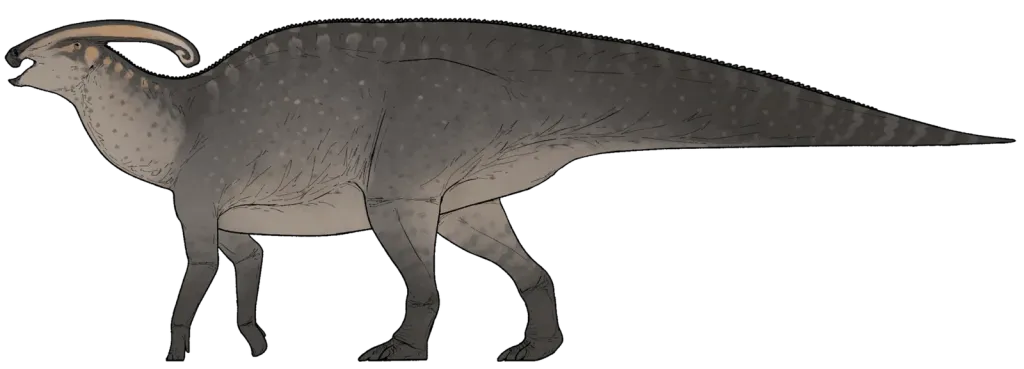
Parasaurolophus walkeri
读音: PAR-ah-sore-OL-oh-fus WAW-ker-eye
Ornithopoda · Hadrosauridae
A duck-billed dinosaur from the Late Cretaceous of Alberta, famous for a long, backward-curving hollow crest. Air from the nose ran through tubes inside the crest, which may have worked as a resonating chamber for deep calls.
- Crested
- Skin impressions known
- 时代
- 白垩纪· 坎潘阶
- 食性
- 植食性
- 体长
- 7.5–10 m
- 体重
- 2,600 kg
- 地点
- Alberta, Canada
快速问答
- Parasaurolophus walkeri有多大?
- Parasaurolophus walkeri体长约7.5–10 m。髋部高约2.2–2.8 m。体重约2.6 t。 (Farke et al. 2013; Wikipedia: Parasaurolophus 2026)
- Parasaurolophus walkeri生活在什么时候?
- Parasaurolophus walkeri生活在晚白垩世,约7650万至7580万年前。 (Paleobiology Database: Parasaurolophus occurr… 2026; Eberth et al. 2023)
- 在哪里发现过Parasaurolophus walkeri的化石?
- Parasaurolophus walkeri的化石发现于Dinosaur Park Formation (Alberta)和Canada。 (Parks 1922; Weishampel 1981)
- Parasaurolophus walkeri吃什么?
- Parasaurolophus walkeri是植食性。 (Parks 1922; Weishampel 1981)
- Parasaurolophus walkeri由谁命名,何时命名?
- Parasaurolophus walkeri由William A. Parks于1922年描述。 (Parks 1922; Paleobiology Database: Parasaurolophus occurr… 2026)
- Parasaurolophus walkeri出现在《侏罗纪公园》里吗?
- 是的。Parasaurolophus walkeri出现在《侏罗纪公园》 (1993)、《失落的世界:侏罗纪公园》 (1997)、《侏罗纪公园3》 (2001)、《侏罗纪世界》 (2015)、《侏罗纪世界2》 (2018)、《侏罗纪世界3》 (2022)和《侏罗纪世界:重生》 (2025)中。电影有不少虚构成分;本页将其与化石证据进行了对比。 (Wikipedia: Dinosaurs in Jurassic Park 2026; Weishampel 1981)
本页内容

- 时代
- 白垩纪76.5–75.8 Ma
- 食性
- 植食性
- 体长
- 7.5–10 m
- 体重
- 2.6 t
- 产地
- Canada
- 分类
- Ornithopoda · Hadrosauridae
- 命名
- 1922, William A. Parks
概览
此内容目前仅提供英文版。
Parasaurolophus walkeri lived in western North America in the Late Cretaceous (Campanian). William Parks named it in 1922 from a skull and partial skeleton (ROM 768) collected in the Dinosaur Park Formation along the Red Deer River, Alberta. Two other species, P. tubicen and P. cyrtocristatus, come from New Mexico and Utah.
It was a large hadrosaur that could walk on two or four legs. Its crest was formed by the nasal and premaxillary bones, and the nasal passages looped through it. David Weishampel (1981) modelled the crest as a resonating tube; for the type specimen the lowest frequency comes out at about 48 Hz, a very deep sound.
A juvenile from Utah (RAM 14000), about 2.5 m long and probably less than a year old, shows that the crest started as a low bump and began growing at less than a quarter of adult skull size, earlier than in other crested hadrosaurs (Farke et al. 2013). Small patches of scaly skin are preserved with it.
名称含义
"Near crested lizard", from Greek para ("beside, near"), sauros ("lizard") and lophos ("crest"), after Saurolophus; walkeri honours Sir Byron Edmund Walker (Parks 1922).
生物学与证据
科学家对这种动物生活方式的看法,以及每种观点的证据有多充分。
皮肤与体表覆盖
Parasaurolophus had scaly skin.
证据等级:有力证据Small skin patches are preserved with the juvenile, as in other hadrosaurs, where skin impressions are common.
支持 / 反对证据 · 1
支持证据
皮肤印痕 · RAM 14000 skin impressions
Two small patches of skin impression (under 5 cm) preserved with the juvenile skeleton.
标本: RAM 14000 “Joe”
生长
A 2.5 m Parasaurolophus was probably less than a year old.
证据等级:中等证据Its leg bone shows fast-growing juvenile tissue with no annual growth lines.
支持 / 反对证据 · 1
支持证据
组织学 · RAM 14000 tibia histology
Well-vascularised juvenile bone with no growth lines, suggesting an animal in its first year.
标本: RAM 14000 “Joe”
Parasaurolophus started growing its crest earlier than other crested hadrosaurs.
证据等级:中等证据A juvenile already had a small crest at less than a quarter of adult skull size; in Corythosaurus the crest appears at about half adult size. It rests on one well-preserved juvenile.
支持 / 反对证据 · 1
支持证据
标本 · RAM 14000 juvenile crest
A 2.5 m juvenile with a low, semicircular crest: crest growth began at less than 25% of maximum skull size, against 50% in Corythosaurus.
标本: RAM 14000 “Joe”
感官
The crest of Parasaurolophus worked as a resonating chamber for deep calls.
证据等级:假说Air passages loop through the crest, and acoustic models of the adult crest give very low frequencies. Soft tissues are not preserved, so the calls themselves cannot be observed.
支持 / 反对证据 · 1
支持证据
生物力学模型 · Parasaurolophus crest resonance model
The nasal passages inside the crest modelled as a resonating tube: 3.46 m of tube in ROM 768 gives a first mode of about 48 Hz.
标本: ROM 768
体型
- 体长
- 7.5–10 m
- 身高
- 2.5 m文献范围 2.2–2.8 m
- 体重
- 2,600 kg
(32.8 英尺)
依据 ROM 768
(8.2 英尺)
依据 ROM 768 (holotype)
时间线
时代: 坎潘阶 (83.6–72.1 Ma), 晚白垩世 (100.5–66 Ma)
P. walkeri is known from the lower 30 m of the Dinosaur Park Formation, the Corythosaurus-Centrosaurus assemblage zone, 76.47-75.77 Ma (U-Pb age model, Eberth et al. 2023). Other Parasaurolophus species (Kaiparowits, Fruitland) are not this profile.
产地
地层
- Dinosaur Park Formation · Alberta
- Red Deer River below Sand Creek, Dinosaur Park Formation, Alberta · Dinosaur Park Formation · Alberta · 位置为近似值
- Kaiparowits Formation, Grand Staircase-Escalante National Monument, Utah · Kaiparowits Formation · Utah · 位置为近似值
这些是发现化石的地点,而不是该动物生活的全部范围。
生态系统
生活于: Dinosaur Park
76.5–74.4 百万年前 · 泛滥平原, 沿海平原, 河流水系
Late Campanian alluvial and coastal plains on the western shore of the Western Interior Seaway, in what is now southern Alberta.


分类
- 演化支Dinosauria
- 演化支Ornithischia
- 演化支Ornithopoda
- 科Hadrosauridae
- 亚科Lambeosaurinae
- 属Parasaurolophus
- 种Parasaurolophus walkeri
分类地位: 有效
化石记录

| 编号 | 类型 | 收藏机构 | 发现年份 |
|---|---|---|---|
| ROM 768 | 正模标本 | Royal Ontario Museum (ROM) | 1920 |
| RAM 14000 “Joe” | 归入标本 | Raymond M. Alf Museum of Paleontology (RAM) | — |
已发现的部分
正模标本: ROM 768
- 保存
- 部分保存
- 复原
- 未知 / 未记录
正模标本: ROM 768
按部位查看(表格)
| 部位 | 状态 |
|---|---|
| Skull | 保存 · With the full tube crest. |
| Mandible | 未知 / 未记录 |
| Teeth | 未知 / 未记录 |
| Cervical vertebrae | 未知 / 未记录 |
| Dorsal vertebrae | 未知 / 未记录 |
| Sacrum | 未知 / 未记录 |
| Caudal vertebrae | 未知 / 未记录 |
| Ribs | 未知 / 未记录 |
| Gastralia | 未知 / 未记录 |
| Scapula / shoulder girdle | 未知 / 未记录 |
| Humerus | 未知 / 未记录 |
| Forearm (radius / ulna) | 未知 / 未记录 |
| Hand (manus) | 未知 / 未记录 |
| Pelvis | 未知 / 未记录 |
| Femur | 部分保存 |
| Tibia / fibula | 未知 / 未记录 |
| Foot (pes) | 未知 / 未记录 |
归入标本: RAM 14000 “Joe”
按部位查看(表格)
| 部位 | 状态 |
|---|---|
| Skull | 保存 |
| Mandible | 保存 |
| Teeth | 未知 / 未记录 |
| Cervical vertebrae | 未知 / 未记录 |
| Dorsal vertebrae | 未知 / 未记录 |
| Sacrum | 未知 / 未记录 |
| Caudal vertebrae | 未知 / 未记录 |
| Ribs | 未知 / 未记录 |
| Gastralia | 未知 / 未记录 |
| Scapula / shoulder girdle | 未知 / 未记录 |
| Humerus | 保存 |
| Forearm (radius / ulna) | 未知 / 未记录 |
| Hand (manus) | 未知 / 未记录 |
| Pelvis | 保存 |
| Femur | 保存 |
| Tibia / fibula | 保存 |
| Foot (pes) | 未知 / 未记录 |

图库

发现
- 命名年份
- 1922
- 命名者
- William A. Parks
- 模式标本
- ROM 768
发现时间线
1920 · 首次发现材料
University of Toronto party collects the Parasaurolophus holotype
A skull with a long tube crest and much of the skeleton are collected on the Red Deer River, Alberta.
1922 · 正式命名
Parks names Parasaurolophus walkeri
Parks names the new crested hadrosaur.
人物:William A. Parks
1981 · 重要研究
Weishampel models the Parasaurolophus crest as a resonator
An acoustic analysis proposes that lambeosaurine crests produced low-frequency calls.
人物:David B. Weishampel
2013 · 重要研究
Juvenile Parasaurolophus described from Utah
The smallest and most complete Parasaurolophus shows how the crest grew.
人物:Andrew A. Farke
《侏罗纪公园》与《侏罗纪世界》中的形象
电影
- 侏罗纪公园 (1993)
- 失落的世界:侏罗纪公园 (1997)
- 侏罗纪公园3 (2001)
- 侏罗纪世界 (2015)
- 侏罗纪世界2 (2018)
- 侏罗纪世界3 (2022)
- 侏罗纪世界:重生 (2025)
此内容目前仅提供英文版。
银幕形象
A background herd animal in every film of the series.
电影与化石对比
- Its long hollow crest probably worked as a resonating chamber for low-pitched calls; the films mostly use it as scenery.
电影名称仅用于识别。DinoDex 与《侏罗纪公园》/《侏罗纪世界》系列无任何关联,也未获其认可。 所有在电影中出现的恐龙
参考文献
- (2026). Paleobiology Database: Parasaurolophus occurrences. The Paleobiology Database (paleobiodb.org), data service 1.2, accessed 2026-09-23. https://paleobiodb.org/data1.2/occs/list.txt?base_name=Parasaurolophus&show=coords,paleoloc,strat,loc,ref&pgm=gplates(在新标签页中打开)
- (2026). Wikipedia: Parasaurolophus. Wikipedia (English), accessed 2026-09-23. https://en.wikipedia.org/wiki/Parasaurolophus(在新标签页中打开)
- (2026). Wikipedia: Dinosaurs in Jurassic Park. Wikipedia. https://en.wikipedia.org/wiki/Dinosaurs_in_Jurassic_Park(在新标签页中打开)
- (2026). Wikipedia: Jurassic World Rebirth. Wikipedia. https://en.wikipedia.org/wiki/Jurassic_World_Rebirth(在新标签页中打开)
- Eberth, D. A., Evans, D. C., Ramezani, J., Kamo, S. L., Brown, C. M., Currie, P. J. & Braman, D. R. (2023). Calibrating geologic strata, dinosaurs, and other fossils at Dinosaur Provincial Park (Alberta, Canada) using a new CA-ID-TIMS U-Pb geochronology. Canadian Journal of Earth Sciences. doi:10.1139/cjes-2023-0037(在新标签页中打开)
- Farke, A. A., Chok, D. J., Herrero, A., Scolieri, B. & Werning, S. (2013). Ontogeny in the tube-crested dinosaur Parasaurolophus (Hadrosauridae) and heterochrony in hadrosaurids. PeerJ 1: e182. doi:10.7717/peerj.182(在新标签页中打开)
- Parks, W. A. (1922). Parasaurolophus walkeri, a new genus and species of crested trachodont dinosaur. University of Toronto Studies, Geology Series 13: 1-32.
- Paul, G. S. (2016). The Princeton Field Guide to Dinosaurs (2nd edition). Princeton University Press.
- Weishampel, D. B. (1981). Acoustic analyses of potential vocalization in lambeosaurine dinosaurs (Reptilia: Ornithischia). Paleobiology 7: 252-261. doi:10.1017/s0094837300004036(在新标签页中打开)